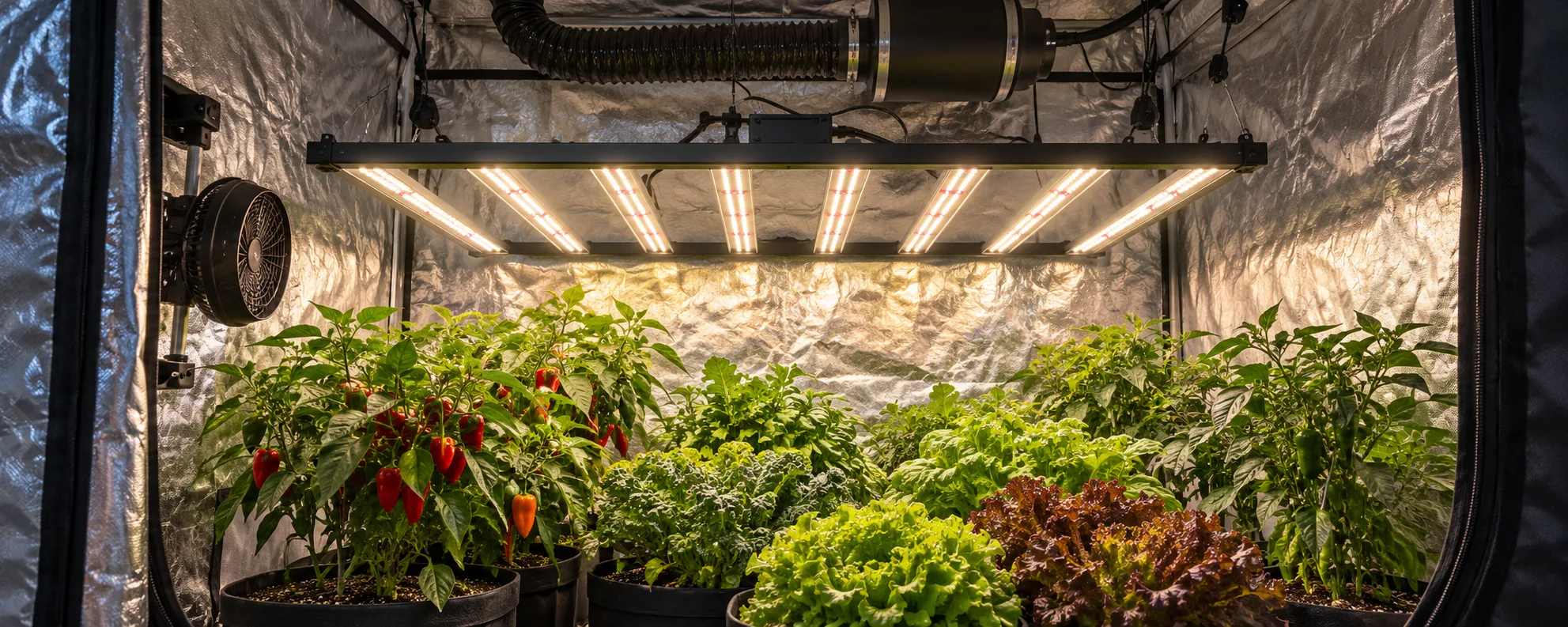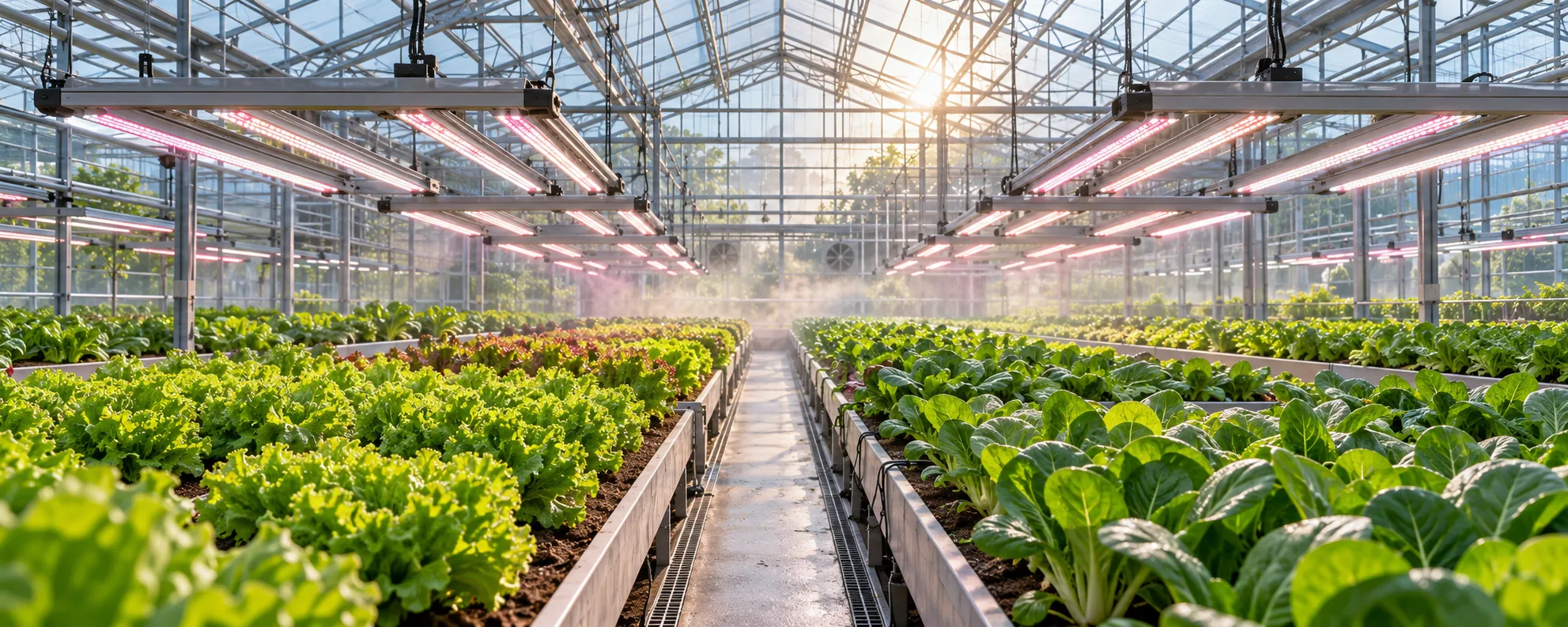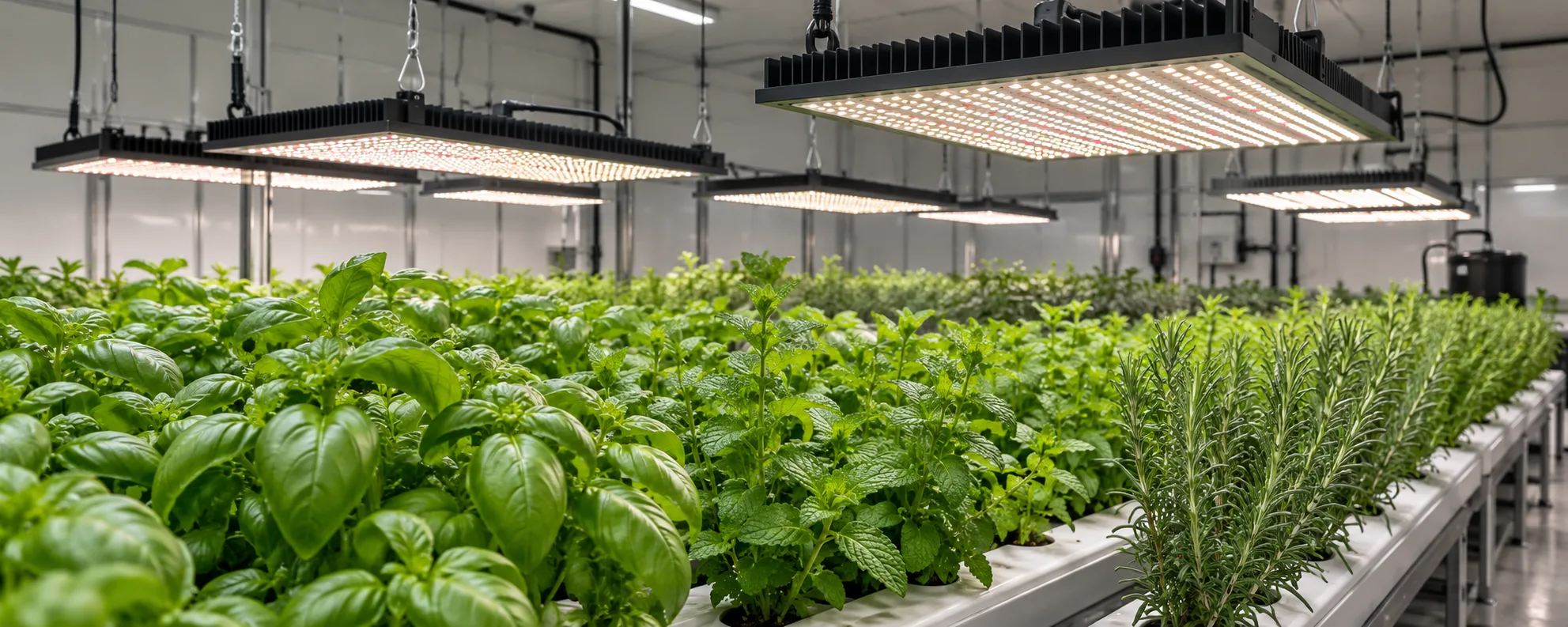
This article is informational and not agronomic, medical or legal advice. At high PPFD the light is only half the system — the canopy environment decides whether that light becomes growth or stress. LED is far cooler than legacy lamps, but it is not heat-free, and at high intensity the fixture still loads the room. The disciplined view is to manage fixture heat, leaf temperature, airflow and CO2 together rather than tuning light alone.
LED reduced heat, it did not remove it
Higher-efficacy LEDs convert more electricity to photons and less to heat than older technologies, which is why they suit dense indoor rooms. But every watt still ends as heat somewhere — in the fixture, the canopy and the air. At high PPFD the load is real, and cooling capacity is part of the design budget, not an afterthought.
| Destination | Effect |
|---|---|
| Photons (useful) | Drives photosynthesis |
| Fixture heat | Must be removed at the fixture / room |
| Canopy absorption | Raises leaf temperature |
| Air heating | Loads HVAC |
Leaf temperature is the real limit
Canopy temperature, not just room air temperature, sets the safe PPFD ceiling. High light plus poor airflow can overheat leaves even in a cool room. Measuring leaf temperature at the canopy — not just the thermostat — is how you know whether more light is helping or hurting.
Light and environment are one system
Turning up PPFD without airflow, cooling and CO2 headroom often just moves the bottleneck. Design the environment and the light together; raising one while starving the other wastes both.
Airflow and CO2 as a view, not a prescription
Adequate air movement at the canopy evens temperature and supplies CO2 to leaf surfaces; CO2 availability interacts with light intensity in how the plant uses photons. The specifics (rates, concentrations) are operation- and regulation-dependent and must follow professional agronomy and law. The framework here is simply: match environment capacity to light intensity before pushing intensity higher.
- Treat fixture heat as a real load in the cooling budget.
- Measure leaf temperature at the canopy, not just room air.
- Ensure airflow reaches the canopy before raising PPFD.
- Keep environment capacity and light intensity in balance.
- Follow applicable law and professional agronomy for any specifics.
| Symptom | First check |
|---|---|
| Leaf temperature high | Airflow at canopy |
| Uneven growth | Map PPFD on a grid |
| Diminishing yield | Energy vs light balance |
| Heat load rising | Fixture plus HVAC capacity |
This article is provided for informational purposes for businesses evaluating horticultural lighting; it is not agronomic, medical or legal advice, and readers are responsible for compliance with the laws of their own jurisdiction.
Worked example: the heat load your lights add
Every watt of electrical power a fixture draws becomes heat in the room (a small share leaves as light energy, but standard HVAC practice treats nearly all of it as heat). This illustrative example uses a 34-fixture flowering room at 2,000 PPF and 2.8 umol/J, so about 24.3 kW of fixture power.
- Fixture heat load: approximately 24.3 kW of thermal load during the photoperiod.
- Convert for HVAC comparison: 24.3 kW x 3,412 = roughly 82,900 BTU/hr from lighting alone.
- Add driver and ballast location: if drivers mount in a plenum or outside the room, their heat partially leaves the canopy zone, which changes where the load lands.
- Season matters: in winter this load offsets heating; in summer it stacks on top of the cooling peak and can drive both chiller sizing and electricity demand charges.
- Dehumidification interaction: cooling coils remove moisture, and a high-PPFD room transpires more, so lighting and dehumidification must be sized as one system.
Lighting decisions are climate decisions. A room designed around a 650 PPFD target and later pushed to 900 without HVAC review will discover the connection through rising leaf-surface temperatures, higher VPD excursions and a compressor that can no longer hold setpoint at midday.
The lighting, airflow and CO2 triangle
Airflow across the canopy
High PPFD without canopy airflow creates microclimates: stagnant, humid air at leaf surface under intense light. Horizontal airflow and vertical air movement keep the boundary layer thin, which supports transpiration and CO2 delivery to the leaf. The practical targets are air velocity across the canopy at plant level, temperature uniformity between zones, and relative humidity held in the intended band; all three are measured, not assumed. Fans are cheap compared with the yield loss of a stagnant high-light canopy.
CO2 enrichment only works inside a climate envelope
CO2 enrichment raises the useful light ceiling, but only when temperature, humidity and airflow are already controlled. Enrichment in a room with failing dehumidification tends to raise fungal pressure risk along with expectations. Sequence the investment: climate and airflow capacity first, then CO2, then the last increment of light. Each stage should be verified with recorded data before the next is bought.
Questions to ask before you buy
- Where do the drivers mount, and how much of the fixture heat can be kept out of the canopy zone?
- Is the fixture rated for the temperature and humidity of your flowering room at full load?
- Does the supplier provide thermal derating curves rather than a single optimum number?
- Can fixtures integrate with your environmental controller for scheduling and load shedding?
- What is the total cost of the lighting change including the HVAC capacity it implies?
This article is provided for informational purposes for businesses evaluating horticultural lighting; it is not agronomic, medical or legal advice, and readers are responsible for compliance with the laws of their own jurisdiction.
Common mistakes in high-PPFD climate planning
Lighting and climate fail together, and the failure modes are predictable:
- Sizing cooling for the room average instead of the photoperiod peak, when every fixture watt is heat exactly when the sun may also be load.
- Treating dehumidification as a side effect of cooling; a high-PPFD canopy transpires enough to overwhelm a system sized on temperature alone.
- Mounting all drivers inside the canopy zone and then wondering why the corner runs hot.
- Adding CO2 before airflow, so enrichment raises the concentration in dead zones and not at the leaf surface where it matters.
- Reading one wall-mounted sensor as canopy conditions; leaf-level temperature and humidity differ from the room by margins that decide the VPD band.
- Forgetting the off-peak half of the year: the same heat load is a heating asset in winter, and a control strategy that cannot shift with seasons wastes that.
Reading leaf-level conditions, not room conditions
Canopy instrumentation
Canopy-level sensing (leaf temperature via infrared, temperature and humidity at bud height, air velocity at the leaf surface) is what turns a high-PPFD room from a gamble into a controlled process. Room-level sensors report the average of a space whose crop lives in a different microclimate a few centimetres away. The gap between room and leaf is not an error to eliminate but a quantity to know, document and design around.
The lighting-climate commissioning step
New and upgraded lighting deserves a commissioning period: run the target intensity through several full photoperiods across a range of outdoor conditions, log everything, and verify that temperature, humidity and VPD hold in band before declaring the upgrade complete. This is where undersized dehumidification, driver heat pockets and control conflicts surface, while they are still cheap to fix. Skipping commissioning converts a lighting project into a climate discovery project mid-flower.
| Check | Condition | Pass criterion | Verified |
|---|---|---|---|
| Fixture heat distribution | Full photoperiod | Canopy temperature in band at all zones | Date + initials |
| Humidity load | Peak transpiration | RH held without coil saturation | Date + initials |
| Airflow | Full photoperiod | Canopy air velocity at planned range | Date + initials |
| Load shedding | Utility peak event | Fixtures dim per strategy without crop harm | Date + initials |
References you can verify
- Controlled Environment Agriculture Center, University of Arizona - greenhouse and indoor climate systems
- e-GRO - environment and lighting interaction summaries
- DesignLights Consortium - horticultural lighting technical resources
Frequently asked questions
Is this agronomic advice?+
No. It is an informational systems view of light and environment. Any operation must follow applicable law and professional agronomy.
Are LEDs heat-free?+
No. They are far cooler per photon than legacy lamps, but high PPFD still loads the room and canopy. Budget for cooling.
Why leaf temperature, not room temperature?+
Canopy can run hotter than room air under intense light with poor airflow. Leaf temperature is what the plant actually experiences.
Should I raise CO2 with light?+
CO2 and light interact, but specifics depend on your operation and regulations. The framework is to balance environment capacity with light intensity; consult professional agronomy.
How do I know I am over-lighting?+
Watch leaf temperature, uniformity and whether extra intensity still returns yield. Stalled or declining response with rising heat is the signal.
What is the first environment fix?+
Usually airflow at the canopy and confirming leaf temperature, before adding more light.
Balancing light and environment?
We help frame a lighting plan with the cooling and airflow budget in mind. Informational support only.
Get a Grow Light Solution