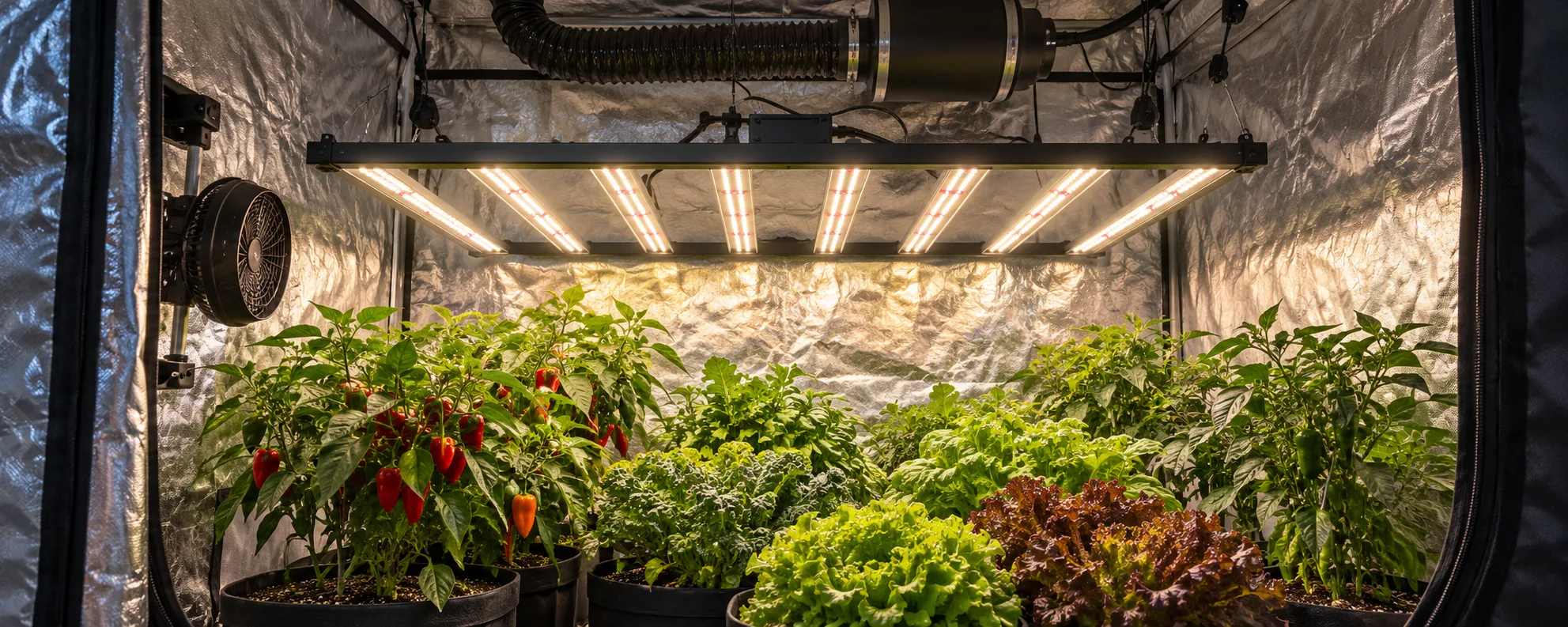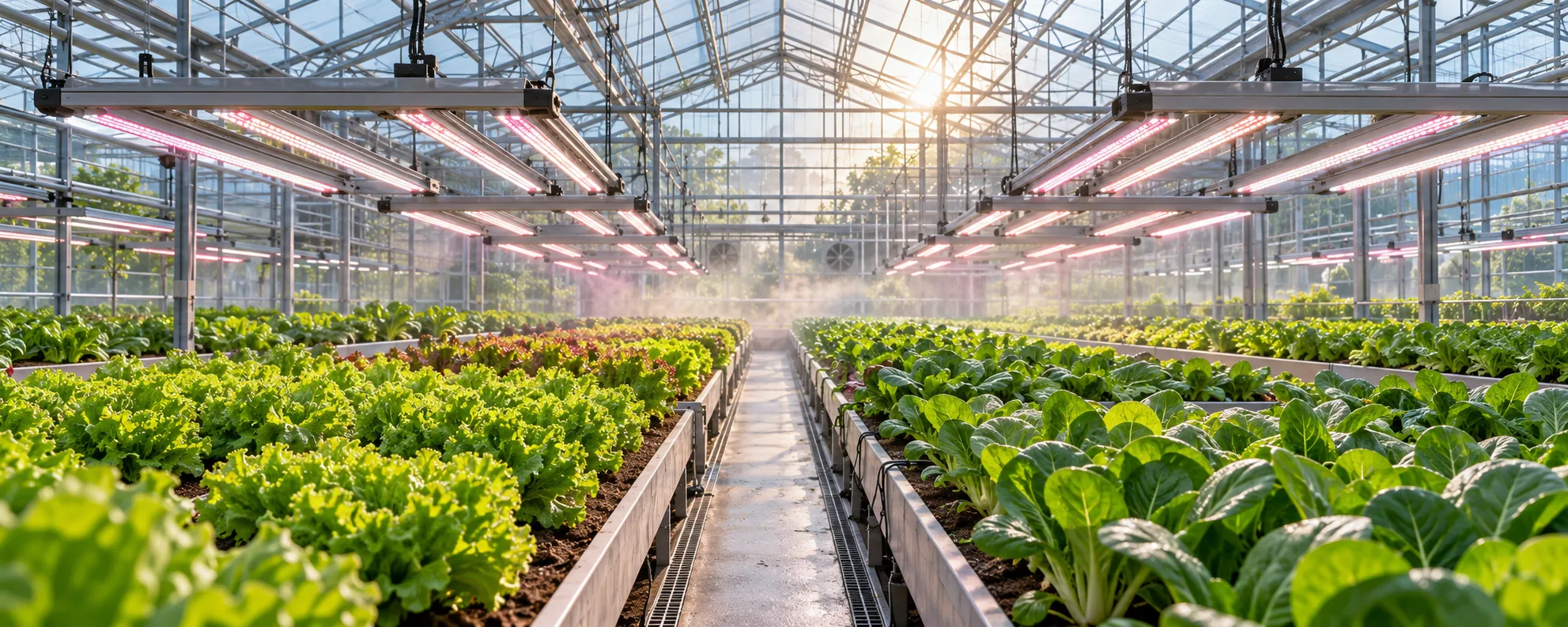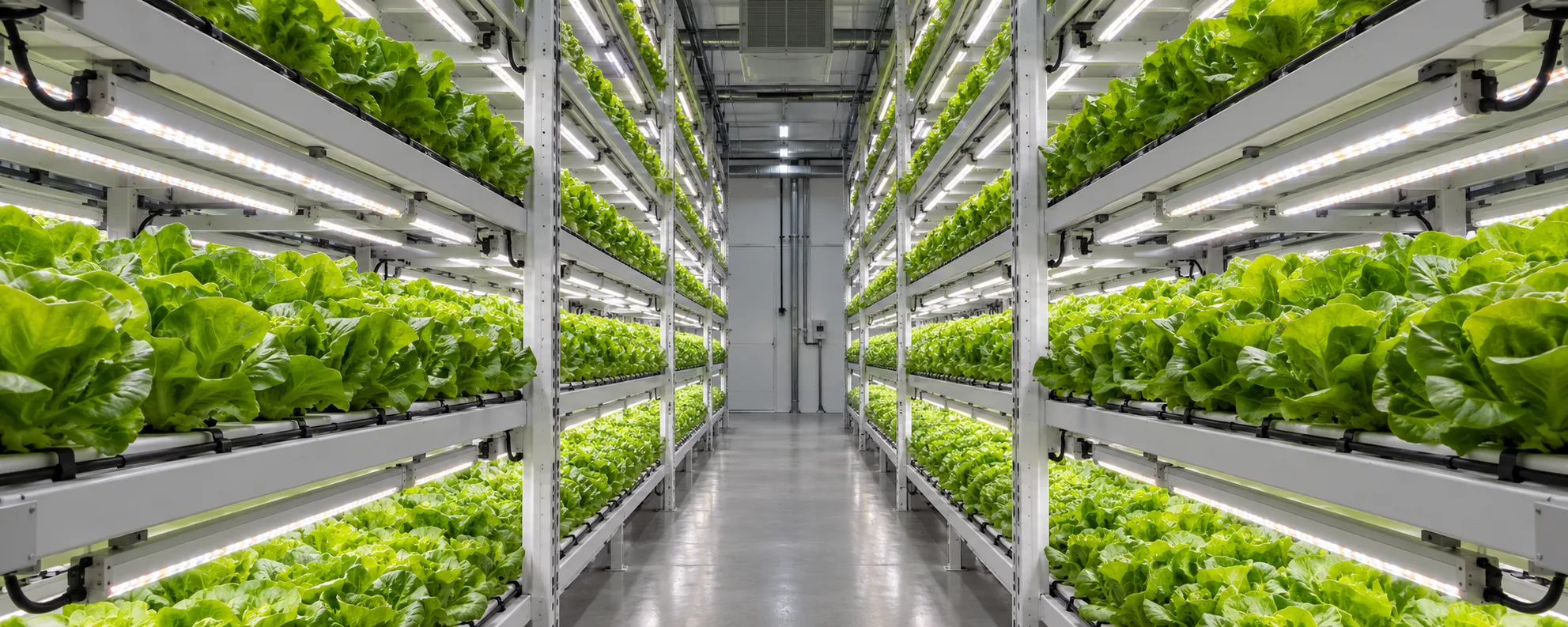
Specifying lighting for a commercial indoor farm is not a question of finding the brightest fixture. It is an engineering exercise: match photon delivery to the crop, keep distribution uniform, control energy cost, and make sure the hardware survives years of continuous operation. This guide walks through the decisions that matter most when you are comparing grow lights for a commercial facility.
Start with the light target, not the fixture
Before comparing products, define the light your crop needs. Most flowering crops in commercial production perform well in the 600–900 µmol/m²/s PPFD range at the canopy, while leafy greens typically run 200–350 µmol/m²/s. Work backwards from that target, your growing area and mounting height to the number of fixtures required. A supplier who cannot talk in PPFD, uniformity and coverage maps is selling you hardware, not a solution.
Check efficacy and energy cost per harvest
Fixture efficacy — measured in µmol/J — tells you how much usable light you get per watt. On a commercial farm, lighting is often the single largest line on the electricity bill, so the difference between 2.4 and 2.8 µmol/J compounds across thousands of operating hours per year. Ask for efficacy figures measured at the drive current the fixture will actually run, not best-case marketing numbers.
Uniformity separates professional fixtures from the rest
Average PPFD means little if half the room is under-lit. Look for fixtures with controlled beam optics and ask the manufacturer for a lighting layout with PPFD distribution across your specific room geometry. Uniformity drives crop consistency — and consistency is what makes a commercial harvest saleable.
Plan for control and automation
Commercial facilities need scheduled dimming, photoperiod control and often integration with environmental controls. Confirm the control interface — 0–10V, PWM, DALI or proprietary — before you commit, and check how many fixtures can run on a single controller channel.
Build for the environment and the maintenance cycle
Indoor farms are wet, humid and regularly sanitized. Fixtures should carry at least IP65 ratings, washable housings and isolated drivers. Ask about the warranty terms, spare-part availability and expected driver replacement intervals — five-year warranties are standard among serious manufacturers.
Evaluate the supplier, not just the product
- Do they manufacture in-house, or resell?
- Can they provide ETL, DLC, CE or FCC certification for your market?
- Do they support OEM branding, custom spectra and packaging?
- Can they reference commercial projects of similar scale?
- Is technical support available during installation and commissioning?
The cheapest fixture rarely wins over a five-year production cycle. Total cost of ownership — energy, maintenance, replacement and crop consistency — is the number that should drive the decision.
Planning a commercial grow light project?
Our team can recommend fixtures and lighting layouts based on your growing area, crop type and target PPFD — with OEM and ODM options for brands and distributors.
Get a Grow Light Solution