LUMAGROW

Industry Application

LED Grow Lighting for Cannabis Cultivation

Cannabis cultivation lighting is planned as a sequence of stage-specific recipes rather than one room-level setting: propagation, vegetative and flowering zones each need their own PPFD, photoperiod and spectrum, and the fixtures must deliver that light evenly through a dense canopy. Multi-channel control and intercanopy lighting are what make those stage changes possible without replacing hardware.

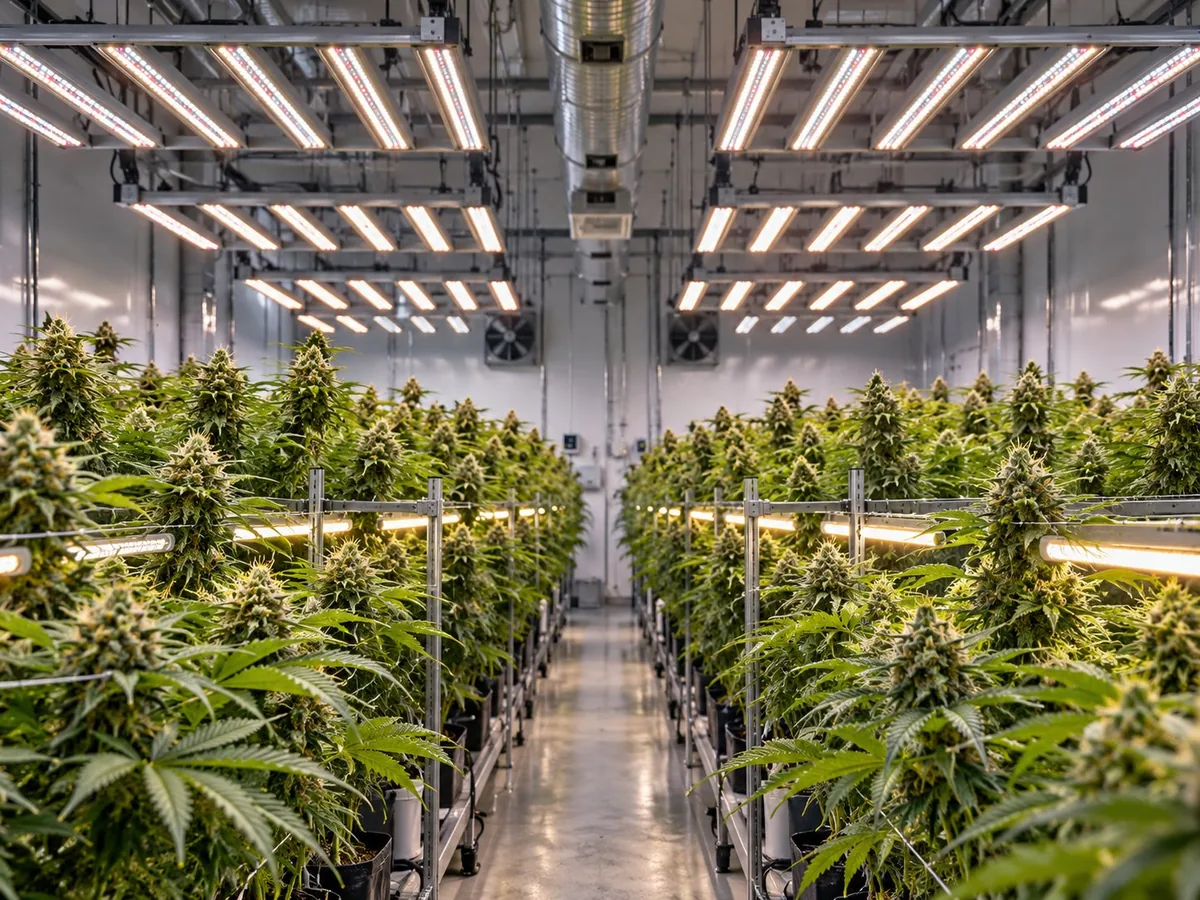
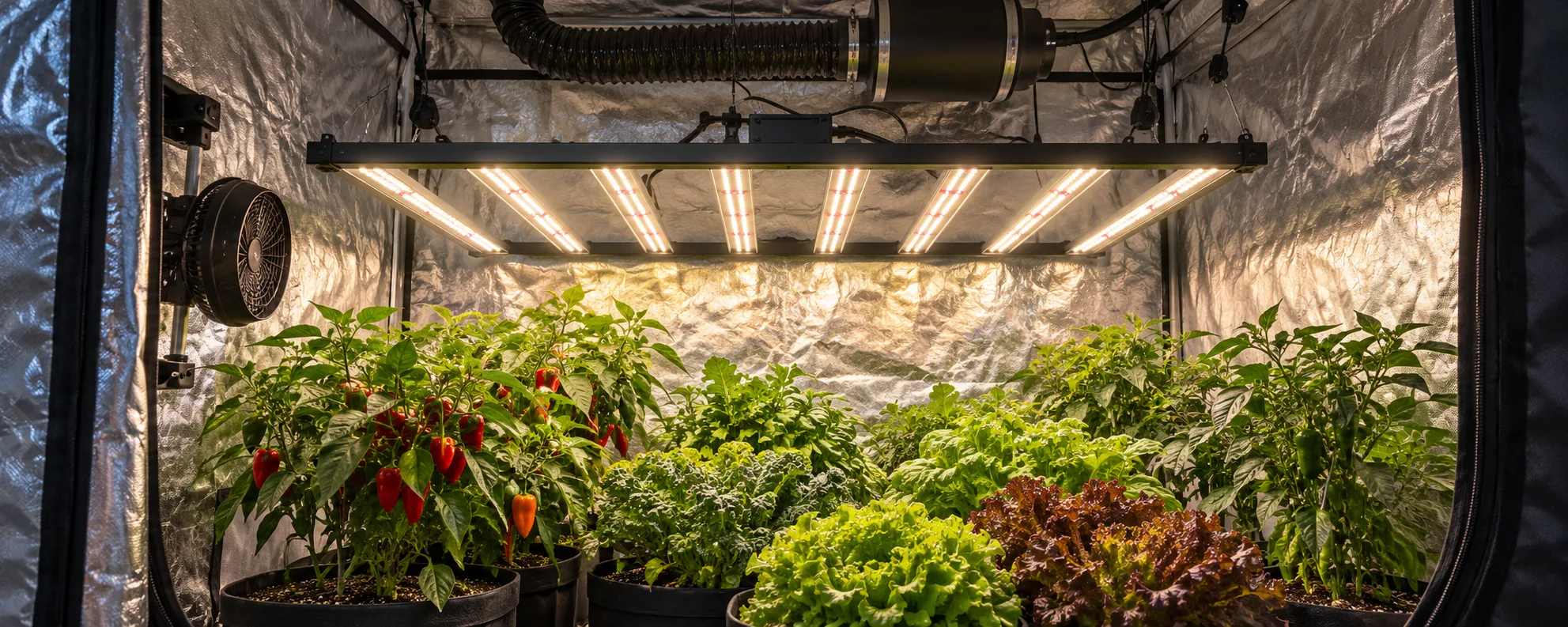
Illustrative view of a commercial cannabis grow room with LED bar lights above the canopy and intercanopy lighting

Illustrative image of a typical cannabis cultivation environment — not a customer installation photograph.

Technical focus on this page

Stage-based PPFD ramps, multi-channel spectrum and canopy penetration

How this application works

What drives lighting decisions in cannabis cultivation

A cannabis facility is really three lighting designs inside one building. Propagation needs modest, even intensity and a long photoperiod; vegetative growth needs more intensity with a spectrum that supports compact structure; flowering needs the highest PPFD the room can support, with full canopy penetration and a spectrum that can be tuned by stage.

Because the crop is trained into a dense, deep canopy, average PPFD measured at the top of the canopy overstates what the lower flowers receive. That is why facilities increasingly combine overhead bar fixtures with intercanopy bars positioned inside the canopy — the overhead system sets the dose, the intercanopy system determines how much of the plant actually receives it.

Regulated markets add a documentation layer. Certificates must match the exact model, driver and configuration placed on the market, and any change to the fixture between the certificate and the shipment creates a compliance problem. This is a purchasing and documentation discipline as much as a lighting one.

Application challenges

What makes cannabis cultivation lighting difficult

These are the constraints that decide whether a lighting plan survives contact with an operating facility.

01

Three stages, three recipes, one building

Propagation, vegetative and flowering rooms run different PPFD, photoperiod and spectrum. If fixtures cannot be re-configured or zoned, the facility is locked into a single recipe and cannot optimise any stage.

02

Dense canopies absorb light before it reaches flowers

In a trained canopy, the upper leaves intercept most incident radiation. Raising overhead intensity to compensate over-lights the top, raises leaf temperature and increases cooling load without necessarily improving the lower canopy.

03

Heat load versus high PPFD

High-intensity flowering rooms combine long photoperiods with high power density, and the resulting heat must be removed while holding VPD. Lighting design and HVAC design have to be planned together, or the room cannot run at its design setpoint.

04

Spectrum changes mid-cycle

Changing spectrum between stages, or during flowering, is only useful if the change is deliberate and recorded. Multi-channel fixtures allow it; single-channel fixtures force a hardware change, which is rarely practical mid-cycle.

05

Certification and documentation

In regulated markets, listing and certification must reference the exact model and configuration shipped. Substituting drivers or changing LED bins after certification can invalidate the documentation the buyer relies on.

Lighting requirements

How to specify lighting for cannabis cultivation

Each metric below has to be set from the crop, structure and operating practice — not from a generic watts-per-square-metre rule.

ParameterPlanning targetWhy it matters
PPFD by stagePropagation roughly 100–200, vegetative roughly 300–600, flowering roughly 600–1,000+ µmol/m²/s at canopy topEach stage has a different light saturation behaviour; applying flowering intensity to clones wastes energy and stresses plants. A controlled indoor trial that grew plants at canopy PPFDs from 120 to 1,800 µmol/m²/s found dry inflorescence yield still increasing linearly at the top of that range, while cannabinoid potency showed no light-intensity effect (Rodriguez-Morrison, Llewellyn & Zheng 2021) — which is why the ceiling here is set by cooling and CO₂, not by a published optimum.
Photoperiod by stageLong day for propagation and vegetative growth, 12 h for flowering (cultivar dependent)Photoperiod triggers and maintains flowering; it also determines the DLI achievable at a given PPFD.
DLIFlowering commonly in the 30–45+ mol/m²/day range where CO₂ and climate control support itDLI is the dose the crop integrates; PPFD alone does not describe a photoperiod-sensitive crop’s daily intake. At 12 h, 800 µmol/m²/s is already 34.6 mol/m²/day, so photoperiod and intensity have to be planned as one pair.
Canopy penetrationVerify PPFD at mid and lower canopy, not only at the topDense canopies lose most of the vertical light gradient within the top layer; intercanopy lighting addresses the deficit.
Spectrum controlSingle, 2-channel or 3-channel dimming depending on the recipes requiredChannel control allows stage-specific recipes without swapping fixtures.
UniformityMinimum-to-average around 0.8 across the canopy at the planned heightUniformity drives batch consistency, which matters for grading and for scheduling harvests.
Power density and coolingW/m² must be checked against HVAC capacity at design ambientHigh-PPFD flowering rooms are usually cooling-limited before they are electrically limited.
CertificationDocumentation matching the exact model, driver and configuration for the destination marketRegulated buyers need traceable paperwork; a certificate for a different configuration is not a substitute.

Reference data

Comparison tables for planning

Planning references compiled from horticultural lighting literature and standards. They are starting points for your own trials, not guarantees of performance.

Stage-based lighting planning reference for cannabis rooms
StageTypical PPFD (µmol/m²/s)PhotoperiodPlanning focusFixture approach
Propagation / clones100 – 20018 h (or 24 h under low intensity)Even, gentle light; avoid leaf stress and stretchingPropagation bars or low-output boards
Vegetative300 – 60018 hStructure and root development; uniform canopy fillQuantum boards or bar fixtures, dimmable
Early flowering600 – 80012 hCanopy fill and stretch control; watch leaf temperatureOverhead bars, dimmed from full output
Peak flowering800 – 1,000+12 hPenetration and uniformity; CO₂ and VPD coordinationOverhead bars plus intercanopy bars
Late flowering / ripening600 – 90012 hMaintain quality; avoid over-lighting as canopy senescesOverhead bars, reduced output
Mother plants200 – 40018 hVigorous but compact growth; long-term reliabilityBoards or bars, lower power density

Planning ranges from published controlled-environment horticulture guidance and commercial practice; the flowering range is consistent with indoor trials in which inflorescence yield kept rising up to 1,800 µmol/m²/s of canopy PPFD (Rodriguez-Morrison et al. 2021). Cultivar, CO₂, VPD and substrate all shift the optimum; these are starting points for your own trials, not guaranteed results.

Single-channel, 2-channel and 3-channel fixtures compared
ConfigurationWhat it allowsBest fitTrade-off
Single channelOne spectrum, dimmable as a wholeSingle-stage rooms with a fixed programmeNo stage-specific spectrum; hardware change required to alter recipe
2-channelWhite/full-spectrum plus a separate red or far-red channelVegetative-to-flowering transitions in one roomLimited independent control of blue and far-red
3-channelIndependent control of white, red and blue/far-red groupsMulti-stage facilities and research-informed recipesMore control hardware and operator discipline required
Overhead + intercanopyAdds a second, independently controlled light layerDense flowering canopiesMore fixtures, more circuits, higher capital cost

Channel count is a production-flexibility decision. More channels mean more recipes and more control hardware; fewer channels mean simpler specification and lower cost.

Lighting system design

How to plan the system, step by step

The order matters: geometry and targets first, fixture count second, verification and control last.

  1. 1

    Zone the facility by stage

    Draw the lighting zones from the production schedule: propagation, vegetative, early flower, peak flower, late flower. Each zone needs its own circuit, control channel and recipe; a single room serving several stages will always compromise one of them.

  2. 2

    Set PPFD and photoperiod per zone

    Choose the target PPFD for each stage and check the resulting DLI. A 12-hour flowering photoperiod at 800 µmol/m²/s gives about 34.6 mol/m²/day — compare that with what your climate control can actually support.

  3. 3

    Design for canopy penetration

    Decide the split between overhead and intercanopy capacity. In a dense canopy, plan a vertical PPFD profile at three heights rather than a single top-of-canopy reading, and size intercanopy bars to fill the lower third. Commercial-scale trials of LED interlighting in Cannabis sativa compared high-pressure-sodium and LED top light with and without an added interlighting layer, and reported yield and chemical-uniformity gains from the interlighting treatments (Bohemen et al. 2025).

  4. 4

    Check power density against HVAC

    Convert the layout into W/m², add it to the room heat balance, and confirm the cooling system can hold VPD at design ambient. If it cannot, reduce power density or accept a lower PPFD target — both are legitimate, but the decision must be deliberate.

  5. 5

    Specify control and recipe documentation

    Define channel assignments, dimming protocol and how recipes are recorded. Reproducibility depends on the operator being able to return to a documented setting, not on memory.

  6. 6

    Lock the certification scope

    Confirm which model, driver and configuration the certificate covers, and make that configuration the ordering specification. Any later substitution should trigger a documentation review, not a silent change.

Worked example

Sizing a 120 m² flowering room, overhead and intercanopy separately

Illustrative example — assumptions stated below, not client data

Assumptions

  • Canopy area: 120 m²
  • Overhead target at canopy top: 800 µmol/m²/s
  • Photoperiod: 12 h
  • Distribution allowance (delivered ÷ installed): 0.85
  • Overhead fixture: 2,240 µmol/s PPF at 720 W input (3.1 µmol/J)
  • Intercanopy bar: 450 µmol/s at 150 W (3.0 µmol/J, product record)
  • Intercanopy layout: 12 rows × 4 bars = 48 bars — a layout decision, not a photon calculation
StepCalculationResult
Overhead DLI check800 × 12 × 0.003634.6 mol/m²/day from the overhead layer alone — high-dose flowering; confirm climate and CO₂ can support it
Overhead PPF at canopy top800 µmol/m²/s × 120 m²96,000 µmol/s reaching the top of the canopy
Overhead installed PPF96,000 ÷ 0.85≈ 112,941 µmol/s of fixture output
Overhead fixture count112,941 ÷ 2,240 µmol/s50.4 → 51 overhead fixtures
Overhead load and power density51 × 720 W ÷ 120 m²36.7 kW overhead, i.e. ≈ 306 W/m² — check against cooling capacity
Intercanopy capacity — sized on rows, not on canopy PPFD48 bars × 450 µmol/s21,600 µmol/s of installed intercanopy PPF. This is a separate photon flux delivered inside the canopy; it is not added to the 800 µmol/m²/s top-canopy target
Intercanopy load48 × 150 W7.2 kW, taking the room to 43.9 kW total
Combined power density43,920 W ÷ 120 m²≈ 366 W/m² — electrical load is additive; PPFD at a given surface is not
Daily lighting energy43.9 kW × 12 h≈ 527 kWh/day for the flowering room
What may not be added112,941 + 21,600134,541 µmol/s is a fixture-capacity total for procurement only. It is not a top-canopy PPFD and must not be divided by the floor area to claim one

Overhead output sets the top-canopy PPFD, which is why the 800 µmol/m²/s target is met entirely by the overhead layer. Intercanopy bars contribute to the light available inside the canopy at a different surface and a different depth, so their 21,600 µmol/s cannot be summed with the overhead flux and reported as canopy PPFD — that would require measurement inside the canopy, or a distribution model calibrated against such measurements. Only the electrical loads (36.7 + 7.2 kW) and the daily energy are legitimately additive. Commercial-scale trials of LED interlighting in Cannabis sativa report yield and chemical-uniformity benefits from adding it to a top-light system, which is the reason to size it as an additional layer rather than as a substitute (Bohemen et al. 2025).

Three different kinds of number

What this calculation is — and what it is not

The worked example above is an initial estimate. It is not a lighting layout, and it is not a verified PPFD. Keeping the three apart is what stops a photon budget from being quoted as delivered performance.

STAGE 1

Initial estimate

Overhead photon budget from the top-canopy PPFD target, plus a separately sized intercanopy row count and the resulting electrical load.

Arithmetic only, and deliberately split: the overhead figure answers “can the top of the canopy reach 800 µmol/m²/s”, the intercanopy figure answers “how many bars fit between the rows”.

STAGE 2

Lighting layout design

Overhead spacing and mounting height, a vertical PPFD profile at three canopy heights, and a row-by-row simulation of the intercanopy contribution.

A design deliverable with two separate predictions — top-canopy PPFD and inner-canopy PPFD — reported as distinct numbers, never as one combined value.

STAGE 3

Verified PPFD performance

Measured PPFD on a canopy-top grid, and measured PPFD at mid and lower canopy height with the intercanopy bars running and with them switched off.

Measurement data only. The difference between those two measurements is the real intercanopy contribution — it is the only defensible way to state what the bars add.

Fixture selection

Which grow light types fit this application

Selected from the six fixture categories we manufacture; the right mix depends on ceiling height, canopy structure and control requirements.

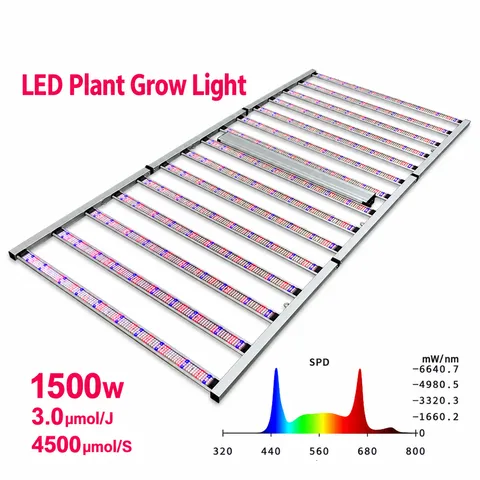
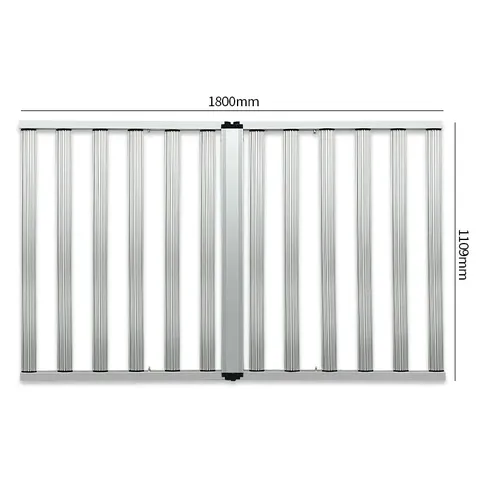
Foldable LED bar fixtures

Primary overhead lighting for flower and veg rooms

Bar geometry spreads PPF across the canopy and foldable frames reduce freight volume; multi-channel versions allow stage-specific recipes without new hardware.

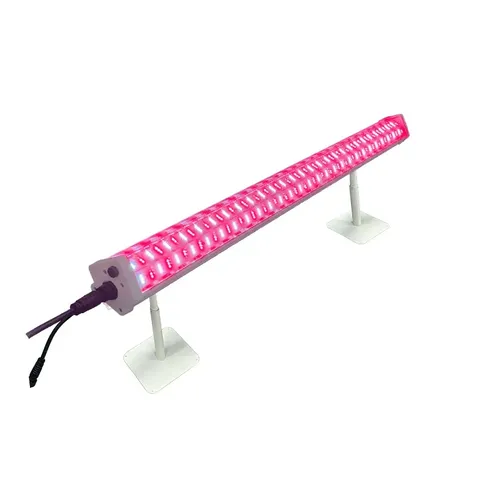
Intercanopy and under-canopy bars

Penetration into dense flowering canopies

Slim bars placed inside the canopy raise light in the middle and lower layers that overhead fixtures cannot reach economically.

Quantum board fixtures

Propagation, mother plants and smaller veg zones

Compact, high-PPF boards suit lower ceilings and small zones where a long bar array is impractical.

OEM & ODM

Project support for brands and importers

We build fixtures to a specification, document what was built, and support the certification and packaging work that a private-label programme needs.

  • Single, 2-channel or 3-channel spectrum configurations tied to your stage recipes
  • Housing, branding and packaging adapted to your product line and market
  • Documentation package prepared for the exact model and configuration shipped
  • Certification options matched to the destination market and its listing requirements
  • Pilot fixtures for a single room before a facility-wide order

Common mistakes

Planning errors that are expensive to fix later

Each of these shows up after installation, when the layout is already fixed and the circuits are already run.

MistakeWhat to do instead
Running one recipe across every roomZone by stage. Propagation, vegetative and flowering have different optima, and a single setting wastes energy in at least two of the three.
Maximising PPFD without checking CO₂, VPD and coolingLight is only usable inside a supporting environment. Plan PPFD together with climate capacity, or the room will run below its design setpoint in warm weather.
Judging canopy light from a single top-of-canopy readingTake a vertical profile at three heights. In a dense canopy the top reading says little about what the lower flowers receive.
Changing spectrum mid-cycle without recording itLog the recipe — channels, dim levels, hours — so a result can be repeated. Undocumented spectrum changes make comparisons meaningless.
Assuming the certificate covers any configurationMatch the ordering specification to the certified model, driver and configuration, and review documentation after any substitution.

Technical references

Every technical figure on this page is traceable to one of the sources below. Each entry gives the publication, its author or issuing body and year, a resolvable link, and the specific claim on this page that it supports — an institution name on its own is not evidence, and no manufacturer marketing material is used here as independent research. All links were checked and resolved on 19 October 2026.

  1. 1
    Cannabis yield, potency, and leaf photosynthesis respond differently to increasing light levels in an indoor environment

    Rodriguez-Morrison V., Llewellyn D. & Zheng Y., Frontiers in Plant Science 12:646020 (2021)

    Supports on this page: The stage PPFD ranges and the statement that inflorescence yield increased linearly with canopy PPFD up to 1,800 µmol/m²/s while cannabinoid potency showed no light-intensity effect.

  2. 2
    LED interlighting: a cost-effective strategy to increase yield and chemical uniformity of Cannabis sativa at commercial scale

    Bohemen J., Carvalho S., Nicole C.C.S., Smith D.L. & Lefsrud M., Scientia Horticulturae, article 114406 (2025)

    Supports on this page: The claim that intercanopy lighting is an additional layer with yield and chemical-uniformity benefits when added to HPS or LED top lighting — and therefore that it must be sized and reported separately from the overhead layer.

  3. 3
    Substituting far-red for traditionally defined photosynthetic photons results in equal canopy quantum yield for CO₂ fixation

    Zhen S. & Bugbee B., Frontiers in Plant Science 11:581156 (2020)

    Supports on this page: The reason a separate far-red channel is worth having on a flowering fixture: absorbed far-red photons were equally efficient for photosynthesis when acting with 400–700 nm photons, rather than only acting as a morphological signal.

  4. 4
    Horticultural Lighting Technical Requirements, Hort V4.0

    DesignLights Consortium, technical requirements effective 18 April 2025

    Supports on this page: The point that qualification references are issued against a specific model and configuration — the basis for insisting that certification paperwork matches the exact product shipped.

  5. 5
    ANSI/ASABE S640 — Quantities and Units of Electromagnetic Radiation for Plants

    American Society of Agricultural and Biological Engineers, standard S640 JUL2017 (reaffirmed 2022)

    Supports on this page: The units and the distinction between PPF, PPFD and DLI that makes it possible to state one flux as a fixture capacity and the other as an intensity at a named surface.

Where a source could not be confirmed as publicly accessible, the claim it would have supported has been written as a lower-certainty statement rather than given a citation. Planning ranges remain starting points for your own trials — they are not guarantees of performance, and no figure on this page is a quotation.

Industry FAQ

Cannabis Cultivation lighting questions

Specific follow-up questions about this application, answered directly and then explained.

What PPFD should I use in vegetative and flowering rooms?

Vegetative rooms are commonly planned around 300–600 µmol/m²/s and flowering rooms around 600–1,000+ µmol/m²/s at canopy top, with the upper end only sensible when CO₂, VPD and cooling can support it. Treat these as planning ranges and confirm the response on your own cultivar before committing to a facility-wide recipe.

Do I need intercanopy lighting in a flowering room?

For dense, trained canopies, usually yes. Overhead fixtures deliver most of their light to the top layer, and raising intensity to reach the lower canopy over-lights the top and adds cooling load. Intercanopy bars placed inside the canopy deliver light where the flowers actually are, at a fraction of the overhead wattage.

Which spectrum is best for flowering?

There is no single best spectrum — the useful answer is that the spectrum should be adjustable and documented. A full-spectrum white base with independent red and far-red channels lets you run stage-appropriate recipes from the same fixture. Claims of specific percentage gains for a particular spectrum should be treated cautiously unless you can reproduce them in your own room.

How many fixtures does a 1,000 m² cannabis facility need?

Work it out per zone rather than per facility: multiply the zone target PPFD by its canopy area, apply a utilisation factor of about 0.85, then divide by fixture PPF. A facility with several stages will have several different fixture counts, and the propagation area will need far fewer watts per square metre than flowering.

What DLI should I target?

Flowering rooms are commonly planned in the 30–45+ mol/m²/day range where the environment supports it; vegetative rooms sit lower. DLI is the product of PPFD and photoperiod, so a 12-hour flowering cycle needs a higher PPFD than an 18-hour vegetative cycle to reach a comparable dose.

How do I compare two lighting layouts for the same room?

Compare them on four numbers: installed PPF, power density in W/m², predicted uniformity at canopy level, and the vertical PPFD profile at three heights. Two layouts with the same total wattage can differ substantially in the last two, and those are the ones that determine crop consistency.

What certification documents should I expect?

Documentation that references the exact model, driver and configuration you are buying, for the market you are selling into. Ask for the certificate and the test report together, and check that the model designation on the paperwork matches the product label — a certificate for a different configuration does not cover your shipment.

Planning a cannabis cultivation lighting project?

Send the growing area, crop and stage, target PPFD or DLI, ceiling or layer height and your market requirements. We will come back with a fixture proposal, a layout suggestion and the documentation you need to evaluate it.