
FAQ & Knowledge Center
LED Grow Light FAQ & Knowledge Center
Find practical answers to commercial LED grow lighting questions, including PPFD, spectrum, indoor cultivation, greenhouse lighting, product selection, OEM manufacturing and wholesale purchasing.
100
Technical answers
8
Knowledge categories
6
Related guides
6
Product categories
Popular Questions
CATEGORY 01
Commercial Grow Lighting
Project planning, fixture counts, wattage, area coverage, fixture selection and energy cost for commercial indoor cultivation.
How many LED grow lights do I need for a 500 m² indoor farm?
The number of LED grow lights for a 500 m² indoor farm is calculated from target canopy PPFD, fixture PPF and a utilization factor — not from floor area alone. First work out the total photon output the canopy needs, then divide it by the PPF of one fixture.
Illustrative example: 600 µmol/m²/s over 500 m² with a 0.8 utilization factor requires about 375,000 µmol/s of delivered PPF. With 2,240 µmol/s fixtures that is roughly 167 fixtures before row rounding. Real layouts round up by rows and spacing, and the PPFD target should come from your crop and stage — so treat this as an estimate, not a quotation.
Formula
Total PPF (µmol/s) = Target PPFD × Canopy area ÷ Utilization factor Fixtures = Total PPF ÷ Fixture PPF
References
Last reviewed: 2026-10-19
How do I choose LED grow lights for a commercial indoor farm?
Choose commercial LED grow lights by matching fixture PPF and PPE to your target PPFD, then checking spectrum, uniformity, dimming, thermal design and certification for your market. The order of decisions matters more than the brand list: define the crop and target DLI first, calculate fixture count second, and compare suppliers last.
A practical sequence: set target PPFD and DLI for each growth stage; calculate total PPF and fixture count; compare fixtures on PPE and PPF rather than wattage; verify uniformity at your mounting height; confirm dimming and control compatibility; check certification and documentation for the destination market; and request samples before committing to a container order.
References
Last reviewed: 2026-10-19
Can I replace 1,000W HPS fixtures with LED grow lights without changing my layout?
You can usually replace 1,000W HPS fixtures with LED fixtures at similar mounting positions, but fixture count and spacing often change because LED PPF per fixture and beam distribution differ from HPS. Match delivered PPFD first, then adjust the layout.
A 1,000W double-ended HPS fixture typically delivers roughly 1,700–2,100 µmol/s depending on lamp and ballast, while a modern LED bar fixture may deliver a comparable or higher PPF at lower wattage. Because LED optics concentrate light differently, the number of fixtures needed for even coverage may drop, and rows may need re-spacing. Use measured PPF data for both systems and verify PPFD on a grid at canopy level before buying.
References
Last reviewed: 2026-10-19
How much energy can LED grow lights save compared with HPS?
LED grow lights save energy when their PPE (µmol/J) is higher than the HPS system they replace, because the same delivered PPF requires fewer watts. The saving is a calculation you run with measured data, not a fixed percentage.
Illustrative example: to deliver 2,000 µmol/s, a 2.8 µmol/J LED needs about 714 W, while a 1.8 µmol/J HPS system needs about 1,111 W — roughly 36% less electrical power for the same photon output, before any HVAC differences. Actual savings depend on the measured PPE of both systems, operating hours and how much of the HPS heat load your climate system was removing.
Formula
Power (W) = PPF (µmol/s) ÷ PPE (µmol/J) Saving (%) = 1 − (LED W ÷ HPS W)
References
Last reviewed: 2026-10-19
Are LED grow lights better than HPS for commercial cultivation?
LED grow lights are usually the better choice for new commercial projects because they deliver more photons per watt, run cooler and allow spectrum and dimming control; HPS can still make sense where upfront budget or existing infrastructure dominates.
The practical comparison is not LED versus HPS in general, but delivered PPFD per dollar of electricity and per dollar of installed capacity. LED systems typically cost more per fixture but reduce power and cooling load and offer control that HPS cannot. HPS has lower fixture cost and proven performance, which matters for short-horizon retrofits. Decide with a full lifecycle calculation for your climate and tariff.
References
Last reviewed: 2026-10-19
How does lighting planning change between a 250 m² and a 1,000 m² indoor facility?
Lighting planning scales with canopy area and layout constraints, not just fixture count: a 250 m² room is usually planned fixture by fixture for uniformity, while a 1,000 m² facility is planned by zones, rows and control circuits.
In a 250 m² room, a single engineer can check every fixture position, and one or two lighting circuits may be enough. At 1,000 m², the design becomes a systems problem: electrical distribution, circuit grouping, control zoning by cultivar or stage, maintenance access, and the interaction between lighting and HVAC all become material. The per-square-meter fixture density may be similar, but the planning effort and commissioning requirements are not.
Last reviewed: 2026-10-19
How much PPF per square meter should I plan for a commercial indoor grow?
Plan PPF per square meter from the target PPFD: 1 µmol/m²/s of PPFD requires 1 µmol/s of delivered PPF per square meter, divided by the utilization factor of the layout.
Illustrative example: a 700 µmol/m²/s target with a 0.8 utilization factor needs about 875 µmol/s of installed fixture PPF per square meter. The utilization factor accounts for light that misses the canopy — wall losses, aisles, fixture spacing and beam spill. A tighter room with reflective walls can use a higher factor; an open or poorly enclosed space needs a lower one. Confirm the actual PPFD with a grid measurement after installation.
Formula
Required PPF per m² = Target PPFD ÷ Utilization factor
References
Last reviewed: 2026-10-19
How do I estimate the lighting cost per square meter for an indoor farm?
Estimate lighting cost per square meter by dividing total installed fixture cost by canopy area, then adding electrical infrastructure and annual energy cost as separate lines.
Illustrative example: 167 fixtures at an assumed unit price, plus mounting and electrical work, divided by 500 m² gives a capital cost per square meter. Annual energy cost per square meter = installed watts × operating hours × electricity tariff ÷ canopy area. Keep capital and operating cost separate, because a cheaper fixture with lower PPE can cost more over five years. Use your own quoted prices — fixture prices vary with specification, certification and order volume.
Formula
Capital cost per m² = (Fixture count × Unit price + Installation) ÷ Canopy area Energy cost per m² per year = Installed W × Hours × Tariff ÷ Canopy area
References
Last reviewed: 2026-10-19
I’m setting up a commercial indoor farm. What should I decide before choosing LED grow lights?
Decide five things before choosing LED grow lights: the crop and target DLI for each stage, the available electrical capacity, the ceiling height and mounting envelope, the HVAC and dehumidification strategy, and the budget split between fixtures, installation and operating cost.
These constraints determine whether a high-output bar fixture or a compact board is realistic, and they usually change the shortlist more than brand comparisons do. Confirm supply and breaker capacity with an electrician, map canopy area separately from aisles, and decide whether rooms will be zoned by cultivar or growth stage. Once those inputs are fixed, the photon calculation becomes straightforward and supplier quotes become comparable.
References
Last reviewed: 2026-10-19
How many watts of LED grow light do I need per square meter?
There is no reliable fixed watt-per-square-meter figure; the correct value is derived from target PPFD and fixture PPE, so two fixtures with different efficiency need different wattage for the same light level.
Illustrative example: 600 µmol/m²/s with a 0.8 utilization factor needs 750 µmol/s per square meter. At 2.8 µmol/J that is about 268 W/m²; at 2.2 µmol/J the same light level needs about 341 W/m². Watts per square meter is therefore an output of the design, not an input. Use it as a sanity check after the photon calculation, never as the starting rule.
Formula
W per m² = (Target PPFD ÷ Utilization factor) ÷ PPE
References
Last reviewed: 2026-10-19
Can I mix different LED grow light brands in the same room?
You can mix brands in one room, but only if you match delivered PPFD, spectrum and dimming behavior across the mixed fixtures; otherwise you create uneven growth and control problems.
Different brands often use different diode bins, optics and dimming curves, so identical wattage does not mean identical output. If you mix, measure PPFD at canopy level across the whole room and group fixtures into separate control zones so each zone can be tuned. For a new commercial room, one fixture family is usually simpler to commission and maintain. Mixing is more defensible when adding supplemental fixtures or phasing an upgrade.
Last reviewed: 2026-10-19
How long do commercial LED grow lights last before replacement?
Commercial LED grow lights are usually replaced when measured output falls to a defined maintenance threshold — commonly L90 or L70 of initial photon output — rather than after a fixed number of years.
Lifetime depends on LED bin, drive current, thermal design and operating hours. A fixture run cooler at lower drive current generally degrades more slowly than one pushed to its maximum. Ask suppliers for the photon maintenance curve and the driver lifetime rating, then plan replacement around measured performance, not calendar age. Re-measure PPFD periodically to detect degradation before yield is affected.
References
Last reviewed: 2026-10-19
I’m retrofitting an HPS room to LED. What electrical upgrades are usually needed?
An HPS-to-LED retrofit usually needs less running power but may still require electrical work: confirming voltage and circuit capacity, checking inrush current and breaker compatibility, and re-grouping circuits for the new fixture layout.
LED drivers can draw high inrush current at startup even when running watts are lower, which can trip breakers sized for HPS. Retrofit projects also often change fixture positions, so existing conduit and outlet locations may not match. Have an electrician review the load schedule, voltage options, breaker types and control wiring before ordering. Certification must also match the installation environment.
References
Last reviewed: 2026-10-19
How does ceiling height affect which LED grow light I should buy?
Ceiling height sets the maximum mounting distance and therefore the beam angle and fixture format you need: low rooms favor wide, low-profile fixtures, while high rooms can use narrower optics and higher-output fixtures.
A fixture hung too close in a low room creates hotspots and poor uniformity; one hung too high in a tall room spreads light beyond the canopy. The design goal is to reach target PPFD at canopy level with acceptable uniformity inside the available height. Check the fixture’s PPFD distribution at your actual mounting distance, not just its peak output.
Last reviewed: 2026-10-19
CATEGORY 02
Cannabis Grow Lighting
Lighting for commercial cannabis cultivation: vegetative and flowering stages, propagation, canopy depth, spectrum and greenhouse supplementary light.
What PPFD do cannabis plants need in vegetative and flowering stages?
Cannabis PPFD targets are commonly planned around roughly 400–600 µmol/m²/s in vegetative growth and 600–1,000+ µmol/m²/s in flowering, with the upper end used only when CO₂, temperature, VPD and nutrition support it.
These are planning ranges, not a universal standard. Cultivar, CO₂ enrichment, canopy depth and leaf temperature all shift the optimum. Above the light saturation point, additional PPFD adds heat and electricity cost without a proportional yield response, and can stress plants when VPD is not managed. Compare supplier data at the same mounting height and verify with a PPFD grid before scaling a room.
References
Last reviewed: 2026-10-19
How many LED grow lights are needed for a 1,000 m² cannabis facility?
The fixture count for a 1,000 m² cannabis facility follows the same photon budget as any crop: target flowering PPFD × canopy area ÷ utilization factor ÷ fixture PPF.
Illustrative example: 800 µmol/m²/s over 1,000 m² at a 0.8 utilization factor requires 1,000,000 µmol/s; with 3,960 µmol/s fixtures (a 1200W three-head top light) that is about 253 fixtures before row rounding. Vegetative and propagation rooms normally run lower PPFD and need separate calculations, and aisle space is excluded from canopy area. Treat the result as a planning estimate and confirm with a layout drawing and PPFD simulation or grid measurement.
Formula
Fixtures = (Target PPFD × Canopy area ÷ Utilization factor) ÷ Fixture PPF
References
Last reviewed: 2026-10-19
Which spectrum is best for cannabis flowering?
There is no single best flowering spectrum for cannabis; a broad full spectrum with strong red content is the common commercial baseline, while added deep red and far-red are used to shape morphology and finishing.
Red light around 600–700 nm drives photosynthesis and flower development, and blue light helps keep growth compact. Far-red around 730 nm can influence phytochrome signaling and stem extension, but overuse can stretch plants. UV is sometimes used in finishing strategies with careful safety controls, though results vary by cultivar. Because responses are cultivar-specific, run side-by-side trials under your own climate before committing a whole room to a new recipe.
References
Last reviewed: 2026-10-19
How should I light cannabis seedlings and clones?
Light cannabis seedlings and clones at low PPFD — commonly around 150–300 µmol/m²/s — with a blue-weighted spectrum and high uniformity so trays develop evenly.
Propagation is more sensitive to excess light than flowering rooms. A DLI of roughly 8–14 mol/m²/day is a common planning range, but the correct value depends on cultivar and root development. Keep fixtures close enough for uniform coverage without hotspots, use dimming to avoid overshooting, and monitor leaf temperature and humidity. Once roots are established and new growth is uniform, PPFD can be raised gradually in the vegetative room.
References
Last reviewed: 2026-10-19
Do I need intercanopy or under canopy lights for cannabis?
Intercanopy and under canopy lights are worth adding when tall cannabis canopies leave the middle and lower flower sites below their light compensation point; they are supplemental, not a substitute for top lighting.
In tall rooms, top fixtures can deliver strong PPFD at the canopy surface while lower flower sites remain shaded. Intercanopy fixtures mounted between layers and under canopy fixtures near the crop base raise light in those zones and can improve uniformity and lower-canopy development. They also add heat and hardware in a humid zone, so use sealed IP-rated fixtures and check that the added light justifies the cost in your own trials.
Last reviewed: 2026-10-19
What DLI should I target for cannabis?
Cannabis DLI is commonly planned at roughly 20–30 mol/m²/day in vegetative growth and 30–45 mol/m²/day in flowering for CO₂-supplemented commercial rooms, and lower without CO₂.
DLI combines intensity and photoperiod, so the same DLI can be reached with higher PPFD over fewer hours or lower PPFD over more hours. In flowering, a 12-hour photoperiod means PPFD must be relatively high to reach the target. Always check that temperature, VPD and CO₂ can support the chosen DLI; pushing DLI beyond what the plant can use wastes electricity and can reduce quality.
Formula
DLI (mol/m²/day) = PPFD (µmol/m²/s) × Photoperiod (h) × 0.0036
References
Last reviewed: 2026-10-19
How do I compare lighting layouts for two cannabis facilities?
Compare cannabis lighting layouts on delivered PPFD uniformity, fixture count and wattage, control zoning, maintenance access and installed cost — not on fixture wattage alone.
Request a PPFD grid at canopy level for both proposals and compare minimum, average and uniformity ratios. Check whether aisle and wall positions fall below the crop requirement, how many control zones each layout creates, and how fixtures are accessed for cleaning and replacement. Then compare total installed watts, annual energy and fixture count against capital cost. A layout with fewer, higher-output fixtures can be cheaper to install but less uniform in a low room.
References
Last reviewed: 2026-10-19
I run CO₂ enrichment. How much PPFD can cannabis use?
CO₂ enrichment raises the light level cannabis can use, but there is no fixed ceiling: the useful PPFD depends on cultivar, leaf temperature, VPD and how well the room can remove the extra heat.
With elevated CO₂, many commercial rooms plan flowering PPFD toward the upper end of common ranges, but pushing light without matching temperature, humidity and nutrition gains little and can stress plants. Increase PPFD gradually and watch leaf temperature and visual stress. The correct target is the point where additional light stops producing proportional growth — which must be found in your own room, not copied from a generic chart.
Last reviewed: 2026-10-19
Should the vegetative and flowering rooms use different fixtures?
Vegetative and flowering rooms can use different fixtures because they need different PPFD and often different spectra, but using one fixture family across both rooms simplifies spares, control and maintenance.
Flowering rooms usually need higher PPFD and a red-weighted spectrum, while vegetative rooms need lower intensity and more blue for compact growth. If budgets allow, specify the flowering fixture as the standard and dim it in vegetative rooms. If you do use different fixtures, keep the same control protocol and driver family so commissioning and replacement remain manageable.
References
Last reviewed: 2026-10-19
What are the signs of light stress in cannabis?
Common signs of light stress in cannabis include bleached or yellowing top leaves, leaves curling or folding at the edges, upward cupping, and stalled growth despite adequate water and nutrients.
Light stress is often confused with nutrient deficiency, so check PPFD at canopy level and leaf temperature before changing feed. Raised leaves, flat or taco-shaped blades and damaged upper flowers are typical when intensity is too high or fixtures are too close. Reduce intensity or raise fixtures, then observe new growth. Persistent symptoms at normal PPFD point to other issues such as VPD, root health or nutrition.
References
Last reviewed: 2026-10-19
How should PPFD change through the flowering weeks?
PPFD is usually held steady or increased slightly through flowering rather than ramped continuously, with the highest values in mid-to-late flower when canopy surface area and light demand peak.
Early flower is more sensitive to excess light, so many growers start below the peak target and raise intensity as the canopy fills. Late in flower, some reduce intensity to limit heat and stress near harvest. The schedule should follow plant response, not a fixed calendar. Keep DLI consistent and adjust photoperiod only if the cultivar and strategy call for it.
Last reviewed: 2026-10-19
How should I light autoflowering cannabis?
Autoflowering cannabis is commonly run under a longer photoperiod — often 18–20 hours — at moderate PPFD, because the plant flowers on its own schedule rather than on day length.
A longer photoperiod raises DLI, so PPFD can often be lower than in a 12-hour flowering room for the same daily light. Watch for light stress and heat buildup, and keep the schedule consistent through the cycle. Because autoflower life cycles are shorter, early stress has a proportionally larger effect on final yield.
Last reviewed: 2026-10-19
How should I light cannabis mother plants?
Light cannabis mother plants at moderate PPFD with a longer photoperiod to maintain vegetative growth and steady cutting production, while avoiding the intensity used in flowering rooms.
Mother plants need healthy, compact growth rather than maximum biomass, so uniform light across the canopy matters more than peak output. Keep PPFD well below flowering targets, maintain a stable photoperiod, and avoid heat stress that reduces cutting quality. Because mothers stay in the room long-term, re-check PPFD at the canopy after any fixture change.
Last reviewed: 2026-10-19
CATEGORY 03
Greenhouse Lighting
Tomato, cucumber, strawberry and pepper greenhouse supplemental lighting, DLI gap planning and combining natural light with LEDs.
How do I plan supplemental lighting for a tomato greenhouse in Canada in winter?
Plan winter supplemental lighting in a Canadian tomato greenhouse by calculating the DLI gap between natural light and the crop target, then sizing fixtures to close that gap within your electricity and heat budget.
Start with monthly natural DLI for your location, set a target DLI for the crop and market grade, and convert the shortfall into supplemental PPFD for the hours you intend to run. Illustrative example: a 10 mol/m²/day gap filled over 16 hours needs about 174 µmol/m²/s of supplemental PPFD. Then check fixture PPF, mounting height, uniformity, electricity tariff and whether the added light changes heating or CO₂ strategy. Canadian winter light is low, so the gap is usually largest in December and January.
Formula
Supplemental PPFD = (Target DLI − Natural DLI) ÷ (Hours × 0.0036)
References
Last reviewed: 2026-10-19
What DLI do greenhouse tomatoes need?
Greenhouse tomatoes are commonly planned at roughly 20–30 mol/m²/day, with the exact target depending on cultivar, CO₂, temperature and the market grade you are growing for.
In high-light regions the natural DLI may already exceed the target in summer, so supplemental lighting is mainly a winter and shoulder-season tool. In low-light regions the gap is larger and the lighting system has to carry more of the annual DLI. Because DLI is an integrated daily value, a bright day and a dull day average together — which is why growers measure natural light and dim supplemental fixtures to fill only the shortfall.
References
Last reviewed: 2026-10-19
Does cucumber greenhouse lighting differ from tomato lighting?
Cucumber lighting differs from tomato lighting mainly in canopy architecture and target intensity: cucumbers grow faster and produce a denser, taller canopy, so uniformity through the canopy and intercanopy supplementation matter more.
Cucumber rows close over quickly and can shade lower leaves, which makes vertical light distribution and leaf pruning important. Target DLI is often similar to tomato, but the taller canopy and faster fruit load mean the lighting plan should be checked against the crop profile rather than the floor area alone. Intercanopy fixtures are more commonly considered for cucumber than for low-wire tomato crops.
Last reviewed: 2026-10-19
Can LED supplemental lighting extend strawberry production in winter?
LED supplemental lighting can extend winter strawberry production in greenhouses by raising DLI and supporting flower initiation and fruit development, but results depend on cultivar, photoperiod response and temperature management.
Strawberry cultivars differ in daylength response, so the lighting strategy — supplemental DLI versus photoperiod extension — must match the cultivar. Raising DLI can improve yield and fruit quality when natural light is limiting, but lighting alone will not compensate for low temperature or poor CO₂. Run a small trial under your own greenhouse climate before investing in a full bay of fixtures.
References
Last reviewed: 2026-10-19
Should I use LED or HPS for greenhouse supplemental lighting?
LED is usually preferred for new greenhouse supplemental lighting because it delivers more photons per watt and adds less radiant heat, while HPS remains common where existing infrastructure and upfront cost dominate.
The trade-off is not only electricity: HPS adds heat that can reduce heating demand in cold climates, while LED adds less heat and may require a separate heating strategy. LED also allows dimming and spectral control, which helps when supplemental light is used to fill a daily DLI gap. Compare both options on annual electricity, heating, fixture life, maintenance and the value of control for your crop.
References
Last reviewed: 2026-10-19
How do I combine natural light with LED supplemental lighting?
Combine natural and LED light by measuring the natural DLI each day and dimming supplemental fixtures to fill only the shortfall to your target DLI.
A light sensor outside or inside the greenhouse feeds a climate computer that integrates natural light over the day. The controller then calculates the remaining DLI requirement and runs or dims the LED fixtures accordingly, within the photoperiod and tariff constraints you set. This approach avoids over-lighting on bright days, reduces electricity cost and keeps the crop close to a consistent daily light integral. Calibrate sensors and review the control logic each season.
References
Last reviewed: 2026-10-19
Should greenhouse supplemental lighting be top lighting or intercanopy?
Use top lighting as the primary greenhouse supplemental source and add intercanopy lighting when the crop canopy is tall enough that top light cannot reach the lower productive zone.
Top lighting is the default because it covers the full floor area from above and integrates with existing truss structures. As crops such as tomato, cucumber or pepper grow taller, the lower canopy can fall below the light compensation point even when top PPFD looks adequate. Intercanopy fixtures address that zone directly. The decision should be based on measured vertical PPFD profiles in your crop, not on a general rule.
Last reviewed: 2026-10-19
I grow peppers in a greenhouse. How much supplemental light do they need?
Pepper greenhouse supplemental lighting is planned from the DLI gap: measure natural DLI, set a crop target, and add only the shortfall within your photoperiod and electricity budget.
Peppers generally need a moderate-to-high DLI depending on cultivar and market, and winter natural light in northern regions is well below target. Convert the gap to supplemental PPFD using the DLI formula, then check uniformity and heat load. Because peppers are warm-season crops, lighting decisions must be coordinated with temperature and CO₂ management rather than treated as a standalone add-on.
Last reviewed: 2026-10-19
Do leafy greens in a greenhouse need supplemental lighting?
Leafy greens in a greenhouse benefit from supplemental lighting when winter or shoulder-season natural DLI falls below the crop requirement, but the need is lower than for fruiting crops such as tomato.
Lettuce and similar greens have a lower DLI target, so in many climates a modest supplemental system is enough to maintain steady production through low-light months. Base the decision on measured natural DLI and the target growth rate, not on a blanket rule. Check whether the lighting cost per unit of marketable yield justifies the investment in your market.
References
Last reviewed: 2026-10-19
How do I calculate the payback of greenhouse supplemental lighting?
Calculate payback by dividing installed cost by the annual net benefit, where net benefit is the value of additional marketable yield minus annual electricity and maintenance cost.
Illustrative example: if a lighting system costs a given amount and adds a measurable yield value each year, payback equals installed cost ÷ (added revenue − added operating cost). Use your own yield trials, tariff and crop price; do not use generic savings percentages. Include changes in heating, CO₂ and labour. Because yield response varies by crop and climate, a pilot bay is usually the most reliable input to the calculation.
Formula
Payback (years) = Installed cost ÷ (Added annual revenue − Added annual operating cost)
References
Last reviewed: 2026-10-19
Can I retrofit my greenhouse from HPS to LED without changing the structure?
You can often retrofit HPS to LED without structural changes because LED fixtures are usually lighter and can mount on existing trusses, but you must confirm truss load, mounting height and electrical distribution first.
LED fixtures may need different spacing and beam angles to cover the same area, and reduced heat output can change your heating strategy. Check that existing mounting points, cable trays and outlets suit the new layout, and have the structure and electrical design reviewed. Certification must match the greenhouse environment, including humidity and wet locations.
References
Last reviewed: 2026-10-19
Do greenhouse lights need to comply with light pollution rules?
Greenhouse lighting may be subject to local light-pollution or dark-sky rules, and the applicable requirements depend on the municipality, crop and lighting schedule — so confirm with local authorities before installing.
Some regions restrict light spill at night, require shielding or curfews, or regulate skyglow from commercial horticulture. Fixtures with controlled optics and proper shielding reduce spill, but compliance is a local planning question, not a product specification. Document your lighting schedule and optics, and check requirements during project planning rather than after installation.
Last reviewed: 2026-10-19
How many hours per day should greenhouse supplemental lights run?
Supplemental lights typically run for a defined photoperiod that fits the crop and local light profile — often extending the natural day rather than running continuously — with the exact hours set by the DLI gap and tariff.
The goal is to deliver the daily light integral, not to maximize hours. Running longer at lower PPFD and shorter at higher PPFD can produce the same DLI, but each has different electricity cost and heat implications. Check crop photoperiod sensitivity, avoid disrupting required dark periods, and use a controller to dim or switch zones as natural light changes.
References
Last reviewed: 2026-10-19
CATEGORY 04
Vertical Farming
Multi-layer racks, leafy greens, propagation shelves, fixture layout, layer spacing and energy per kilogram.
How do I plan LED lighting for a multi-layer vertical farm?
Plan multi-layer vertical farm lighting layer by layer: each tier needs its own PPFD target, fixture spacing and uniformity check, because light does not pass between opaque trays.
Start with the crop and target DLI for each tier, convert DLI into PPFD for the planned photoperiod, and calculate the PPF required for that layer area. Then choose a fixture format that fits the layer height, check uniformity across the tray, and account for heat and airflow inside the enclosed tier. Because layers are independent, a change in crop or tray size on one level does not automatically apply to the others. Build a per-layer schedule before ordering fixtures.
References
Last reviewed: 2026-10-19
What PPFD and DLI do leafy greens need in vertical farming?
Leafy greens in vertical farms are commonly planned at roughly 150–400 µmol/m²/s PPFD and a DLI of about 12–17 mol/m²/day, depending on species and growth-rate targets.
Lettuce, basil, kale and other leafy crops differ in light requirement, and the target also depends on temperature, CO₂ and the harvest size you want. Higher DLI generally increases growth up to the crop’s limit, after which additional light adds cost without proportional benefit. Because vertical farms control photoperiod precisely, DLI can be tuned by hours as well as intensity. Run a small crop trial before setting a whole-farm target.
References
Last reviewed: 2026-10-19
What layer spacing do vertical farm lights need?
Vertical farm layer spacing depends on crop height and fixture profile: leafy greens typically use about 300–450 mm between the tray and the light, while taller crops need proportionally more.
Spacing is set by the tallest crop the tier will carry, plus clearance for airflow, irrigation and maintenance. A slim fixture profile allows tighter tiers and more growing area in the same building height, but tighter spacing also concentrates heat and reduces air movement. Check that the fixture’s beam angle covers the tray at the chosen distance and that PPFD remains uniform as the crop grows closer to the light.
Last reviewed: 2026-10-19
How many grow light bars do I need per rack layer?
Calculate grow light bars per rack layer from the layer area and target PPFD, not from rack length alone: total layer PPF ÷ bar PPF, then round up to a symmetrical layout.
Illustrative example: a 1.2 m × 0.6 m layer at 250 µmol/m²/s with a 0.8 utilization factor needs about 225 µmol/s; with 112 µmol/s bars that is two bars per layer. Round up to a symmetrical arrangement so the tray edges are not under-lit, and check that the bars fit the rack width and do not block irrigation or airflow.
Formula
Bars per layer = (Target PPFD × Layer area ÷ Utilization factor) ÷ Bar PPF
References
Last reviewed: 2026-10-19
How can I reduce energy cost per kg in vertical farming?
Reduce vertical farm energy cost per kg by raising PPE (µmol/J), matching PPFD to the crop requirement, improving uniformity and cutting wasted light on aisles and non-canopy areas.
Lighting is usually the largest electricity load in a vertical farm, so fixture efficacy and schedule discipline dominate operating cost. Choose fixtures with verified PPE, dim or switch tiers when crops are not actively growing, keep light on the canopy rather than aisles, and maintain clean optics and reflectors. HVAC is the second major load: every watt of waste heat must be removed, so efficient fixtures reduce cooling cost as well as lighting cost.
References
Last reviewed: 2026-10-19
Why is light uniformity more important than peak PPFD in vertical farms?
Uniformity matters more than peak PPFD in vertical farms because every tray position must reach the crop’s minimum light requirement; a high peak with dim edges produces uneven growth and wasted energy.
In a multi-layer system, trays cannot be moved to chase light the way plants can be rotated in a greenhouse. If the center of a tier is bright but the edges are below target, edge plants grow slower and the whole tier’s output becomes variable. Fixture spacing, beam angle and distance to the tray determine uniformity. Measure PPFD on a grid at canopy level and fix edge losses before increasing intensity.
References
Last reviewed: 2026-10-19
Which crops work best under LED lighting in vertical farms?
Leafy greens, herbs, microgreens and seedlings are the most common vertical-farm crops because they are short, fast-cycling and respond well to controlled LED lighting; fruiting crops are harder to justify economically.
The best crop is the one whose light requirement, cycle time and market price fit the cost of stacked lighting, HVAC and space. Short crops allow more layers and faster turns, while tall or fruiting crops reduce layer count and raise energy per kilogram. Evaluate crop choice together with lighting design, not before it.
Last reviewed: 2026-10-19
How does lighting affect HVAC load in a vertical farm?
Lighting affects HVAC load because almost all electricity delivered to the LEDs becomes heat inside the enclosed growing space, so lighting power and cooling demand are closely linked.
Higher PPE reduces watts per unit of light, which lowers both lighting and cooling energy. In multi-layer rooms heat is trapped between tiers, so airflow design and fixture placement matter as much as total wattage. Plan lighting and HVAC together: a fixture change alters the sensible heat load, and a cooling shortfall quickly limits how much PPFD the room can actually use.
References
Last reviewed: 2026-10-19
Should I replace fluorescent tubes with LED in my vertical racks?
Replacing fluorescent tubes with LED usually improves efficacy and allows better spectrum control, but the decision depends on fixture fit, heat and the cost of retrofitting the rack wiring.
LED bars often produce more light per watt and last longer, which matters in racks where replacement access is difficult. However, LED drivers and form factors may not fit existing sockets, so the retrofit may require new wiring or fixtures. Compare measured PPFD per tray, watts per layer and maintenance access before switching an entire farm.
Last reviewed: 2026-10-19
How do I measure PPFD inside a vertical rack?
Measure PPFD inside a vertical rack with a calibrated quantum sensor at tray level, taking readings across a grid on each layer rather than a single point under the fixture.
Because tiers are enclosed and close together, PPFD varies sharply between the center and edges of a tray. Take readings at the same distance from the light as the crop canopy, on multiple layers, and record minimum, average and uniformity. Avoid holding the sensor at an angle or blocking light with your body, and re-measure after changing fixture height or tray position.
Last reviewed: 2026-10-19
How does lighting design change from a pilot rack to a full vertical farm?
Lighting design scales from a pilot rack to a full farm by moving from single-layer trials to per-layer schedules, zone control and system-level heat and power planning.
A pilot rack can be tuned by hand, but a full farm needs standard fixture spacing, repeatable PPFD targets per crop, control zones and maintenance access for every tier. Power distribution, HVAC capacity and fire and life-safety requirements also become design constraints. Use pilot data to fix the per-layer recipe, then standardize it rather than re-tuning each tier independently.
Last reviewed: 2026-10-19
What lighting do culinary herbs need in vertical farming?
Culinary herbs in vertical farming generally need moderate PPFD and a DLI similar to leafy greens, with spectrum adjusted for compact growth, leaf color and flavour rather than maximum biomass.
Basil, mint, coriander and parsley differ in light response, so a single recipe across all herbs is a compromise. Higher light can increase growth but may reduce aroma or cause leaf discoloration in some species. Run small trials under your own climate and harvest schedule, and keep PPFD uniform across trays to avoid mixed-quality batches.
References
Last reviewed: 2026-10-19
CATEGORY 05
PPFD, PPE & Spectrum
PPF, PPFD, PPE, PAR, DLI, wavelength bands, photon efficacy and dimming — the measurement language of grow lighting.
What is PPFD?
PPFD (photosynthetic photon flux density) is the number of PAR photons that land on one square meter of canopy every second, measured in µmol/m²/s.
PPFD is what the plant actually receives at a point, so it changes with mounting height, position under the fixture and canopy depth. It is measured with a quantum sensor or estimated from a fixture’s photometric data and layout. Because PPFD is a density, two fixtures with the same PPF can produce very different PPFD depending on how their light is spread.
References
Last reviewed: 2026-10-19
What is PPF?
PPF (photosynthetic photon flux) is the total number of PAR photons a fixture emits every second, measured in µmol/s.
PPF is a fixture-level output value, not an area value: it describes how much photosynthetically active light leaves the luminaire in all directions. Two fixtures with the same PPF can light a room very differently if their optics differ. When comparing grow lights, PPF and PPE are the two spec-sheet numbers that matter most; wattage alone does not tell you how many photons the fixture produces.
Last reviewed: 2026-10-19
What is PPE in LED grow lighting?
PPE (photosynthetic photon efficacy) is how many µmol of PAR photons a fixture produces per joule of electricity, measured in µmol/J.
A higher PPE means the fixture converts electricity into usable photons more efficiently. PPE is calculated as PPF divided by input power, and it is the fair way to compare fixtures of different wattages. Do not confuse PPE with luminous efficacy in lm/W: lm/W weights light for human vision, while PPE weights it for photosynthesis. Program thresholds such as the DLC horticultural specification use PPE as a key metric.
Formula
PPE (µmol/J) = PPF (µmol/s) ÷ Input power (W)
References
Last reviewed: 2026-10-19
What is the difference between PPF, PPFD and PPE?
PPF is total photons emitted per second (µmol/s), PPFD is photons arriving per square meter per second (µmol/m²/s), and PPE is photons produced per joule (µmol/J).
In practice: PPF tells you what the fixture emits, PPFD tells you what the canopy receives at a point, and PPE tells you how efficiently the fixture converts electricity into photons. A lighting plan connects all three — choose a target PPFD, calculate the total PPF needed, then select fixtures by PPE and PPF and check the layout for uniformity. Mixing the units is the most common specification mistake in grow light comparisons.
References
Last reviewed: 2026-10-19
How do I calculate DLI from PPFD?
DLI = PPFD × photoperiod in hours × 0.0036, where PPFD is in µmol/m²/s and DLI is in mol/m²/day.
The 0.0036 factor converts micromoles per second per square meter into moles per day: 1 µmol/m²/s held for one hour equals 0.0036 mol/m²/day. Illustrative example: 600 µmol/m²/s for 18 hours gives 600 × 18 × 0.0036 = 38.9 mol/m²/day. If intensity varies through the day, integrate the curve rather than using a single average.
Formula
DLI (mol/m²/day) = PPFD (µmol/m²/s) × Photoperiod (h) × 0.0036
Last reviewed: 2026-10-19
What is PAR and which wavelengths matter?
PAR is photosynthetically active radiation, conventionally defined as 400–700 nm, the waveband plants use for photosynthesis.
Within PAR, wavelengths are not equally efficient: red around 600–700 nm and blue around 400–500 nm drive photosynthesis strongly, while green light penetrates deeper into the canopy and contributes to whole-plant photosynthesis. Far-red beyond 700 nm sits outside the conventional PAR definition but still affects plant signaling. A modern full-spectrum fixture is designed to deliver a balanced PAR output rather than only red and blue peaks.
References
Last reviewed: 2026-10-19
How do red and blue wavelengths affect plant growth?
Red light (around 600–700 nm) drives photosynthesis and influences stem elongation and flowering responses, while blue light (around 400–500 nm) influences stomatal opening, compact growth and photomorphogenesis.
In practice, a spectrum that is almost entirely red can produce stretched, thin plants, while too much blue can keep plants compact but slow. Commercial full-spectrum recipes balance red, blue, green and often some far-red to support both photosynthesis and plant shape. The right ratio depends on species and stage, so treat published ratios as a starting point and verify with your own crop trials.
References
Last reviewed: 2026-10-19
What does far-red light do and do I need it?
Far-red light (roughly 700–800 nm) is outside conventional PAR but affects phytochrome signaling, stem extension, shade avoidance and, in some crops, flowering timing — so it is a strategy question, not a default requirement.
Far-red can increase canopy light interception and support the Emerson enhancement effect when combined with red light, but excessive far-red relative to red can cause stretching and reduce compactness. Whether you need it depends on crop, cultivar, canopy density and production goal. Because responses are species-specific, far-red is usually introduced through controlled trials or adjustable multi-channel fixtures rather than fixed into every fixture.
References
Last reviewed: 2026-10-19
Can I use lux to compare grow lights?
No — lux is a photometric unit weighted for human vision and cannot be used to compare grow lights, because it does not measure the photons plants use.
Two fixtures with the same lux can deliver very different PPF and spectrum. Grow lights should be compared on PPF (µmol/s) and PPE (µmol/J), and layouts evaluated on PPFD (µmol/m²/s). Some suppliers still quote lux or lm/W; treat those as marketing context, not as horticultural performance data.
References
Last reviewed: 2026-10-19
What tools do I need to measure PPFD?
To measure PPFD you need a quantum sensor calibrated for PAR (400–700 nm), a meter or logger to read it, and a method for taking a consistent grid of readings at canopy level.
Handheld quantum meters are common for spot checks, while fixed sensors and loggers are used for continuous monitoring and control. Sensor cosine response and calibration matter, especially at low light and at angles. For fixture testing, an integrating sphere or goniophotometer is used in a laboratory rather than in the grow room.
References
Last reviewed: 2026-10-19
How does PPFD change with distance from the fixture?
PPFD falls as distance from the fixture increases, but not by a simple universal rule: point-like sources approximate an inverse-square falloff, while bar and board fixtures with wide optics fall off more slowly near the canopy.
That is why mounting height must be matched to beam angle and coverage. Moving a fixture closer raises PPFD but shrinks the uniform footprint and increases heat at the canopy; moving it away lowers PPFD but spreads light more evenly. Always use the manufacturer’s PPFD distribution data at your intended height, then verify with a sensor.
References
Last reviewed: 2026-10-19
What is the difference between photoperiod and DLI?
Photoperiod is the number of hours of light per day, while DLI is the total amount of light delivered over that day, combining intensity and duration.
A 12-hour photoperiod at high PPFD and an 18-hour photoperiod at lower PPFD can produce the same DLI, but they affect plant development differently because photoperiod itself is a signal. DLI is the better metric for comparing total light supply, while photoperiod is the control lever for flowering and morphology. Use both: set photoperiod for crop response, then set PPFD to reach the DLI target.
References
Last reviewed: 2026-10-19
Does spectrum matter more than PPFD?
Intensity usually matters more than spectrum for biomass, but spectrum controls plant shape, quality and development, so neither can be ignored.
Below the light saturation point, increasing PPFD generally increases photosynthesis; beyond it, extra intensity is wasted. Spectrum can change internode length, leaf thickness, flowering timing and secondary metabolites without changing total PPF. A well-designed system first meets the crop’s PPFD and DLI requirement, then uses spectrum to optimize morphology and quality.
References
Last reviewed: 2026-10-19
How much PPFD do LED grow lights lose over time?
LED grow lights lose PPFD gradually as LEDs and drivers age, and the rate depends on drive current, thermal design and operating hours rather than on a single industry-wide figure.
Manufacturers describe this with photon or lumen maintenance curves such as L90 (90% of initial output retained). Fixtures run at lower current and cooler junction temperatures generally degrade more slowly. Because published curves are model-specific, ask for the actual maintenance data and re-measure PPFD periodically in critical rooms.
References
Last reviewed: 2026-10-19
Does green light matter for plant growth?
Green light does matter: although less efficiently absorbed by chlorophyll than red and blue, it penetrates deeper into the canopy and contributes to whole-plant photosynthesis and some signaling responses.
Older red-plus-blue-only recipes assumed green was wasted, but research and commercial practice show that a balanced full spectrum often produces more natural growth and easier visual assessment of crop health. Green also affects shade-avoidance signaling. This is why many commercial fixtures include a broad spectrum rather than only narrow red and blue peaks.
References
Last reviewed: 2026-10-19
CATEGORY 06
Installation & Layout
Mounting height, fixture spacing, coverage area, uniformity, 0–10V dimming and control integration.
What mounting height should I use for LED grow lights?
Mounting height depends on fixture beam angle, target coverage and uniformity: bar and board fixtures are commonly hung about 30–60 cm above the canopy, while greenhouse top lights are mounted much higher and rely on wide optics.
Height is a trade-off. Lower mounting gives higher PPFD but a smaller, less uniform footprint and more heat near the canopy; higher mounting spreads light over a larger area but reduces intensity and can waste photons outside the canopy. The correct height is the one that delivers your target PPFD with acceptable uniformity — measure a PPFD grid at canopy level and adjust before finalizing the layout.
Last reviewed: 2026-10-19
How far apart should grow lights be spaced?
Space grow lights so the PPFD at the midpoint between two fixtures stays within an acceptable band of the value directly beneath a fixture — commonly within about 10–20% — which depends on beam angle and mounting height.
Spacing is a uniformity decision, not just a coverage decision. Wider spacing reduces fixture count and cost but creates darker bands between fixtures; tighter spacing improves uniformity but adds capital cost and heat. The right spacing also depends on whether plants move during the cycle. Model or measure the PPFD grid at the chosen height before fixing the layout.
References
Last reviewed: 2026-10-19
How do I evaluate lighting uniformity?
Evaluate uniformity by comparing minimum to average PPFD across the canopy, not just maximum: a common target is a min/average ratio of at least about 0.8 for production rooms.
Take a PPFD grid at canopy level — including edges, corners and the spaces between fixtures — and calculate minimum, average and the min/average ratio. A layout can have a high average and still fail if corners are far below target. Edge losses are reduced by moving the outer fixtures closer to walls where reflective surfaces allow, or by accepting a lower edge target. Uniformity should be checked at the actual mounting height and canopy distance.
References
Last reviewed: 2026-10-19
What is 0–10V dimming and how does it work?
0–10V dimming controls fixture output with a low-voltage analog signal: about 10 V commands full power and lower voltages reduce output, allowing schedules and DLI-based control.
The control signal is separate from mains power and is wired to a compatible driver or controller. It is widely used because it is simple and supported by many greenhouse climate computers and lighting controllers. Check that the driver’s dimming curve and minimum output match your control strategy, and confirm compatibility before specifying a large system. 0–10V is not the same as PWM dimming, which uses pulse-width modulation.
Last reviewed: 2026-10-19
How much area does one LED grow light cover?
Coverage area for one LED grow light is the footprint where it delivers the target PPFD at the chosen mounting height — it is not a fixed number, and it shrinks as the target PPFD rises.
Illustrative example: a 2,240 µmol/s fixture at a 600 µmol/m²/s target with a 0.8 utilization factor covers about 3.0 m² at that target. The same fixture at 900 µmol/m²/s would cover about 2.0 m². Coverage is also limited by uniformity: the useful footprint is where PPFD stays within your acceptable band, not the outer edge where intensity has fallen off.
Formula
Coverage (m²) ≈ Fixture PPF ÷ (Target PPFD ÷ Utilization factor)
Last reviewed: 2026-10-19
How do I hang commercial LED grow lights safely?
Hang commercial LED grow lights from structural members with rated cables or chains, using the fixture’s designated mounting points and a safety factor appropriate for the load — never from conduit, ductwork or unsupported ceiling tiles.
Check the combined weight of fixture, driver and cables, and confirm the anchor and structure can carry it. Leave enough slack for adjustment and keep cables clear of heat sources and moving equipment. In wet or humid rooms, use hardware rated for the environment. Have the installation reviewed by a qualified person where local codes require it.
References
Last reviewed: 2026-10-19
How many LED grow lights can I daisy-chain?
The number of LED grow lights you can daisy-chain is set by the fixture’s maximum interconnect rating and the circuit capacity, not by a universal number — check the datasheet for each model.
Daisy-chaining links fixtures so one supply feeds several units; exceeding the rated interconnection current can overheat connectors and void certification. Calculate total connected watts and compare with the circuit breaker and the fixture’s chain limit, then leave headroom. Long chains also complicate control zoning, so balance electrical convenience against independent dimming.
References
Last reviewed: 2026-10-19
What controller do I need to dim multiple grow lights?
You need a controller that matches your fixtures’ dimming protocol — commonly 0–10V or PWM — and provides enough output channels or zones for the way you want to schedule and dim the room.
A simple controller can run one zone on a timer and dimming curve; larger rooms need multiple zones by cultivar, stage or fixture group, and may integrate with a climate computer. Confirm signal compatibility, cable type and whether the controller can handle the number of drivers on each channel. Avoid mixing protocols without interface modules.
Last reviewed: 2026-10-19
Do reflective walls improve grow light efficiency?
Reflective walls can improve efficiency by returning light that would otherwise be absorbed by room surfaces, but the benefit depends on wall material, cleanliness and geometry, and should not be assumed as a fixed percentage.
High-reflectance white or reflective film walls can raise PPFD at canopy edges and improve uniformity, especially in small rooms. Dirty, dark or uneven surfaces reduce the benefit. Measure PPFD at the edges before and after any change rather than relying on a generic claim.
Last reviewed: 2026-10-19
What IP rating do I need for a grow room?
For most commercial grow rooms, IP65 is a practical baseline for fixtures because it protects against dust and water jets, while wet, washdown or condensation-heavy zones may require a higher rating.
IP ratings describe ingress protection, not corrosion resistance or suitability for every chemical environment. Check the actual installation environment — humidity, spray, cleaning method — and confirm the fixture’s certification for wet or damp locations. A high IP rating does not replace correct electrical installation and drainage.
References
Last reviewed: 2026-10-19
Do I need backup power for grow lights?
Backup power for grow lights is usually a business-continuity decision rather than a code requirement: critical mother plants, propagation rooms or long-flower crops may justify generator or battery support, while short-cycle leafy crops often do not.
The cost of backup power is high relative to lighting load, so prioritize zones where an outage causes irreversible loss. Consider dimming or partial lighting on backup rather than full-room operation, and coordinate with HVAC and irrigation backup. Check local code requirements for life-safety systems separately from horticultural continuity.
Last reviewed: 2026-10-19
CATEGORY 07
OEM & Wholesale
OEM and ODM programs, private label, samples, MOQ, spectrum and housing customization, and bulk purchasing.
What should I look for in an OEM grow light manufacturer?
Look for an OEM grow light manufacturer that can document real PPF and PPE test data, control driver and diode sourcing, support spectrum and housing customization, and provide market-specific certification.
A practical checklist: photometric or integrating-sphere reports for the specific model, named driver and LED brands, thermal design suitable for continuous commercial duty, a defined sampling and approval process, incoming and outgoing quality control, clear MOQ and lead times, packaging and branding capability, and certification certificates whose scope matches the model you are buying. Ask for references only if they can be shared legitimately, and verify claims against documents rather than brochures.
Last reviewed: 2026-10-19
What MOQ should I expect for OEM grow lights?
OEM grow light MOQ depends on the level of customization: standard models typically start lower, while custom spectrum, housing, driver or branding programs require higher volumes to cover tooling and component orders.
There is no universal MOQ, and a supplier quoting a low number for a heavily customized fixture should be able to explain how tooling and component costs are recovered. Ask for tiered MOQ by customization level, a sample policy before mass production, and how tooling amortization is handled. For a first order, a smaller batch of a standard platform is usually lower risk than a full custom program.
Last reviewed: 2026-10-19
How does the OEM sampling process work?
The OEM sampling process normally runs from specification and quotation, through sample production and photometric testing, to approval, then mass production and pre-shipment inspection.
At the specification stage, confirm power, spectrum, PPF/PPE target, dimming, housing, branding and certification. The supplier then produces a sample and shares test data and photos. You evaluate performance and build quality, request changes if needed, and approve the golden sample. Mass production should be checked against that approved sample, with pre-shipment inspection covering appearance, function and packaging. Sample lead time depends on how much of the design is customized.
Last reviewed: 2026-10-19
Can I customize the spectrum and housing for my brand?
Yes — OEM programs commonly customize spectrum ratios, channel configuration, housing color and branding, provided the order volume supports the component and tooling changes.
Spectrum changes may involve different diode mixes and driver settings, and housing changes may involve new tooling or surface treatment. Both can affect certification, so confirm whether the customized model needs re-testing for the destination market. Branding options usually include logo printing, label design and packaging artwork. Request a specification sheet for the customized configuration and approve a sample before mass production.
Last reviewed: 2026-10-19
What documents should an OEM grow light supplier provide?
An OEM grow light supplier should provide product specifications, photometric or PPF test reports, driver and LED datasheets, certification certificates, packaging artwork files and a compliance statement for the destination market.
For a smooth import and resale process, ask for documents that match the exact model and configuration you are ordering, not a generic brochure. Certification certificates should show the model or series covered and the standard applied. Keep the approved sample specification and test reports as the reference for future orders, and confirm which documents can be shared with your customers or customs brokers.
References
Last reviewed: 2026-10-19
What is the difference between OEM and ODM grow lights?
OEM means the supplier builds to your specification and brand, while ODM means the supplier offers an existing design that you rebrand with limited or no hardware changes.
OEM usually requires more development work, tooling and higher MOQ, but gives control over power, spectrum, housing and certification. ODM is faster and cheaper to start because the design already exists, but differentiation is limited. Many projects begin with ODM to test the market and move to OEM once volume and specification are proven.
Last reviewed: 2026-10-19
What branding options are available for private label grow lights?
Private label grow light branding typically covers logo and label printing, housing colour, packaging design, user manuals and model naming, with the depth of customization depending on volume and tooling.
Some suppliers offer branded cartons and labels on standard fixtures, while full custom housing and silkscreen require new tooling and higher MOQ. Confirm which elements affect certification — changing a driver or housing may require re-testing — and ask for artwork proofs before production. Keep a master artwork file for repeat orders.
Last reviewed: 2026-10-19
What lead time should I expect for OEM grow lights?
OEM grow light lead time depends on whether the model is standard or customized: standard fixtures are typically faster, while custom spectrum, housing or branding adds development, tooling and approval time.
Lead time should be quoted in stages — sample, approval, mass production, inspection and shipping — rather than as one number. Ask for the production schedule in writing and identify which steps depend on your approvals. Seasonal demand and component availability can also move the date, so plan buffer for first orders.
Last reviewed: 2026-10-19
What payment terms are typical for OEM grow light orders?
Typical OEM grow light payment terms combine a deposit before production with the balance before shipment, though the exact split depends on order size, trading history and the supplier’s risk policy.
First orders often require a higher deposit because there is no trading history; repeat orders may qualify for more flexible terms. Ask for the terms in writing, including what happens if inspection fails or schedules slip. Payment terms are a commercial negotiation, not a technical specification, and should be reviewed alongside lead time and warranty.
Last reviewed: 2026-10-19
How do I inspect an OEM grow light shipment?
Inspect an OEM grow light shipment against the approved sample and specification: check appearance, labelling, quantity, packaging, power-up function, dimming and any model-specific performance claims.
A practical inspection covers carton condition, model and voltage labels, cosmetic defects, accessory completeness and a sample power test. For performance, rely on the agreed test report and, where critical, third-party or in-house PPFD checks. Record findings with photos and lot numbers, and resolve deviations before the shipment leaves the factory.
Last reviewed: 2026-10-19
How should OEM grow lights be packaged for export?
OEM grow lights should be packaged to protect the fixture, driver and optics from impact and moisture during export, with carton strength, internal cushioning and palletization matched to the shipping method.
Fixtures are heavy and fragile at the optics and connectors, so internal bracing and edge protection matter. Include desiccant where humidity is a risk, label cartons with model, quantity and handling marks, and confirm pallet dimensions and stacking limits. Packaging also carries branding and compliance labels, so approve artwork and label content before production.
Last reviewed: 2026-10-19
What warranty and after-sales support should an OEM supplier offer?
An OEM supplier should state warranty length, what is covered, how claims are handled and what spare parts or replacement process is available — in writing, not only verbally.
Ask whether warranty covers the driver, LEDs, housing and labour, and how batch failure rates are handled. Clarify the claim process, who pays freight, and typical response time. Warranty terms are commercial commitments, so compare them across suppliers and keep the agreed terms in the purchase contract.
Last reviewed: 2026-10-19
CATEGORY 08
Certifications & Importing
ETL, UL, DLC, CE, FCC and RoHS requirements, compliance documentation and importing grow lights into the US and EU.
Which certifications should I check when importing LED grow lights into the US?
For US imports, check UL or ETL listing to the applicable UL 8800 horticultural lighting standard, FCC compliance for the driver and electronics, and DLC horticultural listing if you want utility rebate eligibility.
Requirements depend on the product, the installation environment and the authority having jurisdiction, so confirm with your importer or compliance advisor. UL 8800 is the safety standard commonly referenced for horticultural lighting systems; FCC rules apply to the electronic driver. DLC listing is voluntary but often required for rebates. Verify that each certificate covers the exact model and configuration you are importing, and keep the documents available for customs and customers.
References
Last reviewed: 2026-10-19
What is the difference between ETL and UL listing?
ETL and UL are both NRTL marks that certify a product to the same safety standards; the difference is the testing organization, not the safety level.
UL is published by UL Solutions, and the ETL mark is issued by Intertek. Both are recognized nationally recognized testing laboratories in the US, and products bearing either mark are generally accepted where an NRTL listing is required. What matters for buyers is that the mark covers the correct standard and the exact model being imported. Always check the certificate scope rather than the logo alone.
Last reviewed: 2026-10-19
What is DLC horticultural listing and why does it matter?
DLC horticultural listing is a voluntary qualification that verifies a grow light’s photon efficacy and performance data, and it is often required for utility rebate programs in North America.
The DesignLights Consortium reviews test data against its horticultural specification, including PPE thresholds that have tightened across versions. Listing is model-specific, so confirm that the exact model you are buying appears in the DLC qualified products list. DLC listing is not a safety certification; it sits alongside UL or ETL listing and supports rebate eligibility and performance transparency.
Last reviewed: 2026-10-19
What do I need for importing LED grow lights into the EU?
For EU imports, LED grow lights normally need CE marking covering the Low Voltage Directive and EMC Directive, RoHS compliance, and an EU-based responsible economic operator, with documentation available as required.
The exact obligations depend on the product and the destination market, so confirm details with your EU importer or compliance advisor. CE marking is supported by a declaration of conformity and technical documentation; RoHS restricts hazardous substances; the responsible operator handles market surveillance contact. Keep test reports and declarations aligned with the specific model, and check whether any additional national requirements apply.
References
Last reviewed: 2026-10-19
What is UL 8800 and does my grow light need it?
UL 8800 is the safety standard for horticultural lighting systems, and US buyers commonly require listing to it because it addresses the specific risks of grow-light installations.
Whether your product needs UL 8800 listing depends on the market, the authority having jurisdiction and the buyer’s requirements; many commercial and utility programmes expect it. Listing is model-specific and should cover the exact configuration being imported. Confirm the standard edition and certificate scope with the supplier and your compliance advisor.
References
Last reviewed: 2026-10-19
How do I get CE marking for LED grow lights?
CE marking is a declaration supported by technical documentation and testing against the applicable EU directives — commonly Low Voltage and EMC — rather than a certificate issued by a single authority.
The manufacturer or EU importer prepares a declaration of conformity, technical file and test evidence, and affixes the mark. The specific directives and standards depend on the product and its use, so confirm with a compliance advisor. Keep the technical file available for market surveillance and make sure the marked model matches the documentation.
Last reviewed: 2026-10-19
What does RoHS compliance mean for grow lights?
RoHS compliance means the product restricts specified hazardous substances — such as lead, mercury and certain flame retardants — above defined limits in electrical and electronic equipment.
For grow lights, this affects components, solder, cables and housings throughout the supply chain. Compliance is supported by supplier declarations and material data, not only by a logo on the box. EU RoHS is the common reference, but other markets have their own restricted-substance rules, so confirm the requirement for each destination.
References
Last reviewed: 2026-10-19
Does my LED grow light driver need FCC certification?
LED grow light drivers and other digital electronics sold in the US generally need to meet FCC electromagnetic compatibility rules, with the applicable requirements depending on whether the product is intended for residential or commercial environments.
FCC Part 15 covers unintentional radiators and limits conducted and radiated emissions; the supplier should provide test reports and the appropriate compliance statement. Requirements are product- and market-specific, so confirm with the supplier and a compliance professional. Keep test documentation aligned with the exact driver and model.
Last reviewed: 2026-10-19
What shipping and import documents are needed for grow lights?
Typical grow light imports require a commercial invoice, packing list, bill of lading or airway bill, and destination-specific compliance documents such as certification and a declaration of conformity.
The exact set depends on the destination country, shipping method and product. Customs may also request test reports, country-of-origin information or labels. Agree document responsibilities with the supplier and freight forwarder before shipment, and check that model names and quantities match across all documents to avoid clearance delays.
Last reviewed: 2026-10-19
Why does the certificate need to match my exact model?
A certificate must match the exact model and configuration because certification is granted to a tested design, and changing the driver, LED load, housing or optics can invalidate the test basis.
Importers and authorities check that the certificate scope covers what is actually shipped. A certificate for a similar model does not automatically cover a customized version. When ordering OEM changes, confirm whether re-testing or a new listing is required, and keep the approved configuration documented with the certificate.
References
Last reviewed: 2026-10-19
Content last reviewed: 2026-10-19
Technical Library
Explore Our Grow Light Guides
Short answers live here. Full planning methods, calculations and comparisons are covered in these in-depth guides.
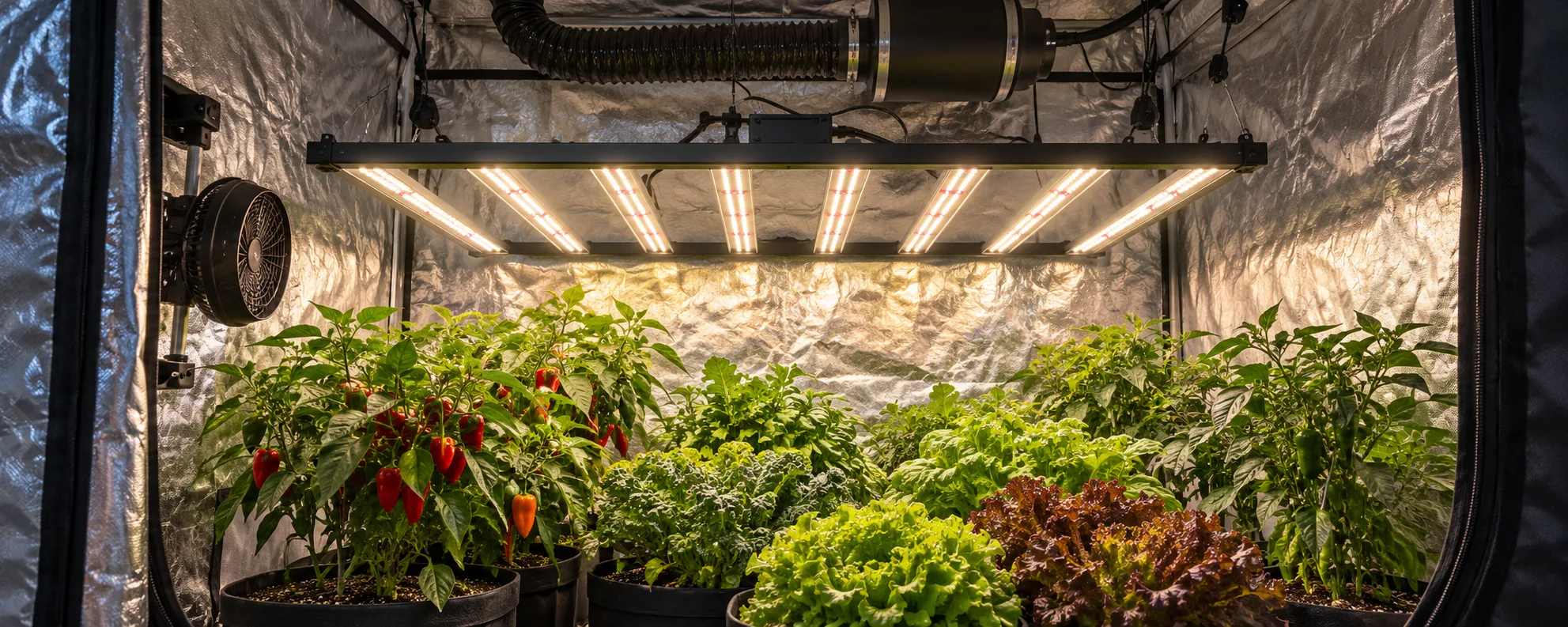
How to Choose LED Grow Lights for Commercial Indoor Growing
A commercial buyer’s framework for choosing LED grow lights: match crop PPFD and DLI targets, fixture efficacy (µmol/J), uniformity, spectrum, dimming, IP rating and total cost of ownership.
Read Guide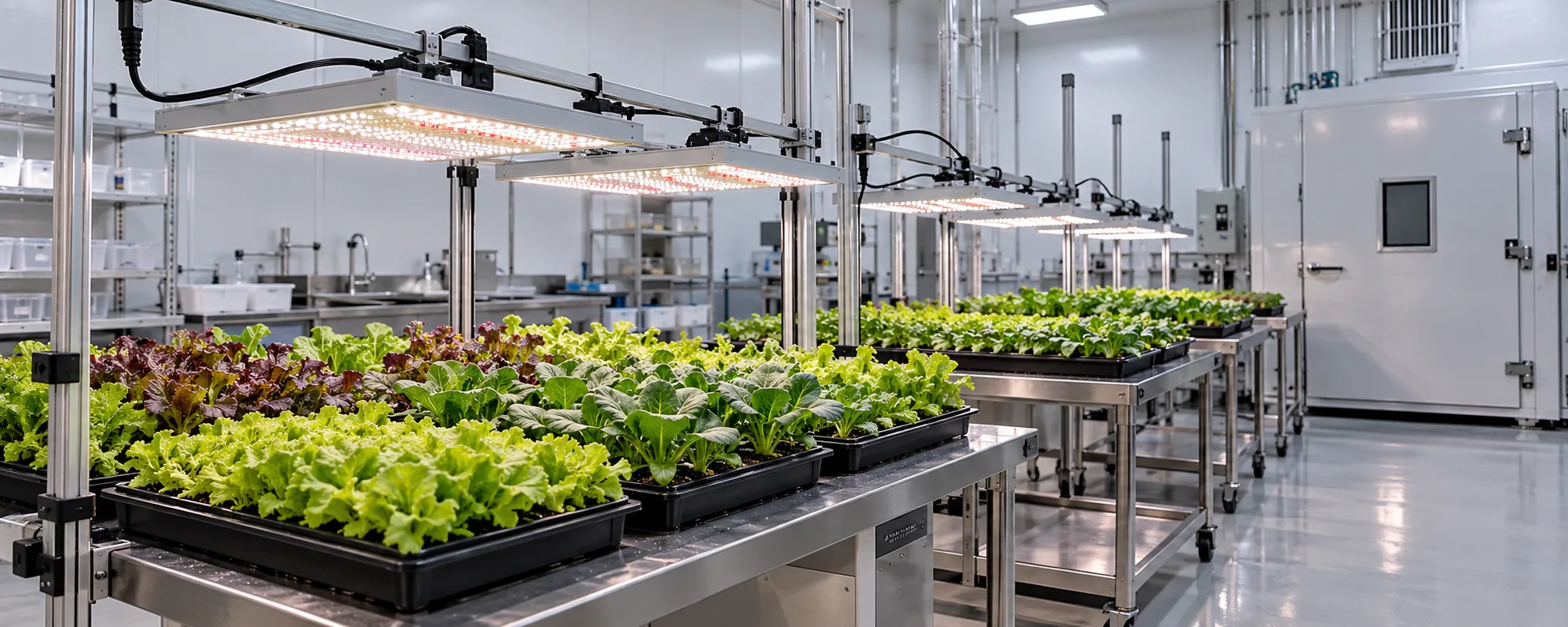
PPF vs PPFD vs PPE: What’s the Difference in LED Grow Lighting?
PPF is total photon output (µmol/s), PPFD is canopy intensity (µmol/m²/s), and PPE is efficacy (µmol/J). Learn the exact units, formulas and how to use each when specifying LED grow lights.
Read Guide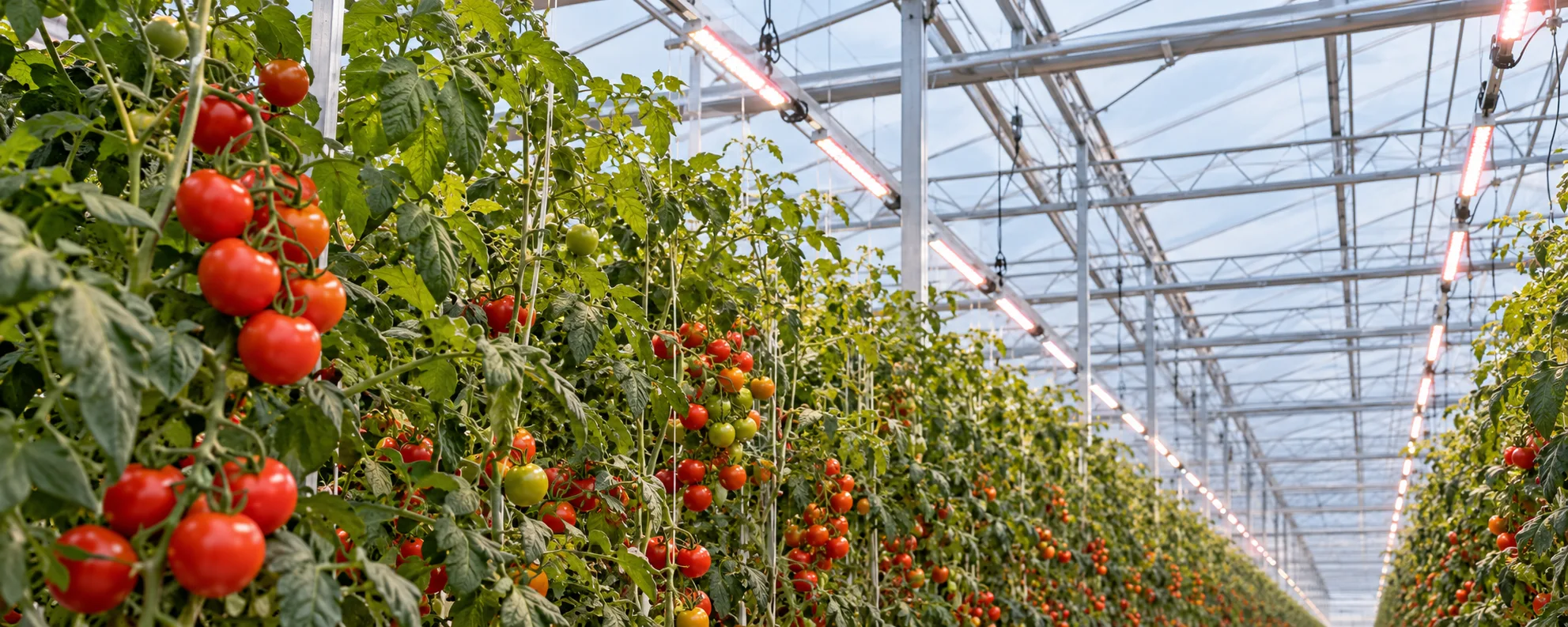
LED Grow Lighting for Commercial Greenhouses: A Complete Planning Guide
Plan supplemental LED lighting for a commercial greenhouse — calculate the DLI gap, choose top-lighting vs intercanopy, size fixtures by PPFD and PPE, and integrate dimming with your climate computer.
Read Guide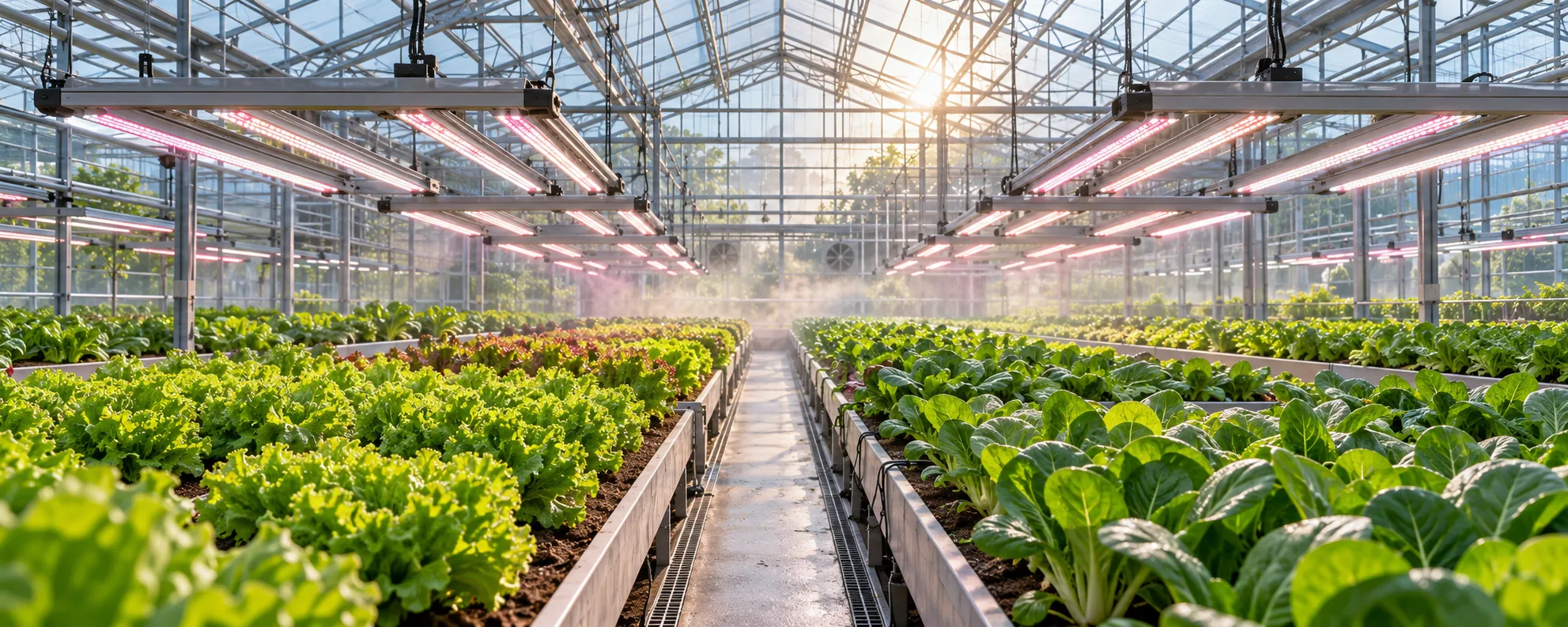
PPFD vs PPF: What Growers Need to Know
PPF and PPFD are the two most quoted numbers on a grow light spec sheet — and the two most commonly confused. Here is what each one measures and how to use them.
Read Guide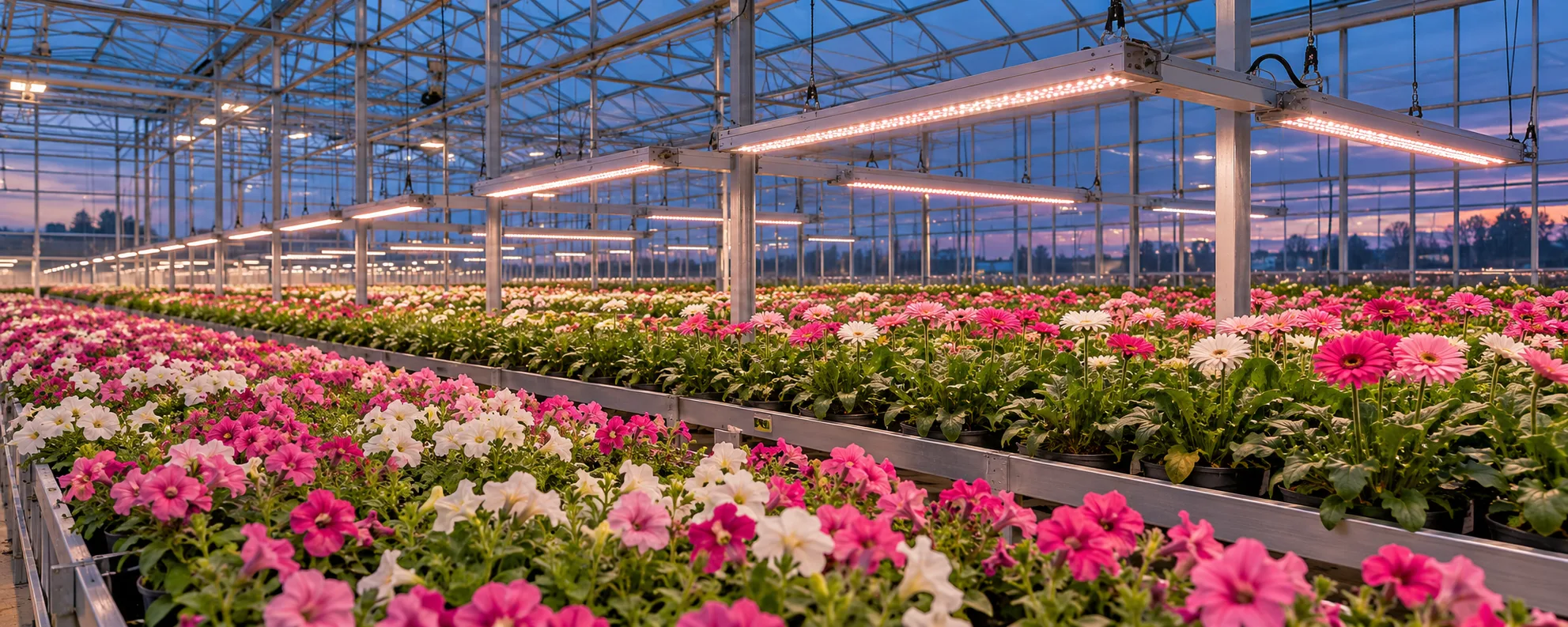
Full Spectrum vs Multi-Channel Grow Lights
Full-spectrum fixtures are the default choice for most growers. Multi-channel systems cost more but add spectral control. Which one fits your operation?
Read Guide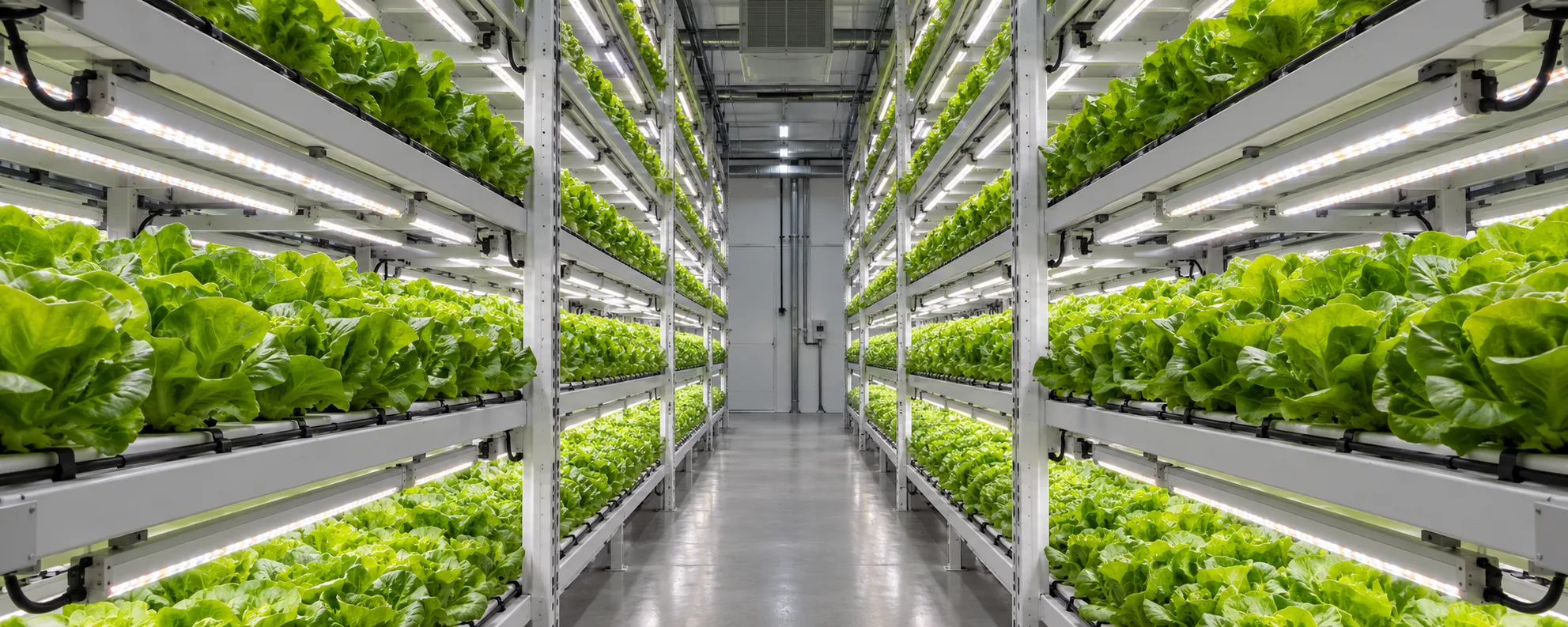
How to Choose LED Grow Lights for a Commercial Indoor Farm
A practical framework for specifying grow lights on a commercial indoor farm — from PPFD targets and uniformity to efficacy, controllability and total cost of ownership.
Read GuideProduct Categories
Explore Commercial Grow Light Solutions
Browse the fixture formats used in the layouts and calculations described above.
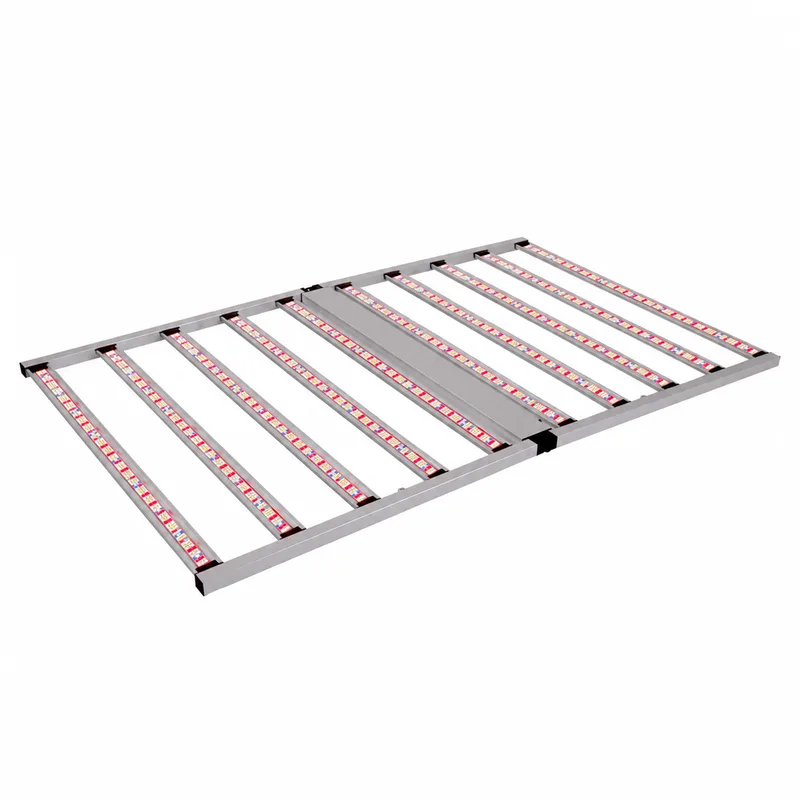
Foldable LED Bar Grow Lights
Commercial high-output lighting for indoor grow facilities.
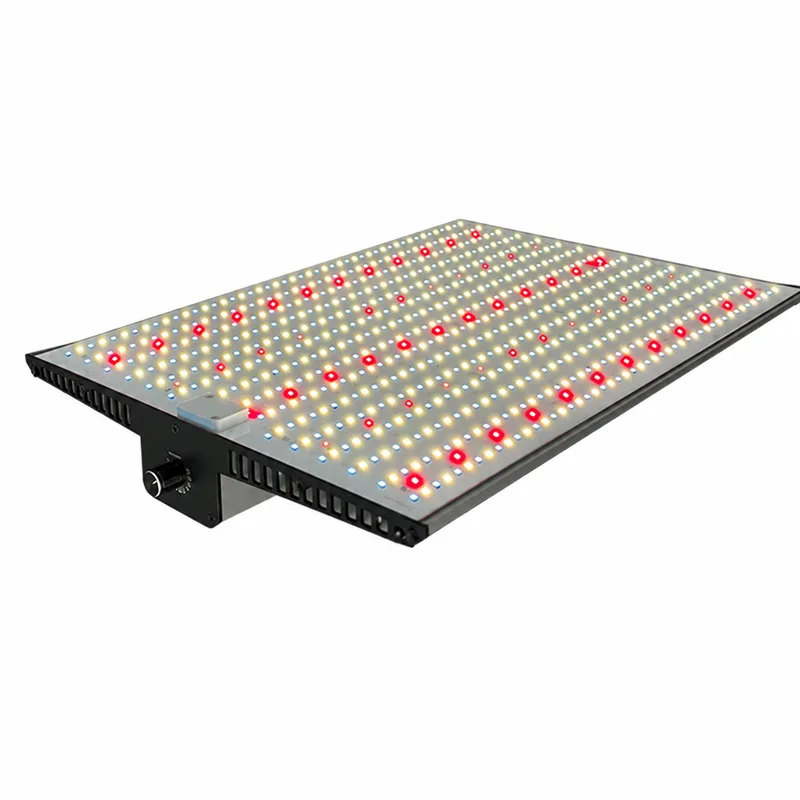
Quantum Board Grow Lights
Compact and efficient full-spectrum lighting for indoor cultivation.
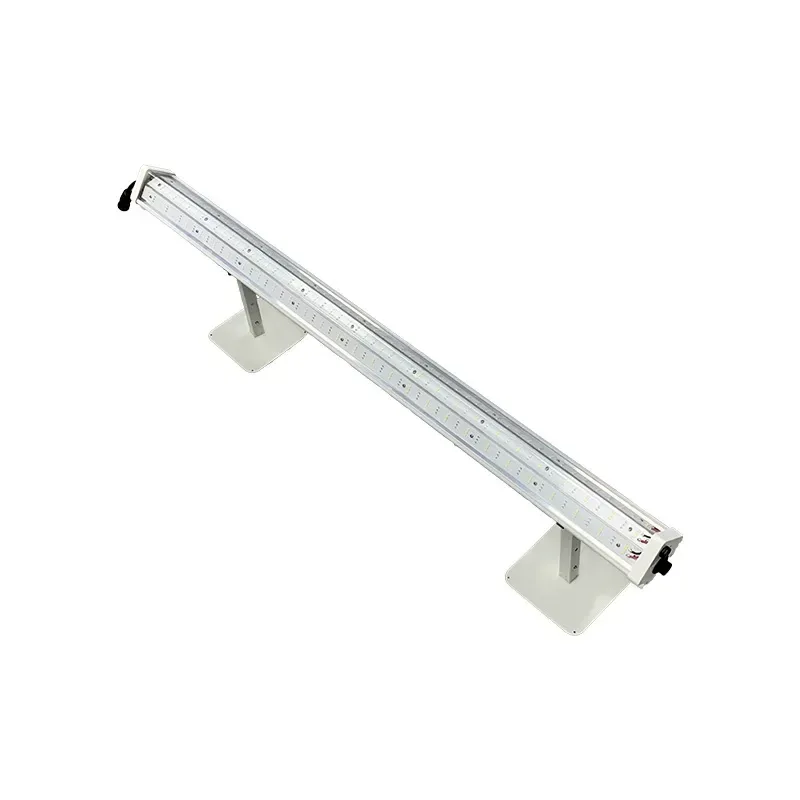
Intercanopy & Under Canopy Grow Lights
Supplemental canopy lighting for improved light distribution and lower plant development.
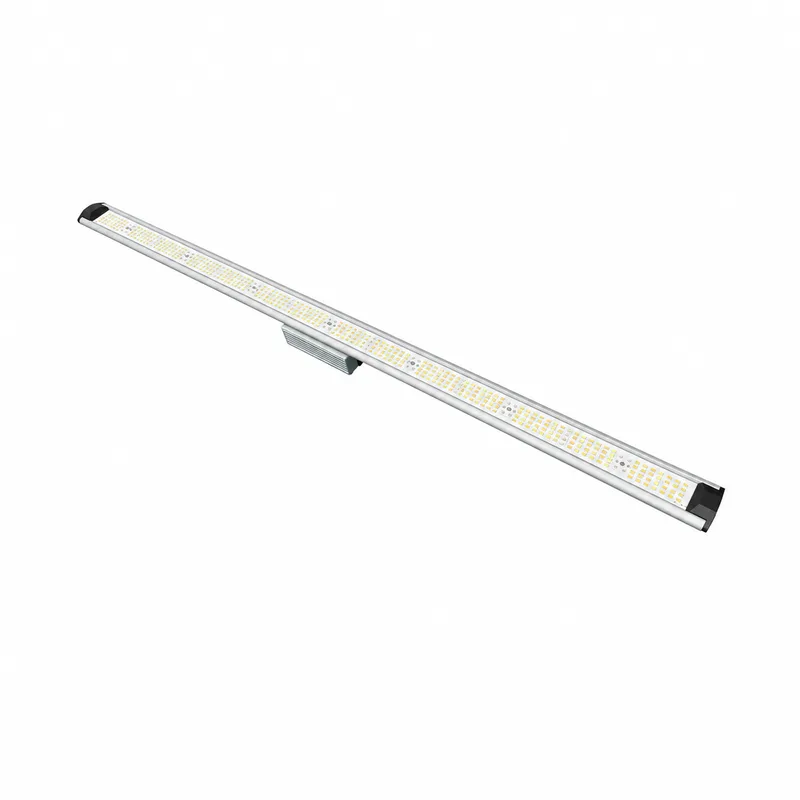
Propagation & Rack Grow Lights
Low-profile lighting for seedlings, clones and multi-layer cultivation systems.
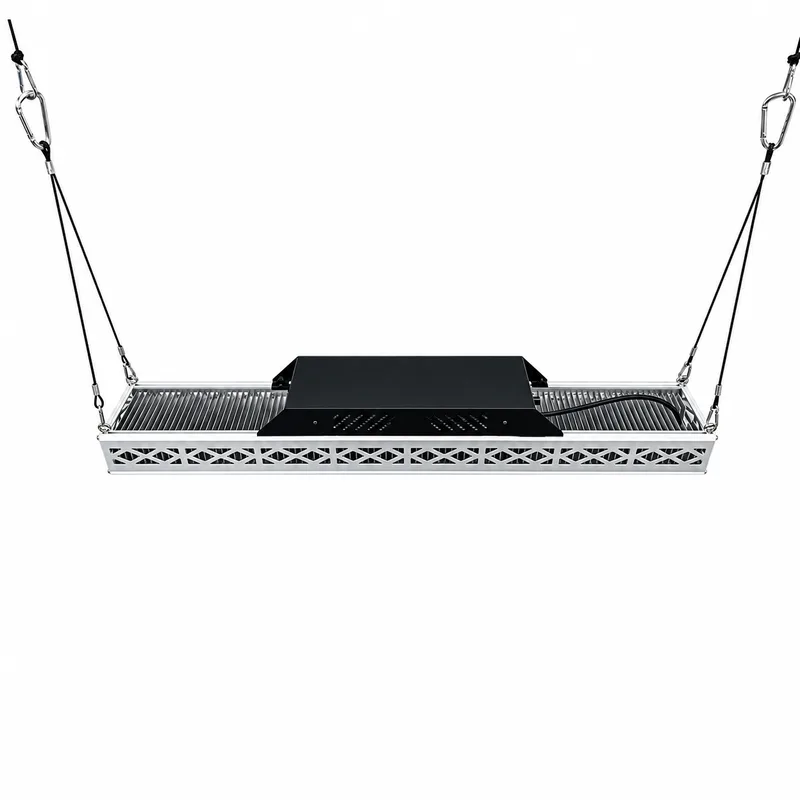
Greenhouse Top Lighting
High-output overhead supplemental lighting for commercial greenhouse production.
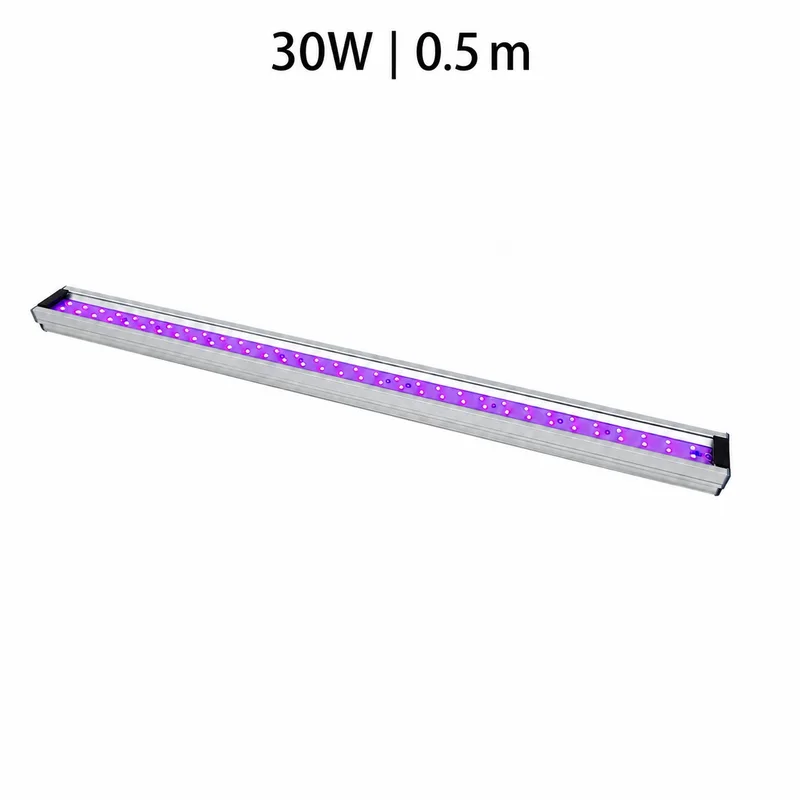
Supplemental Spectrum Grow Lights
UV, far-red, deep-red and customized spectrum solutions for specialized cultivation strategies.
Still Have Questions About Commercial LED Grow Lighting?
Tell us about your crop, cultivation area, lighting requirements or OEM project. Our team can help you evaluate suitable grow lighting solutions.