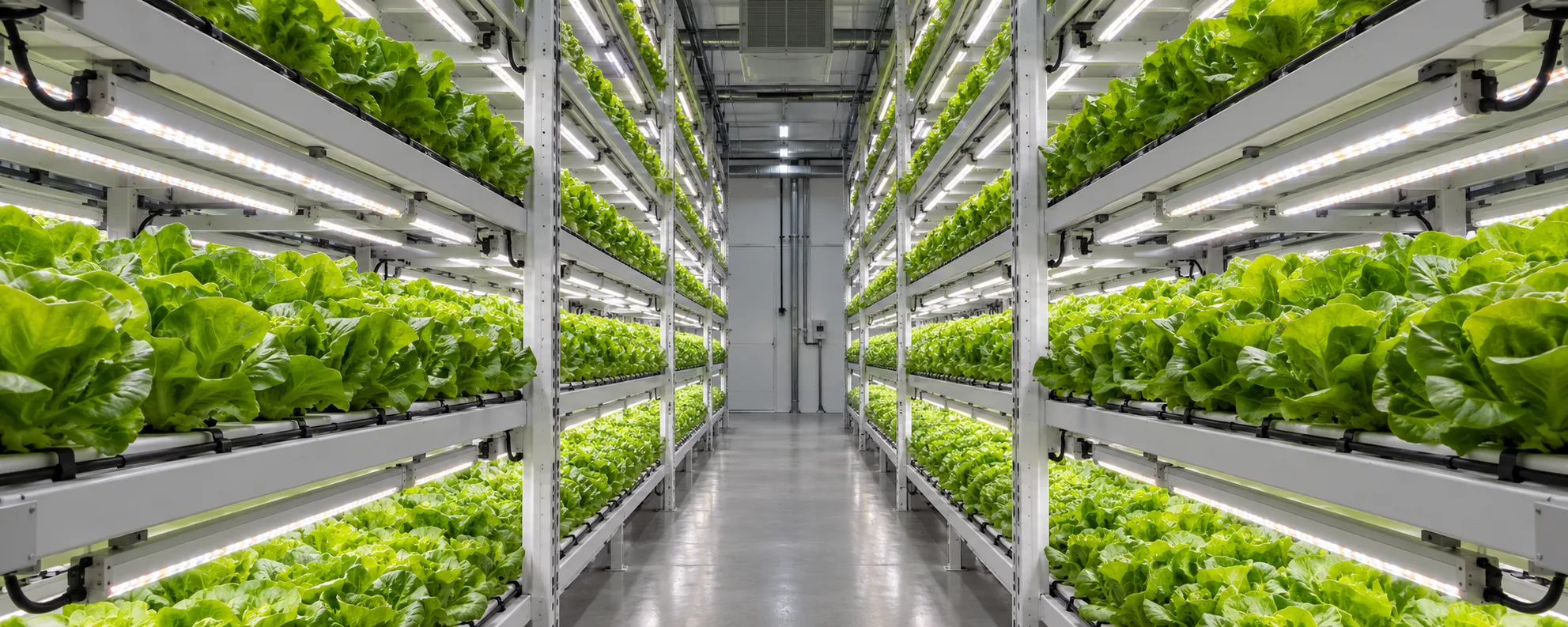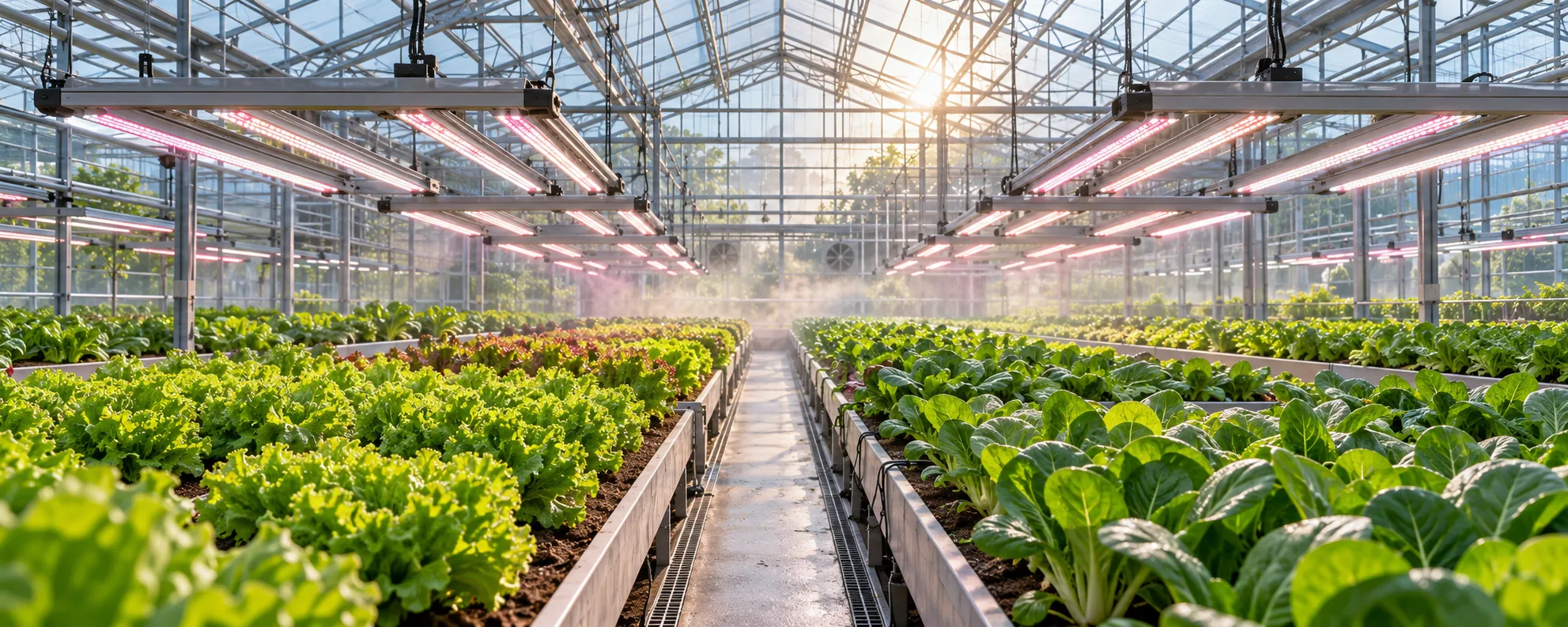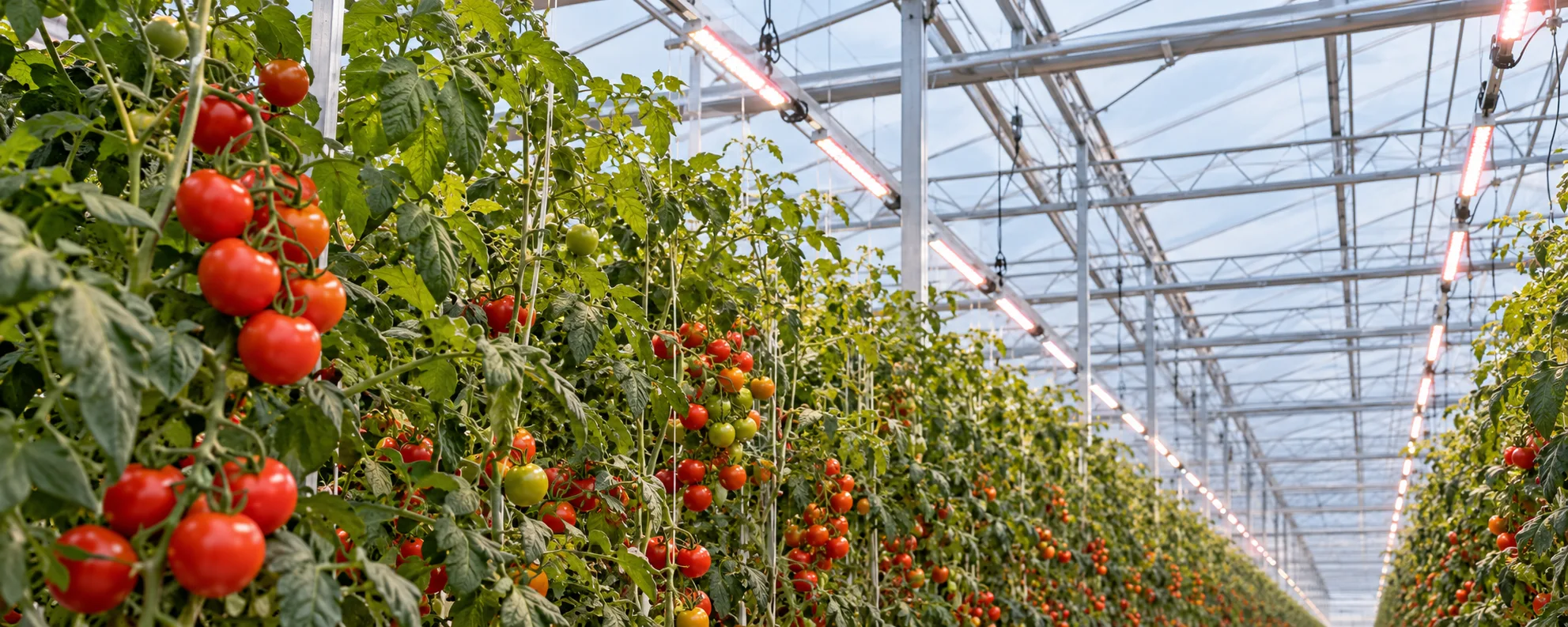
Planning LED grow lighting for a commercial greenhouse starts with the daily light integral (DLI) your crop needs minus the light your location already receives from the sun, then selecting top-lighting and/or intercanopy fixtures sized by PPFD, photon efficacy (µmol/J) and IP rating, and integrating dimming with your climate computer so the daily light dose stays steady across weather and season.
Key Takeaways
- Size LEDs from the DLI gap (crop target − natural light), not from watts.
- Top lighting raises average DLI; intercanopy fills shade in tall crops.
- Use PPFD at height, PPE (≥2.5 µmol/J) and IP54–IP65 for selection.
- DLI-based dimming saves energy on bright days and stabilizes yield.
- Account for glazing transmission (often 60–85%) in the layout.
Start From the DLI Gap, Not the Fixture
Natural light in a greenhouse varies by latitude, season, glazing and cloud cover. Your supplemental load is the crop’s target DLI minus what the sun already delivers. A greenhouse in a cloudy northern winter may receive only 8–12 mol/m²/day, so a crop needing 20 needs roughly 8–12 mol/m²/day from LEDs. Calculate the gap first; the fixture choice follows.
Convert the required daily dose into a target PPFD and photoperiod, then into fixture count. Crop DLI targets are published by university extension programs; the Michigan State University Greenhouse & Horticultural Lighting course is a standard reference for crop-specific values.
Top Lighting vs Intercanopy Lighting
Top lighting delivers light from above the canopy and is the default way to raise average DLI across the house. Intercanopy (under-canopy) bars sit between rows and push light into the shade created by upper leaves in tall crops, improving lower-canopy yield and uniformity. Many commercial operations combine both, especially for vine crops and high-density leafy greens.
When should I add intercanopy lighting?
Add intercanopy lighting when upper leaves shade the lower canopy enough to limit yield or stretch the crop — common in tomatoes, cucumbers and dense leafy-green aisles. For low, uniform crops under even top light, top lighting alone is usually sufficient. The decision is crop-height and row-spacing dependent, not a default.
| Aspect | Top lighting | Intercanopy |
|---|---|---|
| Mount position | Above the canopy | Between rows, under canopy |
| Main effect | Raises average DLI | Fills lower-canopy shade |
| Best for | Most greenhouse crops | Tall, dense crops (tomato, cucumber, leafy aisles) |
| Typical use | Default supplemental layer | Add-on for uniformity in high canopies |
- Top lighting: raises average DLI, suits most greenhouse crops.
- Intercanopy: fills shade in tall, dense canopies.
- Combined: maximizes uniformity in high-value, tall crops.
Choose Fixtures by Power, PPE and IP Rating
For greenhouses, photon efficacy and ingress protection matter as much as raw power. The DLC Horticultural QPL requires at least 2.5 µmol/J (V4.0); LUMAGROW’s 250 W and 400 W greenhouse top lights are specified at 3.0 and 3.3 µmol/J, exceeding that threshold. Greenhouses are humid and chemically aggressive, so rate the IP class and housing honestly — IP65 is preferred, with IP54 acceptable on some models.
| Model | Power options | PPE | Spectrum highlights | IP | Cert | Notes |
|---|---|---|---|---|---|---|
| 60W Greenhouse Top | 60–180W | — | Full spectrum | IP65 | CE | 0.6–1.2 m bars, modular |
| 250W Greenhouse Top | 250–320W | 3.0 µmol/J | White + red | IP65 | CE | 1200 mm bar |
| 400W Greenhouse Top | 400–1200W | 3.3 µmol/J | Red LED | IP65 | CE-EMC | Peak PPFD 650–717 µmol/m²/s |
| 600W Greenhouse Top | 600W | — | 3000K+5000K+460+660+730nm | IP54 | CE | 1000 mm, RJ45 |
| 800W Greenhouse Top | 800W | — | White+Red+Blue+IR+UV | IP54 | — | Samsung diodes, RJ12 |
For high-output greenhouse rows, the 400W greenhouse top light is a strong reference point with stated 3.3 µmol/J and manufacturer PPFD data; the 60W greenhouse top light suits modular, lower-profile installations. Browse the full greenhouse top lighting category for the complete range.
Supplemental Lighting Control and Climate Integration
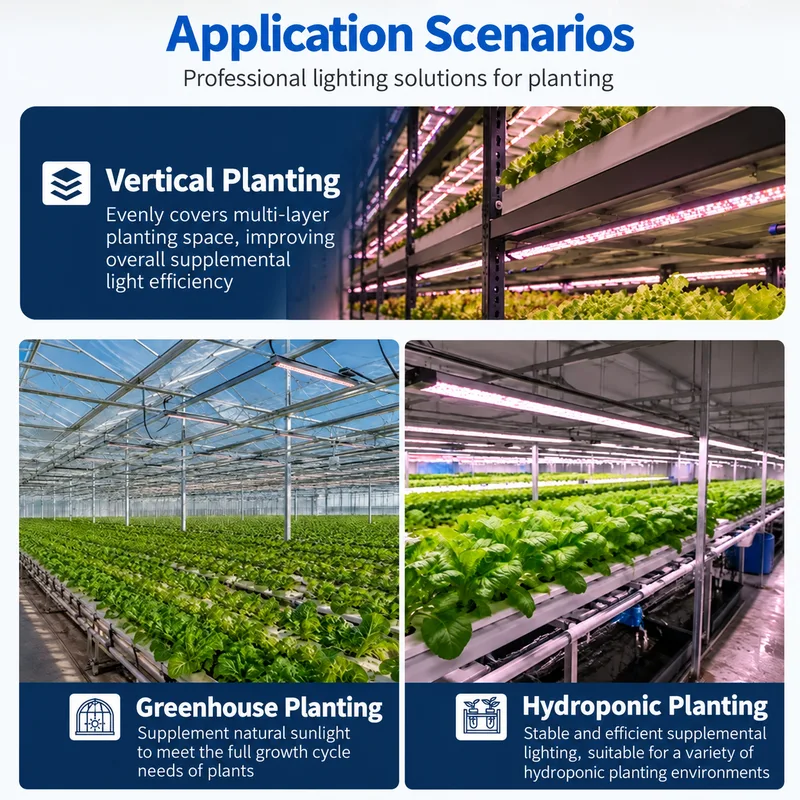
Professional greenhouse lighting dims with outdoor light so the daily light integral stays on target without wasting energy on bright days. Fixtures support 0–10V or PWM dimming and connect to controllers that read a light sensor and the climate computer. This protects crop morphology, stabilizes yield across weather, and cuts electricity cost versus fixed-output operation.
- DLI-based dimming driven by a rooftop light sensor.
- 0–10V / PWM control interface as the commercial baseline.
- Integration with the greenhouse climate computer.
- Per-zone scheduling for mixed crops under one roof.
Mounting, Uniformity and Glazing Loss
Glazing transmits only part of the light — often 60–85% depending on material, age and condensation — so the layout must compensate for that loss. Ask for a PPFD distribution map across your house geometry at the proposed mounting height and spacing, and confirm fixture spacing matches your bench and row layout. Uniformity across the canopy is what makes the harvest consistent and gradeable.
Worked Example: Sizing a 1,000 m² Greenhouse
To make the method concrete, take a 1,000 m² greenhouse in a location that delivers about 10 mol/m²/day from the sun in winter, growing a crop with a 20 mol/m²/day target. The LED gap is 10 mol/m²/day. Over a 14-hour photoperiod, the required average PPFD is 10 ÷ (14 × 0.0036) ≈ 198 µmol/m²/s across the canopy. If each fixture delivers about 600 µmol/m²/s at its spacing over roughly 3 m² of bench, one fixture covers ~3 m² at that PPFD, pointing to roughly 330 fixtures — then adjusted by measured uniformity and glazing loss. This is an illustrative calculation; always confirm with a supplier PPFD layout map.
Common Planning Mistakes
- Sizing LEDs from watts instead of the DLI gap.
- Ignoring glazing transmission and condensation loss.
- Skipping DLI-based dimming and over-lighting on sunny days.
- Under-rating IP for a humid, chemical-rich greenhouse.
- Using lm/W instead of µmol/J to judge fixture efficiency.
- No PPFD layout map for the actual house geometry.
Frequently Asked Questions
How much supplemental light does a greenhouse need?+
It equals your crop’s target DLI minus the sunlight your location delivers. A greenhouse in a cloudy northern winter may receive only 8–12 mol/m²/day, so a crop needing 20 needs roughly 8–12 mol/m²/day from LEDs. Calculate the gap first, then size fixtures by PPFD and photoperiod.
What DLI do greenhouse crops need?+
Leafy greens and herbs typically target 12–17 mol/m²/day, seedlings 10–12, and fruiting crops such as tomato and pepper 20–30+. Targets vary by species, cultivar and climate; university extension programs such as the MSU Greenhouse & Horticultural Lighting course publish crop-specific guidance.
Should I use top lighting or intercanopy lighting?+
Top lighting delivers light from above and is the default for raising average DLI. Intercanopy (under-canopy) bars fill shade created by upper leaves in tall crops, improving lower-canopy yield. Many operations combine both; the choice depends on crop height, row spacing and canopy density.
Can LED greenhouse lights handle humidity and condensation?+
They must. Greenhouse fixtures should carry at least IP54, with IP65 preferred, plus corrosion-resistant housings and conformal-coated drivers for sulfur vapor and agricultural chemicals. LUMAGROW greenhouse top lights are rated IP54–IP65 depending on model; confirm the rating for your humidity level.
How do I calculate the number of fixtures?+
Estimate the DLI gap, convert it to required PPFD, then divide by the PPFD each fixture delivers at your mounting height and spacing. Ask the supplier for a PPFD layout map for your house dimensions. Avoid guessing from watts — PPFD at height is what the crop sees.
Do greenhouse LEDs integrate with climate control?+
Yes, in professional systems. Fixtures support 0–10V or PWM dimming and connect to controllers that dim based on outdoor light (DLI-based control) and the climate computer. This saves energy on bright days and keeps the daily light integral steady across weather and season.
What PPE should greenhouse fixtures have?+
The DLC Horticultural QPL requires at least 2.5 µmol/J (V4.0). LUMAGROW’s 250 W and 400 W greenhouse top lights are specified at 3.0 and 3.3 µmol/J, exceeding the threshold. Higher efficacy directly reduces the electricity cost of reaching your DLI target.
Are LUMAGROW greenhouse lights certified?+
Certification depends on the model and target market; options include CE, ETL, UL, DLC and FCC/RoHS, confirmed per model during quotation. Our factory operates under ISO 9001 quality management, and we provide LM-79 photometric reports and warranty terms (commonly 5 years) with commercial orders.
Conclusion
A commercial greenhouse lighting plan is built backwards from the DLI gap, then expressed as top-lighting and/or intercanopy fixtures chosen by PPFD, PPE and IP rating, with dimming tied to the climate computer. Start from crop and location, verify with a PPFD layout map, and judge efficacy on µmol/J. See our indoor grow light selection guide and the PPF/PPFD/PPE explainer for the underlying metrics, and visit our greenhouse industry page for more context.
References
- Michigan State University Extension — Greenhouse & Horticultural Lighting — crop DLI targets and supplemental lighting principles.
- DesignLights Consortium — Horticultural Technical Requirements V4.0 — current PPE threshold ≥2.5 µmol/J.
- Utah State University (Bugbee & Nelson) — Economic Analysis of Greenhouse Lighting — PPF, PPE and PAR (400–700 nm) definitions.
- DesignLights Consortium — Horticultural Technical Requirements V3.0 (PDF) — LM-79 testing methodology for horticultural lighting.
Planning a Commercial Greenhouse Lighting Project?
Share your house dimensions, crop, location and target DLI. Our team returns a supplemental-lighting plan with fixture counts, PPFD maps and a wholesale quotation.
Get a Grow Light Solution