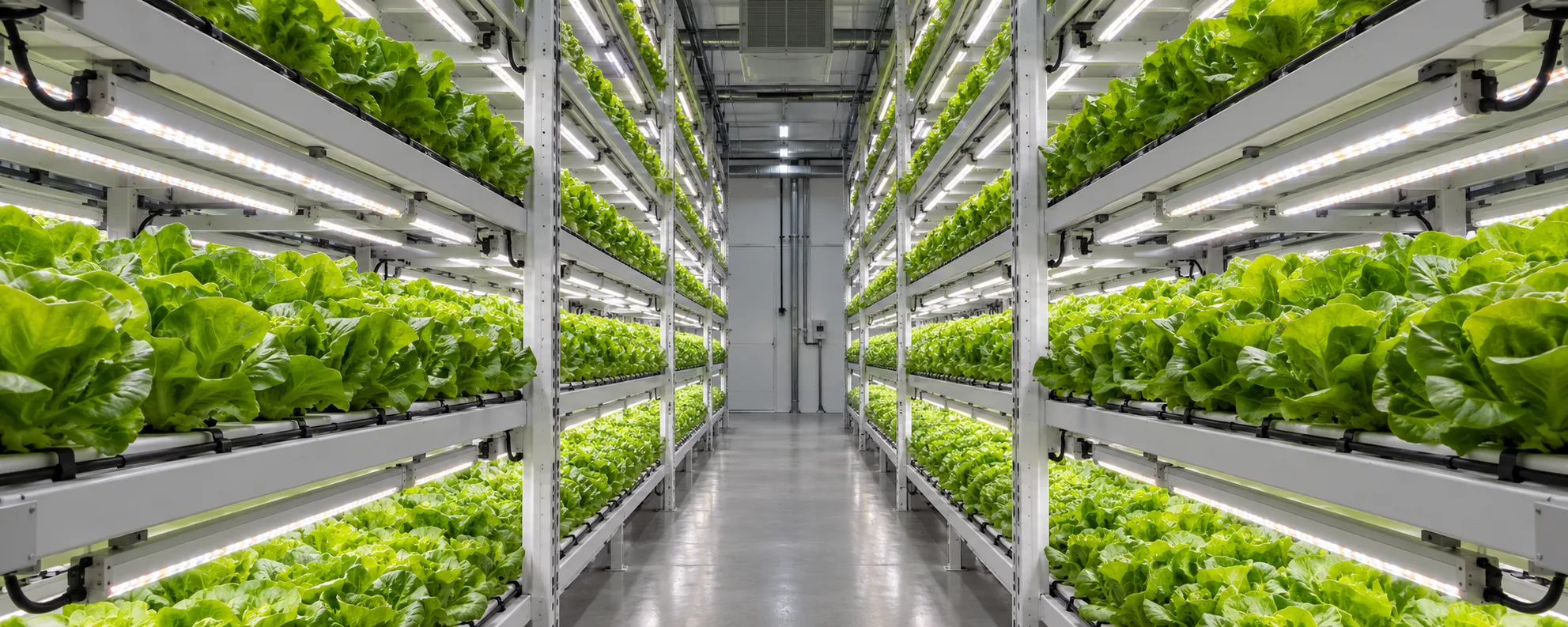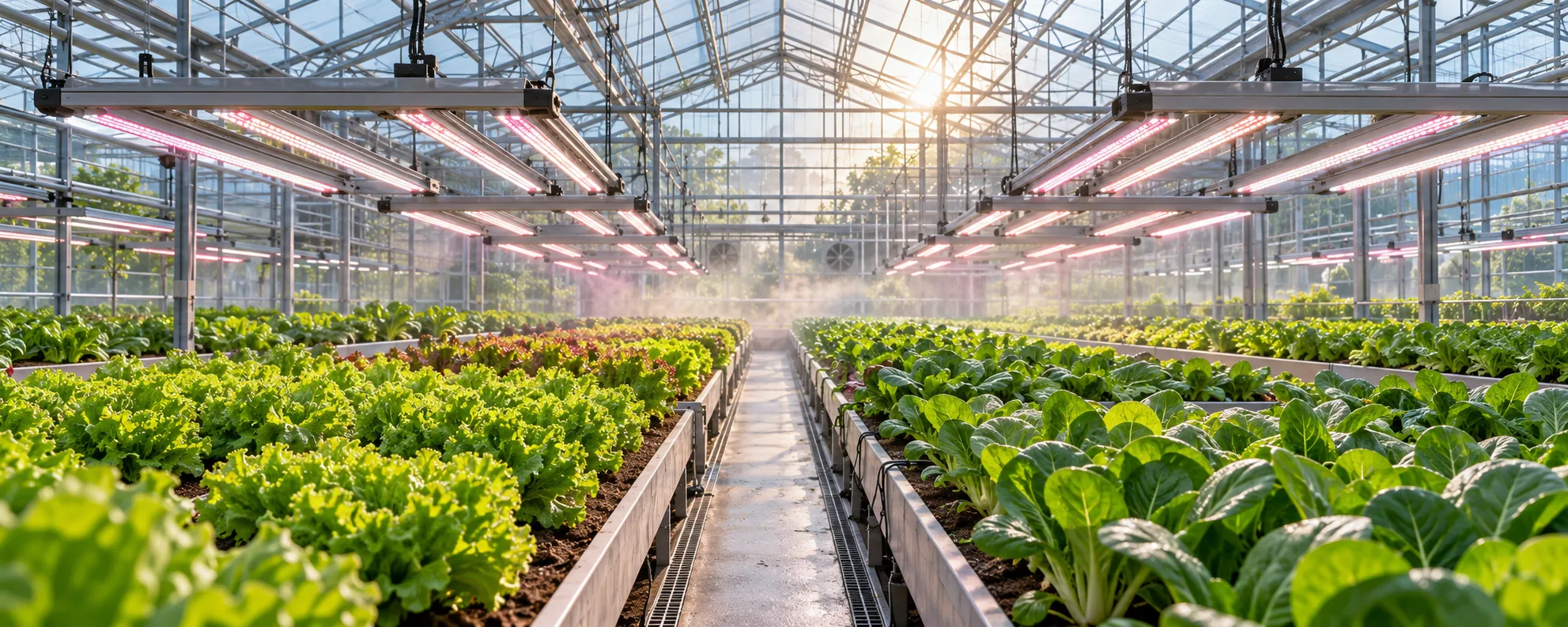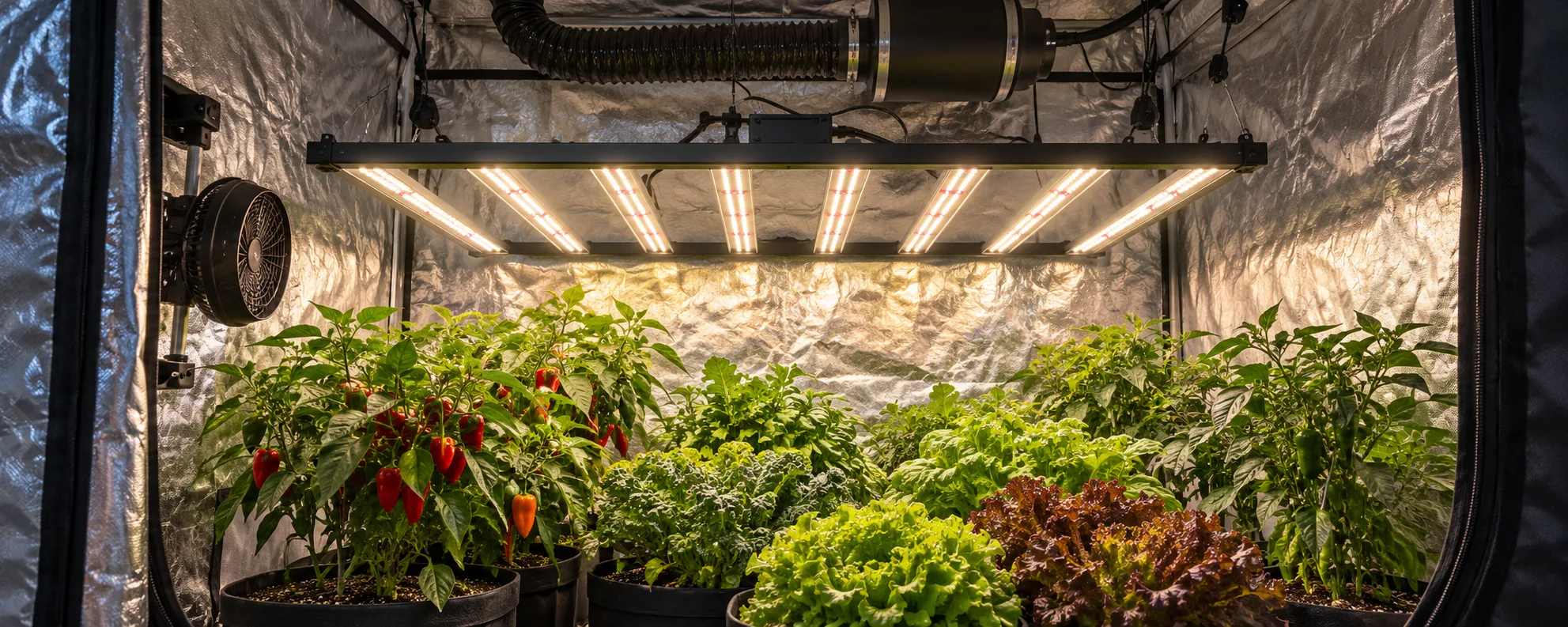
Choosing LED grow lights for commercial indoor growing means matching each crop’s target PPFD and daily light integral to fixture efficacy, spectrum, PPFD uniformity, dimming control and the room’s installation conditions — then selecting hardware whose total cost of ownership, not just purchase price, fits a multi-year production cycle.
Key Takeaways
- Specify light from the crop target (PPFD + DLI), never from watts alone.
- Efficacy (PPE, µmol/J) drives energy cost; DLC V4.0 requires ≥2.5 µmol/J for listed fixtures.
- Uniformity and a PPFD layout map matter more than a headline PPF number.
- Rate the environment: IP54–IP65, isolated drivers, 50,000 h life, 5-year warranty.
- Total cost of ownership — energy, maintenance, crop consistency — wins over the cheapest fixture.
Start With the Crop’s Light Target, Not the Fixture
Before comparing products, define what your crop needs at the canopy. Most leafy greens and herbs thrive at 200–300 µmol/m²/s PPFD, while fruiting and flowering crops such as tomatoes, peppers and cannabis need 600–900 µmol/m²/s to reach full yield. Translate that into a daily light integral (DLI) and work backwards to the number and type of fixtures. A supplier who speaks in PPFD, uniformity and coverage maps is selling a solution; one who only quotes watts is selling hardware.
| Crop group | Target PPFD (µmol/m²/s) | Target DLI (mol/m²/day) |
|---|---|---|
| Leafy greens & herbs | 200–300 | 12–17 |
| Seedlings & transplants | 100–200 | 10–12 |
| Floriculture & ornamentals | 250–450 | 12–20 |
| Fruiting & flowering (tomato, pepper, cannabis) | 600–900 | 20–40 |
DLI connects instantaneous PPFD to the full light period. The standard formula is DLI = PPFD × Photoperiod × 0.0036, with PPFD in µmol/m²/s, photoperiod in hours/day, and the result in mol/m²/day. A crop held at 500 µmol/m²/s for 16 hours delivers 28.8 mol/m²/day — a useful planning number, not a measured result.
Match Fixture Efficacy to Your Energy Budget
Photon efficacy (PPE), measured in µmol/J, tells you how many usable photosynthetically active photons a fixture produces per watt of electrical input. On a commercial farm, lighting is usually the largest single electricity line, so small efficacy differences compound across thousands of operating hours per year. The DesignLights Consortium Horticultural Qualified Products List requires at least 2.5 µmol/J under its V4.0 technical requirements (2.3 under V3.0). A widely cited Utah State University study (Bugbee & Nelson) measured the best LED and double-ended HPS fixtures at about 1.66–1.70 µmol/J in the mid-2000s; modern high-output fixtures such as LUMAGROW’s 250 W and 400 W greenhouse lights are specified at 3.0 and 3.3 µmol/J.
Always ask for efficacy measured at the drive current the fixture will actually run, from an ANSI/IES LM-79 report, not a best-case marketing number. Efficacy and PPF together let you convert watts into photons and then into operating cost.
Uniformity and Coverage Decide Crop Consistency
Average PPFD means little if half the room is under-lit. Look for fixtures with controlled beam optics and request a lighting layout showing PPFD distribution across your exact room geometry. Uniformity drives crop consistency — and consistency is what makes a commercial harvest saleable and gradeable. A 10% drop in uniformity often costs more in rejected product than a slightly cheaper fixture saves up front.
Spectrum: Full Spectrum or Tunable?
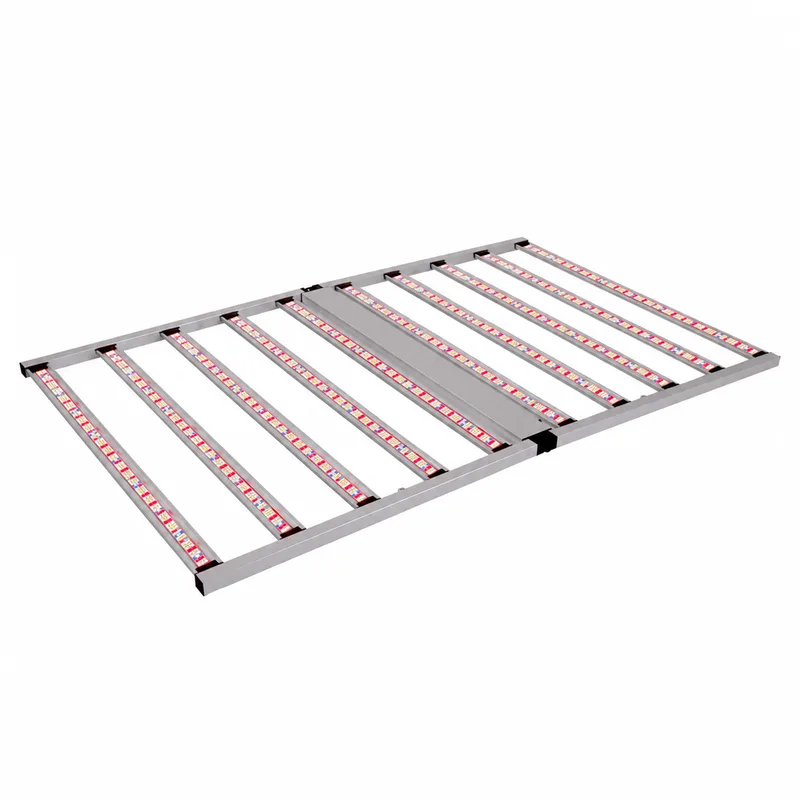
A full-spectrum fixture combines white LEDs with deep-red and often blue diodes to cover the whole crop cycle with a fixed, factory-set recipe — efficient, simple and predictable. A multi-channel fixture splits the spectrum into separately driven bands (deep red, far-red, blue, white) that you can tune per stage or cultivar. Most commercial rooms do well on full spectrum; spectral control pays off in research, breeding trials and facilities running mixed crops.
Do I need far-red?
Far-red (700–800 nm) is outside the 400–700 nm PAR window but influences stem extension and flowering in many crops. Michigan State University Extension notes that a spectrum rich in red (600–700 nm) inhibits short-day flowering, while adding far-red (700–800 nm) can accelerate long-day flowering. It is a production lever, not a baseline requirement — decide based on your crop, not on the spec sheet.
- Full spectrum: single-crop commercial rooms, greenhouses and operations prioritizing cost per µmol.
- Multi-channel: cannabis production, research programs, breeding trials and mixed-crop facilities.
- Hybrid: full-spectrum base lighting plus a few trial fixtures to validate recipes before scaling.
Control, Dimming and Automation
Commercial facilities need scheduled dimming, photoperiod control and often integration with environmental systems. Confirm the control interface — 0–10V, PWM, DALI or proprietary — and how many fixtures a single controller channel can drive. Dimming also lets you follow a DLI target across the day instead of running flat-out, which saves energy and protects crop morphology.
- 0–10V or PWM dimming as the commercial baseline.
- Controller channel capacity and daisy-chain limits.
- Photoperiod scheduling and DLI-based dimming.
- Integration path with your existing environmental controller.
Environmental Rating and Service Life
Indoor farms are wet, humid and regularly sanitized. Fixtures should carry at least IP54, with IP65 preferred near misting and irrigation, plus washable housings and isolated drivers. Ask about warranty terms, spare-part availability and expected driver replacement intervals — five-year warranties are standard among serious commercial manufacturers.
| Requirement | Typical commercial spec | Why it matters |
|---|---|---|
| Ingress protection | IP54–IP65 | Resists humidity, misting and cleaning |
| Driver | Isolated, conformal-coated | Survives wet, corrosive environments |
| Certification | ETL / UL / CE / DLC / FCC | Market access and safety compliance |
| Lifespan | ≥ 50,000 hours | Multi-year continuous operation |
| Warranty | ≥ 5 years | Protects total cost of ownership |
Apply the Framework to Real Fixtures
The table below maps representative LUMAGROW foldable LED bar grow lights and quantum board fixtures to their documented specifications. Efficacy is shown only where the catalog states it; for other models request the LM-79 report, and use the DLC V4.0 ≥2.5 µmol/J line as your minimum.
| Model | Power | Input | Dimming | IP | Cert | Best for |
|---|---|---|---|---|---|---|
| 240W Foldable LED Bar | 240–500W | 110–277V | 0–10V, PWM | IP54 | CE | Small rooms, propagation |
| 720W Foldable LED Bar | 720W | 100–277V | 0–10V, smart panel | IP54 | ETL, UL, CE | Mid-size rooms |
| 800W Foldable LED Bar | 800–1200W | 110–277V | Knob | IP54 | CE | High-bay rooms |
| 1500W Foldable LED Bar | 1200–1500W | 110–277V | Knob | IP54 | CE | Large flowering rooms |
| 100W Quantum Board | 100–480W | 100–277V | 0–10V, Wi-Fi | IP65 | CE | R&D, clones, shelving |
For indoor flowering rooms at scale, the 800W foldable LED bar is a common starting point; for research and propagation benches, the IP65 100W quantum board suits tighter spaces. Always confirm PPF, PPFD at height and PPE from the model datasheet before committing volume.
Common Mistakes When Specifying Indoor Grow Lights
- Buying on watts instead of PPF, PPFD at height and PPE.
- Trusting a single headline PPF number without a uniformity map.
- Ignoring IP rating and driver isolation for wet rooms.
- Confusing luminous efficacy (lm/W) with photon efficacy (µmol/J).
- Skipping a lighting layout for the actual room geometry.
- Choosing the cheapest fixture over total cost of ownership.
Frequently Asked Questions
What PPFD do leafy greens need compared with flowering crops?+
Leafy greens and herbs generally perform well at 200–300 µmol/m²/s canopy PPFD, while fruiting and flowering crops such as tomatoes, peppers and cannabis need 600–900 µmol/m²/s to reach full yield. The right number depends on the crop, cultivar and growth stage; always start from the target rather than the fixture wattage.
How many fixtures do I need for my room?+
Fixture count comes from your target PPFD, room area and the PPFD each fixture delivers at your mounting height. A supplier should return a layout map showing PPFD distribution across your exact room. As an illustrative step, PPF (µmol/s) divided by coverage area gives average PPFD; then adjust for optics and overlap.
Is higher wattage always better?+
No. Wattage is input power, not light delivered to plants. A 400 W fixture at 3.3 µmol/J outputs about 1320 µmol/s, while a less efficient 600 W unit may deliver less usable light and more heat. Compare PPF and PPFD at your mounting height, and PPE (µmol/J) for energy cost — not watts alone.
What does IP65 mean for an indoor farm?+
IP65 means the fixture is protected against dust and low-pressure water jets, important in humid, sanitized grow rooms. Indoor farms should specify at least IP54, with IP65 preferred near misting and irrigation. Wet environments also need isolated drivers and corrosion-resistant housings for a multi-year service life.
Should I choose full-spectrum or multi-channel fixtures?+
Full-spectrum fixtures are simpler and cost less per µmol, and suit single-crop rooms. Multi-channel fixtures let you tune red, far-red, blue and white bands per stage or cultivar, which pays off in research, breeding and mixed-crop facilities. Many operations standardize on full spectrum and keep a few trial fixtures.
Can LUMAGROW provide a lighting layout for my room?+
Yes. Send your room dimensions, crop plan, mounting height and target PPFD, and our team returns a fixture layout with expected PPFD distribution plus a wholesale quotation. We also support OEM branding, custom spectra and private-label packaging for distributors and brands.
Do you support OEM and private-label production?+
Yes. LUMAGROW manufactures in-house and offers OEM/ODM services including custom logo, housing, spectrum, driver and packaging, with MOQ discussed per project. Samples are available for testing before bulk production, and certification scope (ETL, DLC, CE, FCC, RoHS) is confirmed per model.
Conclusion
Selecting LED grow lights for a commercial indoor farm is an engineering decision, not a shopping decision. Anchor everything to the crop’s PPFD and DLI targets, verify efficacy and uniformity with real reports, rate the environment honestly, and judge the fixture on total cost of ownership. See our guide to PPF, PPFD and PPE for the underlying metrics, or the commercial greenhouse lighting guide for greenhouse-specific planning. More background is on our indoor growing industry page.
References
- Michigan State University Extension — Greenhouse & Horticultural Lighting — university course on DLI, PPFD and supplemental lighting by Erik Runkle and Heidi Lindberg.
- DesignLights Consortium — Horticultural Technical Requirements V4.0 — sets the current PPE threshold at ≥2.5 µmol/J for listed horticultural fixtures.
- Utah State University (Bugbee & Nelson) — Economic Analysis of Greenhouse Lighting — foundational definition of PPF, PPE and PAR (400–700 nm).
- Utah State University (Cope & Bugbee) — Blue and green light in plant photosynthesis — relative quantum efficiency across wavelengths.
Need Help Selecting Commercial LED Grow Lights?
Send us your room dimensions, crop plan and target PPFD. Our team returns a fixture layout with expected PPFD distribution and a wholesale quotation with OEM and ODM options.
Get a Grow Light Solution