LUMAGROW

Industry Application

LED Grow Lighting for Greenhouse

Greenhouse LED lighting should be designed around the difference between available natural daylight and the crop’s target daily light integral, rather than fixture wattage alone. The design question is how many moles per square metre per day the structure delivers in the weakest month, how much the crop needs, and how the gap is closed with the fewest installed watts.

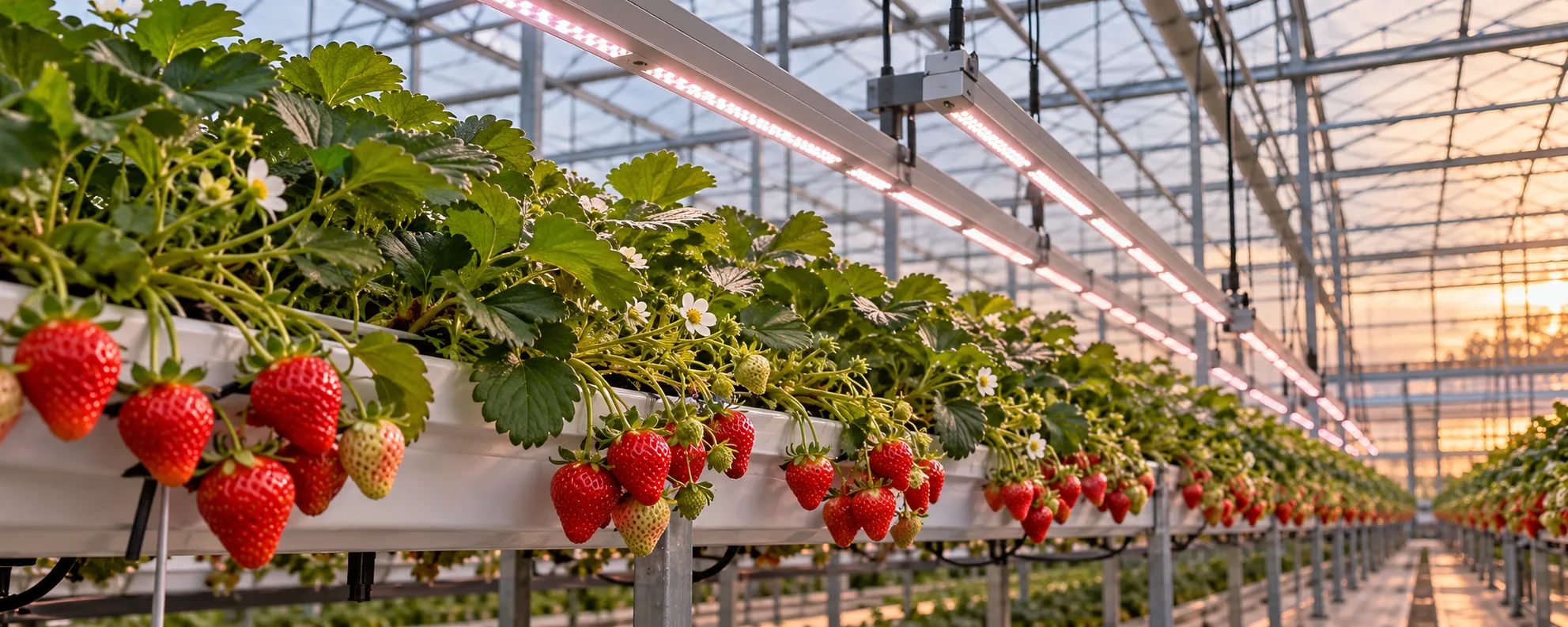
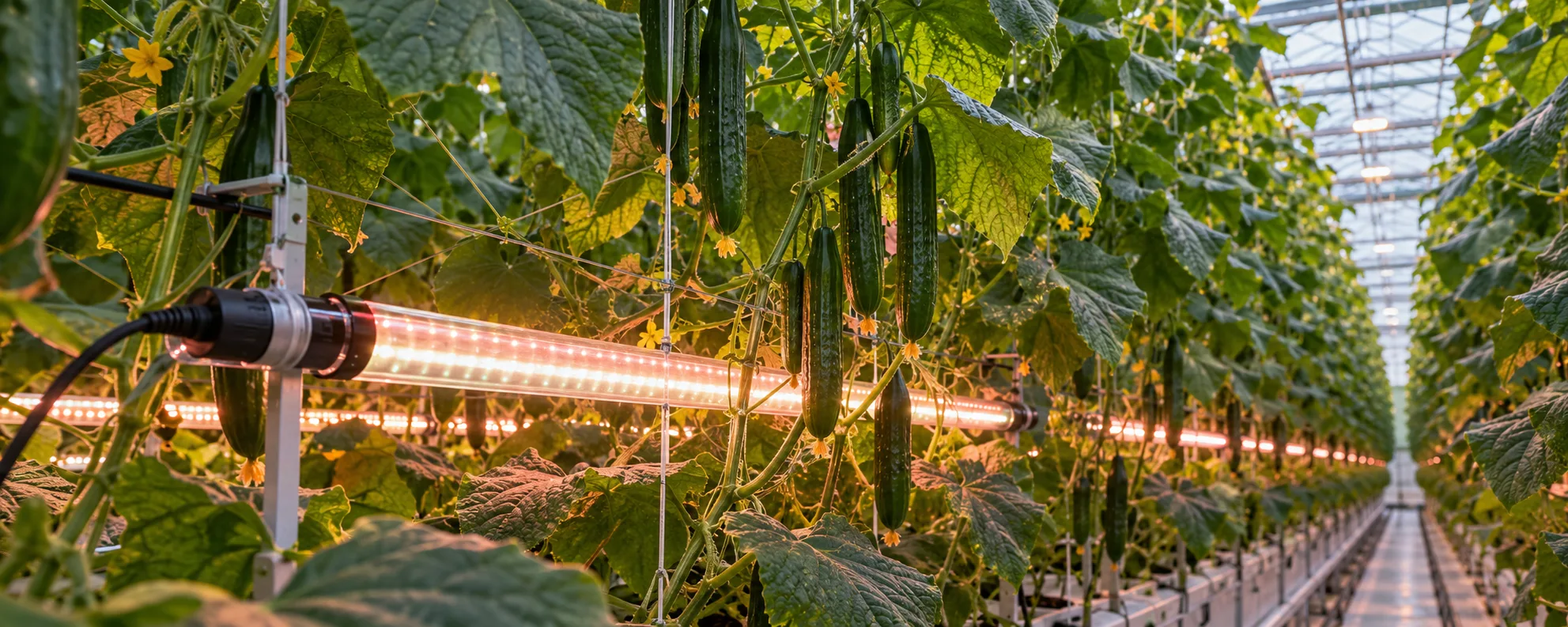
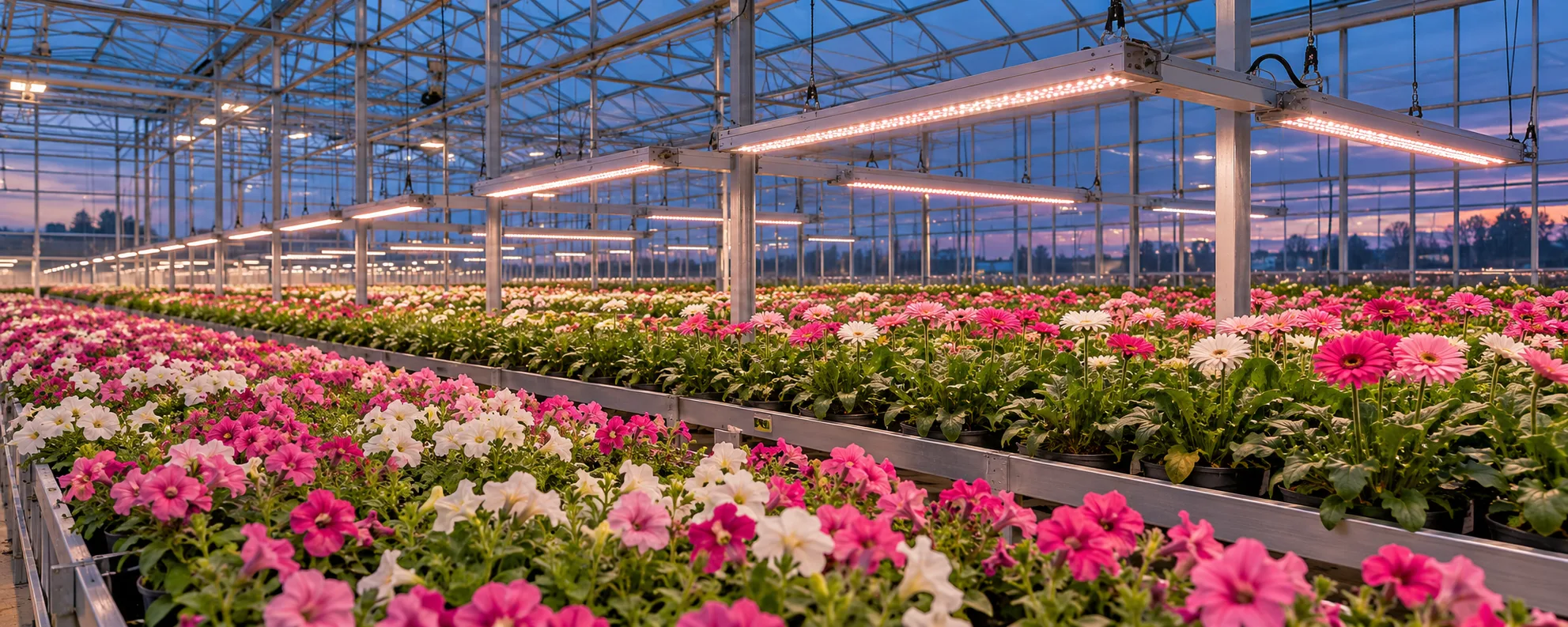
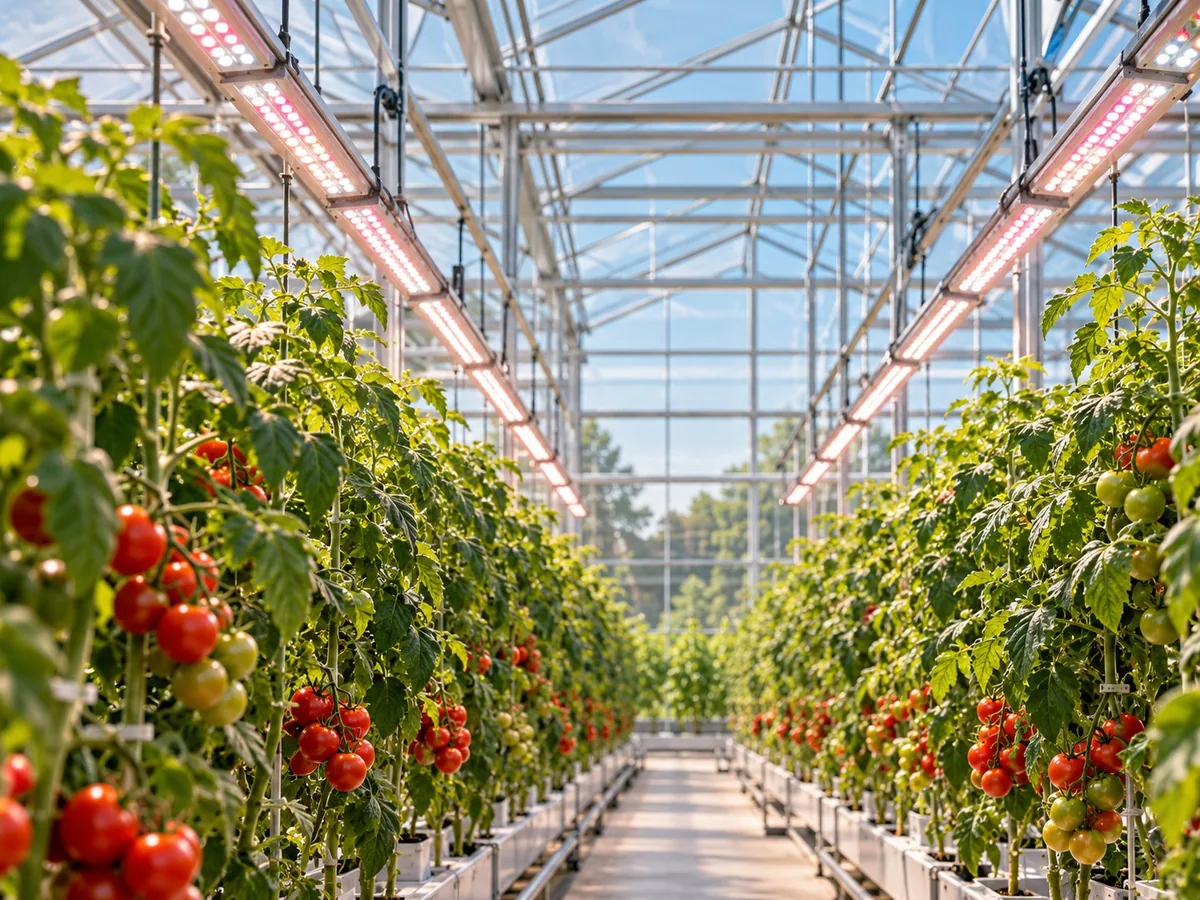
Illustrative view of a glass greenhouse with tomato plants under overhead LED grow lighting

Illustrative image of a typical greenhouse environment — not a customer installation photograph.

Technical focus on this page

Seasonal DLI deficit, top versus intercanopy, structure and humidity

How this application works

What drives lighting decisions in greenhouse

A greenhouse is a hybrid system: daylight supplies the base load, and supplemental lighting fills a seasonal deficit. That single difference changes the entire planning method compared with an indoor room. Fixture count is not derived from area alone, because the same structure can be light-limited in December and self-sufficient in June.

Transmission is the first number to establish. Glazing type, age, dirt, structural shading, gutters, trusses and thermal screens all reduce what reaches the crop, and the reduction is not uniform across the floor. Extension guidance for commercial houses puts typical transmission at 60–70 %, so a third of the outdoor resource can be lost before the crop sees it, and the figure should be measured in the actual house rather than taken from a glazing datasheet (Runkle, How much supplemental lighting do you need?).

The second number is the crop’s target DLI by growth stage. For most ornamental crops a common minimum target is 10–12 mol/m²/day, while vegetable crops are usually higher (Runkle, Maximizing the benefits of supplemental lighting). Once the monthly natural DLI and the target are both known, the deficit is arithmetic — and it tells you whether you need supplemental lighting at all, which months it must run, and how many hours per day it is worth operating.

Application challenges

What makes greenhouse lighting difficult

These are the constraints that decide whether a lighting plan survives contact with an operating facility.

01

The deficit moves with the season

A lighting system sized for December is idle in July; one sized for the annual average leaves the crop short in the weakest months. Most commercial greenhouse designs are therefore sized for a defined target month, and the control system handles the rest of the year by dimming or switching zones.

02

Transmission losses are structural, not cosmetic

Glazing haze, condensation films, hanging baskets, irrigation booms and thermal screens all intercept light before it reaches the canopy. Measure transmission in the actual house rather than trusting a catalogue figure, and re-measure after screen installation.

03

Top light does not reach the lower crop profile

In tall fruiting crops, the upper canopy intercepts most of the light. Intercanopy fixtures raise the light level in the middle and lower layers where fruit set and quality are determined; relying on top light alone means over-lighting the top to satisfy the bottom.

04

Humidity, condensation and chemicals

Greenhouse interiors combine high humidity, condensation on cold surfaces, sulfur vaporisation and routine chemical application. Fixtures and drivers need corrosion-resistant housings and an IP rating that matches the actual washdown and fogging regime, not a dry-room rating.

05

Structure and electrical capacity

Retrofitting HPS to LED changes point loads, hanger positions and circuit design. LED fixtures are usually lighter, but the distribution and control architecture differ, and existing contactor switching may not support dimming or DLI-based control.

06

Light pollution and municipal rules

Some jurisdictions restrict upward light emission, overnight operation or light spill beyond the property line. Screening, shielding and scheduling may be required, and they affect both fixture choice and the achievable photoperiod.

Lighting requirements

How to specify lighting for greenhouse

Each metric below has to be set from the crop, structure and operating practice — not from a generic watts-per-square-metre rule.

ParameterPlanning targetWhy it matters
Natural DLI by monthMeasured or modelled for the specific site, corrected for glazing transmissionThe deficit, not the crop target alone, sets the installed capacity.
Crop target DLIStage-specific; fruiting crops commonly 20–30 mol/m²/day, leafy crops 12–17Defines how much of the deficit is worth closing in each production phase. Published greenhouse guidance suggests a 12–14 mol/m²/day minimum for lettuce and at least 15 — preferably more than 20 — for vine crops (Runkle, Lighting greenhouse vegetables).
Supplemental PPFDSized from the deficit and the planned operating hours: PPFD = deficit ÷ (hours × 0.0036)Converts a daily photon gap into an intensity the fixtures must add to the natural level. For high-light vegetable crops, 125–175 µmol/m²/s is a typical supplemental intensity, rising to around 200 µmol/m²/s in northern-European tomato houses (Runkle, Lighting greenhouse vegetables).
Operating hoursUsually coordinated with the natural photoperiod; long summer days need less supplementRunning supplemental light when daylight already meets the target is pure waste: extension guidance is to light at night and in cloudy weather and to switch off once the daily light integral passes roughly 10–12 mol/m²/day (Runkle, Maximizing the benefits of supplemental lighting).
Uniformity across the floorMinimum-to-average around 0.8 in the lit zone; accept lower values only outside the crop areaGreenhouse floors are uneven; structural shadows create permanent low-light zones.
IP rating and corrosion resistanceIP65 or better for humid houses with fogging or washdownCondensation and chemicals shorten the life of dry-rated fixtures dramatically.
Control integrationDLI-based dimming linked to the climate computer where availableSupplemental lighting should respond to measured light, not to a fixed clock.

Reference data

Comparison tables for planning

Planning references compiled from horticultural lighting literature and standards. They are starting points for your own trials, not guarantees of performance.

Reference greenhouse crop targets and supplemental strategies
CropTarget DLI (mol/m²/day)Typical supplemental PPFDStrategy note
Tomato (vine)20 – 30125 – 200 µmol/m²/sTop light plus intercanopy in tall crops; coordinate with CO₂ and humidity control
Cucumber20 – 30125 – 200 µmol/m²/sFast canopy development; check upper-canopy temperature under high PPFD
Pepper18 – 25100 – 175 µmol/m²/sMore tolerant of moderate light; avoid over-sizing for the weakest month only
Strawberry15 – 2575 – 150 µmol/m²/sPhotoperiod and cultivar interactions; day-extension is often more valuable than peak intensity
Leafy greens / lettuce12 – 1780 – 150 µmol/m²/sShort cycles; supplemental light is often used to stabilise supply rather than maximise growth
Herbs and transplants12 – 2075 – 150 µmol/m²/sUniform trays matter more than peak PPFD; watch edge rows near sidewalls

Supplemental intensities follow published guidance for high-light vegetable crops — 125–175 µmol/m²/s typical, around 200 µmol/m²/s in northern-European tomato production (Runkle, Lighting greenhouse vegetables); DLI targets follow the same extension guidance and the national DLI maps of Faust & Logan (2018). Winter deficits depend on latitude, glazing and screens — calculate for your own site before sizing fixtures.

Top lighting versus intercanopy lighting in greenhouse production
FactorTop lightingIntercanopy lightingPlanning consequence
Primary jobRaises overall DLI across the floorRaises light inside the canopy profileTop light sets the dose; intercanopy sets the distribution
Best fitLow crops, young plants, uniform benchesTall fruiting crops, dense canopies, multi-layer guttersMatch to crop architecture, not to habit
InstallationHangers from trusses, high mountingSuspended between rows at crop heightRow spacing and trolley access constrain the layout
MaintenanceAccessible from the aisle or catwalkMore exposed to crop contact and sprayHigher IP rating and mechanical protection needed
ControlZone dimming with the climate computerOften a separate zone, lower hoursPlan separate circuits and channels
RiskOver-lighting the top to reach the bottomShadowing if rows are too narrowVerify with a vertical PPFD profile, not a single point

Neither strategy replaces the other in tall crops. The right split depends on canopy height, crop architecture and how much of the lower profile must stay productive.

Lighting system design

How to plan the system, step by step

The order matters: geometry and targets first, fixture count second, verification and control last.

  1. 1

    Establish the real transmission of the house

    Measure light inside and outside the structure on a clear day, at canopy height, at several positions. Correct for the screens and structure that will be in place during the production period, not for an empty house. This is the same method extension guidance recommends: read the sensor outside, read it immediately inside, and take the ratio as the transmission figure.

  2. 2

    Build a monthly natural DLI profile

    Combine site irradiance data with measured transmission to get natural DLI for each month. Compare against the crop target to see which months have a deficit and how large it is.

  3. 3

    Choose the design month and the deficit to close

    Decide which month the system must satisfy — often the weakest month of the main crop cycle — and how much of the deficit is economic to close. A partial deficit is a legitimate commercial choice if it is a deliberate one.

  4. 4

    Convert the deficit into supplemental PPFD and hours

    Divide the deficit by operating hours and by 0.0036 to get the additional PPFD required. Longer hours reduce the intensity needed but overlap more with natural daylight, so the two must be optimised together.

  5. 5

    Decide the top and intercanopy split

    For tall crops, allocate part of the installed capacity to intercanopy fixtures at crop height. Verify with a vertical PPFD profile so that the lower canopy is not relying on light that never arrives.

  6. 6

    Check structure, power and control

    Confirm hanger points and point loads, circuit capacity, and whether the climate computer can dim by DLI or only switch by time. Control capability determines whether the design can actually follow the weather.

Worked example

Closing a December DLI deficit in a tomato house

Illustrative example — assumptions stated below, not client data

Assumptions

  • Target DLI for tomato: 22 mol/m²/day — planning assumption for this example
  • Natural DLI in December, measured inside at canopy height with screens in place: 8 mol/m²/day — an example figure, not a site reading
  • Planned supplemental operating window: 16 h
  • Distribution allowance (delivered to canopy ÷ fixture output): 0.85
  • Fixture basis: 1,000 µmol/s top light at 400 W input (2.5 µmol/J) — a fixture class, not a catalog model
  • Lit area: 1,000 m²
StepCalculationResult
Consistency check on the natural-light figure8 ÷ 0.70 and 8 ÷ 0.60Inside 8 mol/m²/day implies roughly 11–13 mol/m²/day outside at the 60–70% transmission typical of commercial houses. If a measured outdoor value is far from that band, one of the two readings is wrong
Deficit to close22 − 814 mol/m²/day
Required supplemental PPFD14 ÷ (16 × 0.0036)≈ 243 µmol/m²/s at canopy level
Installed PPFD including distribution allowance243 ÷ 0.85≈ 286 µmol/m²/s of fixture output
Fixture count for 1,000 m²286 × 1,000 ÷ 1,000 µmol/s286 fixtures, then re-checked against rafter spacing and structural shadows
Installed load and power density286 × 400 W ÷ 1,000 m²114.4 kW installed, i.e. 114 W/m² of lit area
Energy per winter day114.4 kW × 16 h≈ 1,830 kWh/day at full output — the figure the payback calculation has to start from

Two assumptions dominate the result: the natural DLI and the operating window. Closing the same 14 mol/m²/day over 12 hours instead of 16 raises the required PPFD to about 324 µmol/m²/s and the fixture count with it, while the daily energy stays in the same range but the load profile changes. Recalculate with your own measured transmission, target month and fixture PPF — and note that this is a photon budget for one deficit month, not a lighting layout.

Three different kinds of number

What this calculation is — and what it is not

The worked example above is an initial estimate. It is not a lighting layout, and it is not a verified PPFD. Keeping the three apart is what stops a photon budget from being quoted as delivered performance.

STAGE 1

Initial estimate

Monthly DLI deficit ÷ operating hours ÷ distribution allowance, converted into fixture count and installed load.

Arithmetic on two assumed inputs (natural DLI and hours). Valid for budgeting and for comparing supplier proposals — invalid as a claim about how the crop will perform.

STAGE 2

Lighting layout design

Rafter and truss positions, hanger points, screen and gutter obstructions, then a predicted PPFD grid at canopy height plus a vertical profile through the crop.

A design deliverable stating the mounting height, the grid resolution and the minimum-to-average ratio, including the effect of structural shadows.

STAGE 3

Verified PPFD performance

Inside-versus-outside transmission measured on a clear day, PPFD measured on a canopy grid under the installed layout, and the DLI logger trend across a full production month.

Measurement data only. A single point reading at head height is not verification of a greenhouse lighting system.

Fixture selection

Which grow light types fit this application

Selected from the six fixture categories we manufacture; the right mix depends on ceiling height, canopy structure and control requirements.

Greenhouse top lighting

Base DLI supplementation across the floor

High-mount fixtures with greenhouse-grade ingress protection and corrosion-resistant housings, sized to the monthly deficit rather than to the peak.

Intercanopy bars

Raising light inside tall crop profiles

Slim bars hung between rows add light where the top canopy has already absorbed most of the incident radiation, improving lower-fruit development.

Foldable bar fixtures for gutters and benches

Flexible zoning over benches, gutters and propagation areas

Movable or reconfigurable fixtures suit multi-crop greenhouses where the lit area changes between seasons.

OEM & ODM

Project support for brands and importers

We build fixtures to a specification, document what was built, and support the certification and packaging work that a private-label programme needs.

  • Spectrum and wattage configurations matched to the crop and the design month
  • Corrosion-resistant housings and driver protection specified for humid houses
  • Control interfaces compatible with common greenhouse climate computers
  • Certification documentation for the destination market, referenced to the exact model
  • Sample fixtures for a lighting trial in one compartment before a full-house order

Common mistakes

Planning errors that are expensive to fix later

Each of these shows up after installation, when the layout is already fixed and the circuits are already run.

MistakeWhat to do instead
Copying indoor fixture-count maths into a greenhouseStart from the monthly natural DLI and the resulting deficit; the greenhouse already receives light for free, and the deficit changes month by month.
Assuming catalogue transmission equals installed transmissionMeasure inside and outside on a clear day with screens and structure in place, then apply the measured figure.
Running supplemental light when daylight already meets the targetUse DLI-based control or at minimum a light sensor; fixed-clock operation wastes energy in bright weeks.
Sizing only for top light in a tall fruiting cropCheck a vertical PPFD profile and allocate capacity to intercanopy fixtures where the lower canopy is light-starved.
Specifying dry-room IP ratings in a fogged houseMatch the IP rating and housing material to the actual humidity, condensation and washdown regime, and check the driver enclosure separately.

Technical references

Every technical figure on this page is traceable to one of the sources below. Each entry gives the publication, its author or issuing body and year, a resolvable link, and the specific claim on this page that it supports — an institution name on its own is not evidence, and no manufacturer marketing material is used here as independent research. All links were checked and resolved on 19 October 2026.

  1. 1
    How Much Supplemental Lighting Do You Need?

    Runkle E., Michigan State University Extension / Greenhouse Product News

    Supports on this page: The 60–70% transmission range for commercial greenhouses, the inside-versus-outside measurement method, and the step-by-step conversion from a DLI deficit plus operating hours into a required supplemental intensity.

  2. 2
    Maximizing the Benefits of Supplemental Lighting

    Runkle E., Greenhouse Product News, January 2018 (Michigan State University Extension)

    Supports on this page: The 10–12 mol/m²/day minimum DLI target for ornamental crops, the rule to light at night and in cloudy weather, and the switch-off threshold once the daily light integral passes that band.

  3. 3
    Lighting Greenhouse Vegetables

    Runkle E., Michigan State University Extension Floriculture Team

    Supports on this page: The crop targets in the table: 12–14 mol/m²/day minimum for lettuce, at least 15 and preferably over 20 for vine crops, and 125–175 µmol/m²/s of supplemental intensity rising to about 200 µmol/m²/s in northern-European tomato production.

  4. 4
    Daily Light Integral: A Research Review and High-resolution Maps of the United States

    Faust J.E. & Logan J., HortScience 53(9): 1250–1257 (2018)

    Supports on this page: The monthly natural-DLI profile used to identify which months carry a deficit, and the regional variation behind the statement that winter deficits depend on latitude.

  5. 5
    ANSI/ASABE S640 — Quantities and Units of Electromagnetic Radiation for Plants

    American Society of Agricultural and Biological Engineers, standard S640 JUL2017 (reaffirmed 2022)

    Supports on this page: The units used for the deficit conversion: DLI in mol/m²/day, PPFD in µmol/m²/s, and the 0.0036 factor that links the two over a stated number of hours.

Where a source could not be confirmed as publicly accessible, the claim it would have supported has been written as a lower-certainty statement rather than given a citation. Planning ranges remain starting points for your own trials — they are not guarantees of performance, and no figure on this page is a quotation.

Industry FAQ

Greenhouse lighting questions

Specific follow-up questions about this application, answered directly and then explained.

How much supplemental light does a tomato greenhouse need in winter?

Size it from the deficit, not from a fixed number. If the crop targets 22 mol/m²/day and the house delivers 8 in December at canopy height, the gap is 14 mol/m²/day, which over 16 hours is about 243 µmol/m²/s at the canopy. Sites at higher latitude, older glazing or with closed screens will need more.

Should greenhouse supplemental lighting be top light or intercanopy?

Both, in tall crops. Top light raises the DLI across the floor and sets the daily dose; intercanopy bars raise light in the middle and lower canopy where the top leaves have already taken most of the radiation. Low crops and young plants usually need top light only.

Can I run supplemental lights all night to hit the DLI?

Running through the dark period changes the photoperiod, which affects flowering in photoperiod-sensitive crops and may conflict with light-pollution rules. Most programmes extend the day at the start and end of the natural photoperiod, or supplement during the day when daylight is short — check both crop response and local rules.

Do greenhouse LED lights need a higher IP rating than indoor fixtures?

Generally yes. Houses with fogging, overhead irrigation, condensation and routine spraying need IP65 or better, with corrosion-resistant housings and protected drivers. A dry-room IP54 fixture may function initially and fail early in a wet house.

Can I retrofit HPS to LED without changing the structure?

Usually, because LED fixtures are lighter, but the hanger positions, point loads, circuit layout and control architecture all need checking. The distribution also changes, so a one-for-one swap by position may not deliver the intended PPFD; plan the retrofit from a PPFD grid rather than from the old fixture positions.

How do I know whether supplemental lighting will pay back?

Compare the annual lighting energy plus any capacity cost against the value of the additional or earlier production the deficit was limiting. The calculation needs your tariff, operating hours by month and crop response data from your own trials — no generic percentage applies across crops and markets.

Do I need shielding for light pollution?

It depends on the jurisdiction and on neighbouring land use. Some regions restrict upward emission, overnight operation or spill beyond the property line, which can require shielding, screening or schedule limits. Confirm the local requirement before fixing the layout and photoperiod.

Planning a greenhouse lighting project?

Send the growing area, crop and stage, target PPFD or DLI, ceiling or layer height and your market requirements. We will come back with a fixture proposal, a layout suggestion and the documentation you need to evaluate it.