For tall vine crops like tomatoes and cucumbers, top lighting alone can leave the lower and inner canopy starved because upper leaves shade everything beneath them. Interlighting — fixtures placed within the canopy, between rows — puts photons where top light cannot reach. The two are not competitors; they solve different parts of the same shading problem. This article compares them so you can decide how to combine them for your vine crop.
What each one actually does
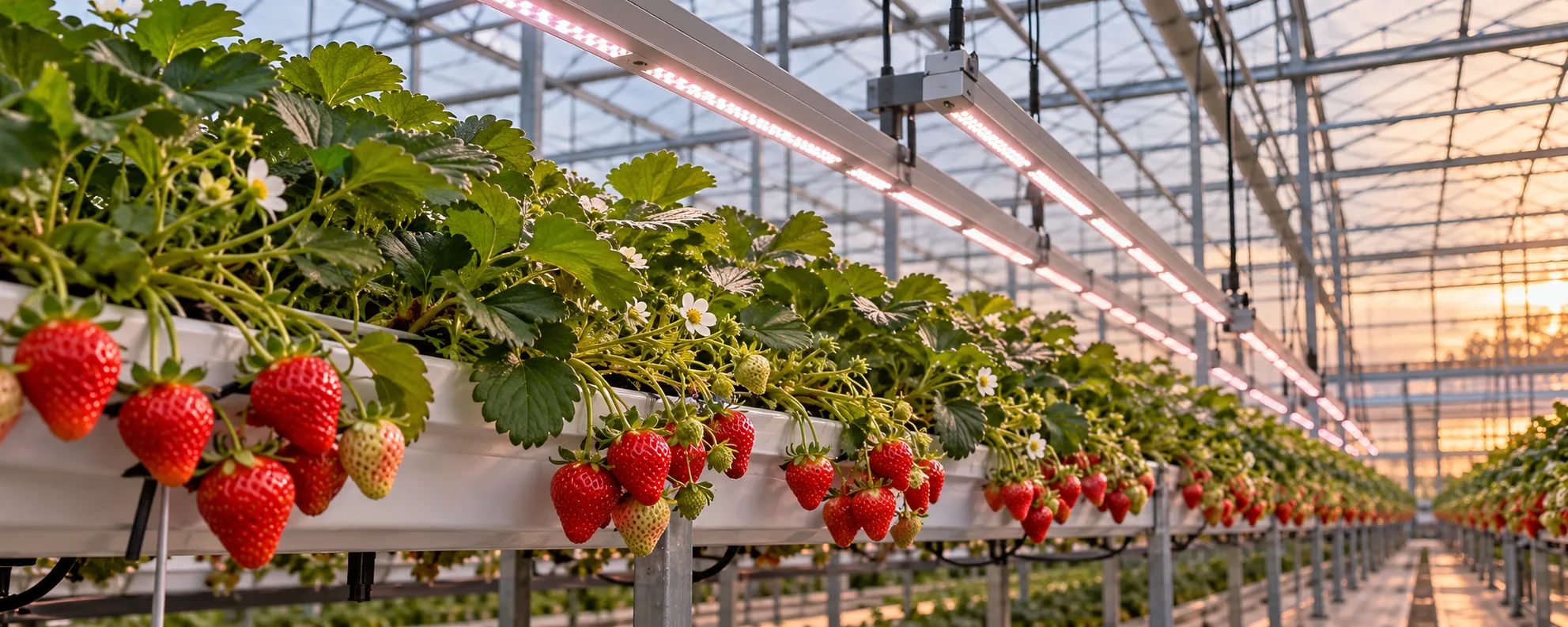
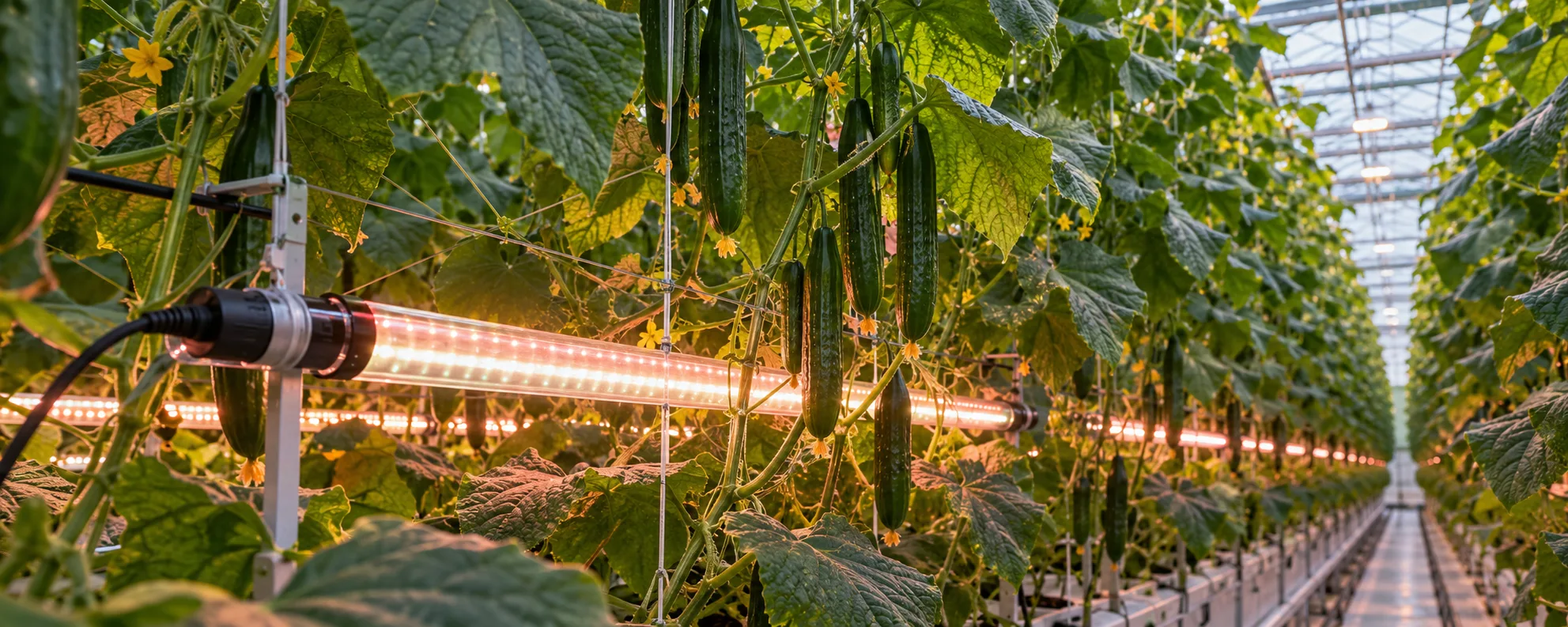
Top lighting delivers the bulk of the photosynthetically active light from above and is the backbone of any greenhouse supplement plan. Interlighting targets the shaded middle and lower canopy, lifting the light a plant receives deep in the canopy where top light is intercepted by upper leaves. Research and grower reports on vine crops commonly describe yield and quality responses when the inner canopy is lit, but the size of the response is crop-, density- and climate-specific.
| Dimension | Top lighting | Interlighting (intercanopy) |
|---|---|---|
| Position | Above the canopy | Within / between rows |
| Primary job | Bulk DLI delivery | Light the shaded inner canopy |
| Best crop | All greenhouse crops | Tall vine crops (tomato, cucumber) |
| Main risk | Upper-leaf shading of lower canopy | Heat and labour in dense rows |
| Typical use | Always | Add when canopy is tall and dense |
Interlighting is a distribution fix, not a replacement
Interlighting rarely replaces top lighting. Think of it as redistributing photons to the parts of the plant that top light misses. A common approach is to meet most of the DLI target with top light, then add interlighting to raise inner-canopy PPFD and keep lower trusses productive. Because interlighting sits close to plant tissue, fixture heat and spacing matter more than for overhead bars.
Measure inside the canopy, not just above it
With vine crops the useful number is inner-canopy PPFD, not the reading at the top. A layout that looks fine at the top can still starve lower trusses. Measure deep in the canopy to judge interlighting.
Energy and labour trade-offs
Interlighting adds fixtures, wiring and labour in already dense rows, and it can raise humidity and disease pressure if airflow is not managed. The payoff is inner-canopy productivity. The decision should be economic: does the extra deep-canopy yield justify the fixtures and the labour? That answer differs by crop value and climate, so pilot before scaling.
| Check | Add interlighting if… | Skip if… |
|---|---|---|
| Canopy height | Tall, dense vine crop | Short or sparse crop |
| Inner-canopy PPFD | Clearly below target | Already adequate |
| Labour capacity | Can maintain dense rows | Cramped, hard to access |
| Crop value | High-value vine crop | Low margin |
Related products and reading
Our greenhouse top lighting and intercanopy & under canopy grow lights ranges cover both roles. For the broader greenhouse method see the greenhouse industry page.
A decision framework for choosing between them
The choice is rarely either-or, but the primary system should match your crop architecture. Use this framework as a starting discussion, not a verdict:
- Tall, trellised crops with dense canopies (tomato, cucumber, pepper): top lighting as the base system, with interlighting considered when lower-leaf light starvation limits yield or fruit quality.
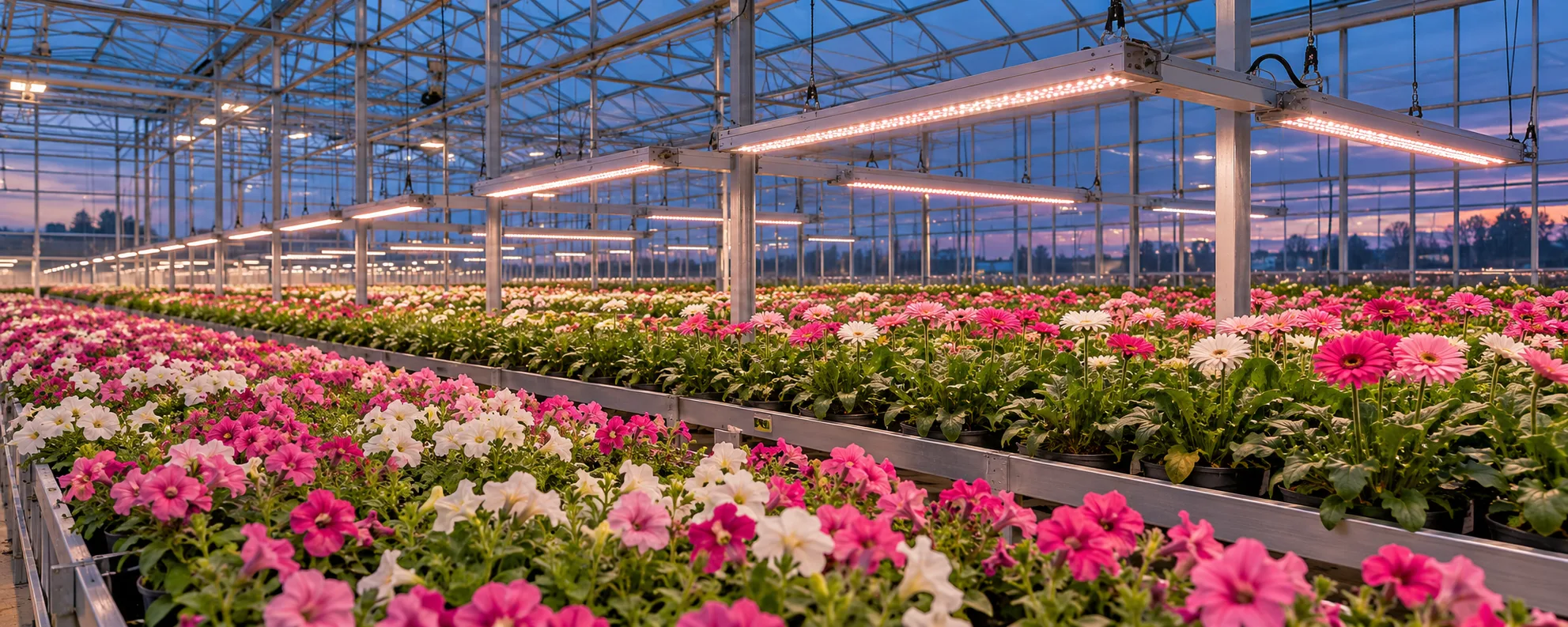
- Short, homogeneous crops (lettuce, leafy greens on gutters, bedding plants): top lighting alone is almost always sufficient; interlighting adds cost without a canopy gap to fill.
- Retrofit projects with existing HPS infrastructure: replacing HPS tops with LED tops is the first step; interlighting is a second-phase decision after one season of canopy data.
- New builds with high wire crops: design the structure and electrical layout so interlighting can be added later without rework, even if you do not install it on day one.
Installation and safety considerations for interlighting
Where the fixtures live matters
Interlighting modules sit inside the canopy, close to foliage, irrigation lines and workers. That changes the engineering: fixtures need mechanical protection against trolleys and harvesting equipment, wiring must be routed away from water, and surfaces need cleanability because a warm, humid canopy is also a good environment for biofilm and algae. IP ratings, cable management and fixture surface temperature all deserve more scrutiny than for a top-lighting installation.
What interlighting changes about the canopy
Light delivered inside the canopy reaches leaves that top lighting barely touches, which can improve lower-leaf photosynthesis and, in some trials reported by extension services, fruit set on lower trusses. It also changes the microclimate: fixtures add a small heat source inside the canopy, which can slightly lower local humidity but also raises the stakes for airflow design. Any interlighting decision should follow a season of canopy PPFD measurements at multiple heights, because the need differs block by block.
Questions to ask before you buy
- Does the supplier offer both top and interlighting optics from one platform, so controls and spares stay uniform?
- What is the interlighting module rating for water, mechanical impact and canopy temperature?
- Can the supplier reference greenhouse installations of comparable size and crop, and connect you with a reference grower?
- How are interlighting fixtures serviced mid-season without removing the crop?
- What mounting and cabling hardware is included, and what does the structure need to provide?
Common mistakes when comparing top lighting and interlighting
The comparison invites simple answers to a layered question. These mistakes show up repeatedly in real projects:
- Choosing interlighting because a trial at another farm succeeded, without measuring the lower-canopy light starvation that would justify it locally.
- Treating the two systems as substitutes; on tall crops they are complements at different canopy depths.
- Underestimating installation complexity inside the canopy: cabling, protection from trolleys and mid-season service are real costs.
- Comparing fixture prices while ignoring mounting hardware, which differs a lot between roof-mounted tops and in-canopy modules.
- Skipping the season of canopy measurements that tells you where the light actually runs out in your structure.
- Designing airflow as an afterthought; interlighting changes local convection, and stagnant pockets follow.
Measuring before deciding: a one-season protocol
What to measure and where
A one-season protocol needs more than a sensor at the top of the canopy. Place quantum sensors at three heights (upper, mid and lower canopy) in a few representative rows, log through the season, and compare the vertical light profile between sunny and dull weeks. If lower-canopy PPFD falls below a small fraction of top-canopy levels for weeks at a time, that is the deficit interlighting addresses; if it does not, the money is better spent elsewhere. The same data also sizes the interlighting output correctly instead of guessing.
Reading the crop, not only the sensors
Sensors say where light is; the crop says whether it matters. Lower-leaf colour loss, premature senescence and weak lower trusses are the agronomic symptoms that justify intervention. Recording these observations alongside the light log turns a vague feeling into a decision document: this block, this deficit, this symptom, this action. Suppliers respond differently to a documented case than to a request for a catalogue quote.
| Condition observed | Weight of evidence | Likely action |
|---|---|---|
| Lower canopy above 30 percent of top PPFD all season | Strong | Top lighting only; revisit next season |
| Lower canopy below 15 percent for most of winter | Strong | Interlighting pilot on part of the block |
| Mixed profile, symptoms unclear | Weak | Continue measurement one more season |
| New build with high-wire crop | Structural | Design conduit and power for later interlighting |
References you can verify
- Controlled Environment Agriculture Center, University of Arizona - greenhouse systems research
- e-GRO - greenhouse grower newsletter with lighting trials
- University of Florida IFAS - horticulture extension
Frequently asked questions
Can interlighting replace top lighting?+
Rarely. It redistributes light to the inner canopy; top lighting still delivers the bulk DLI. Most plans keep top lighting and add interlighting.
Which crops benefit most?+
Tall, dense vine crops such as tomatoes and cucumbers, where upper leaves shade lower trusses. Short crops gain little.
Does interlighting raise disease risk?+
It can, if it traps humidity in dense rows. Manage airflow and spacing; the close placement means heat and moisture need attention.
How do I know if my inner canopy is under-lit?+
Measure PPFD deep in the canopy, not just at the top. A large drop from top to inner canopy signals the gap interlighting addresses.
Is the yield gain guaranteed?+
No. Reported responses vary by crop, density and climate. Treat any gain as a hypothesis to pilot, not a promise.
Where should interlighting fixtures sit?+
Between rows at the canopy mid-height, clear of plant tissue and with airflow. Exact height depends on trellis and spacing.
Planning vine-crop lighting?
Tell us your crop, row spacing and canopy height. We suggest a top + interlighting split to trial.
Get a Grow Light Solution