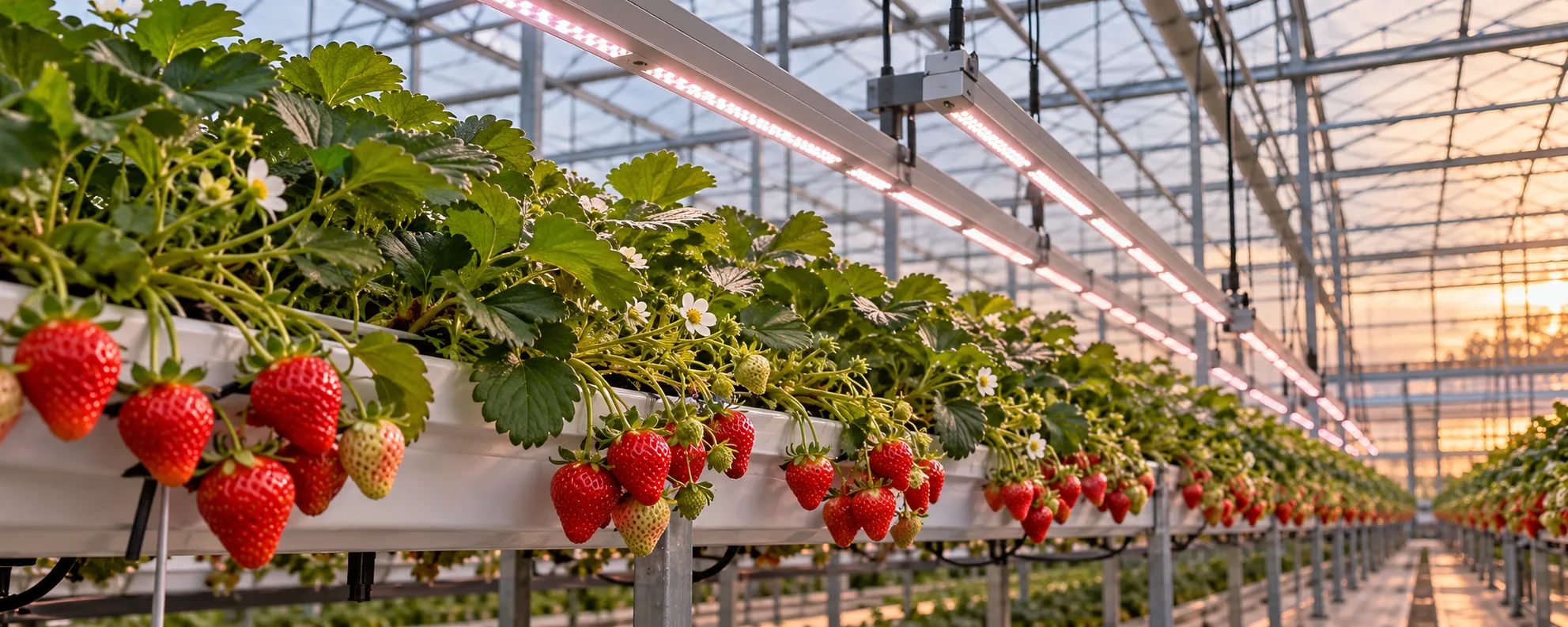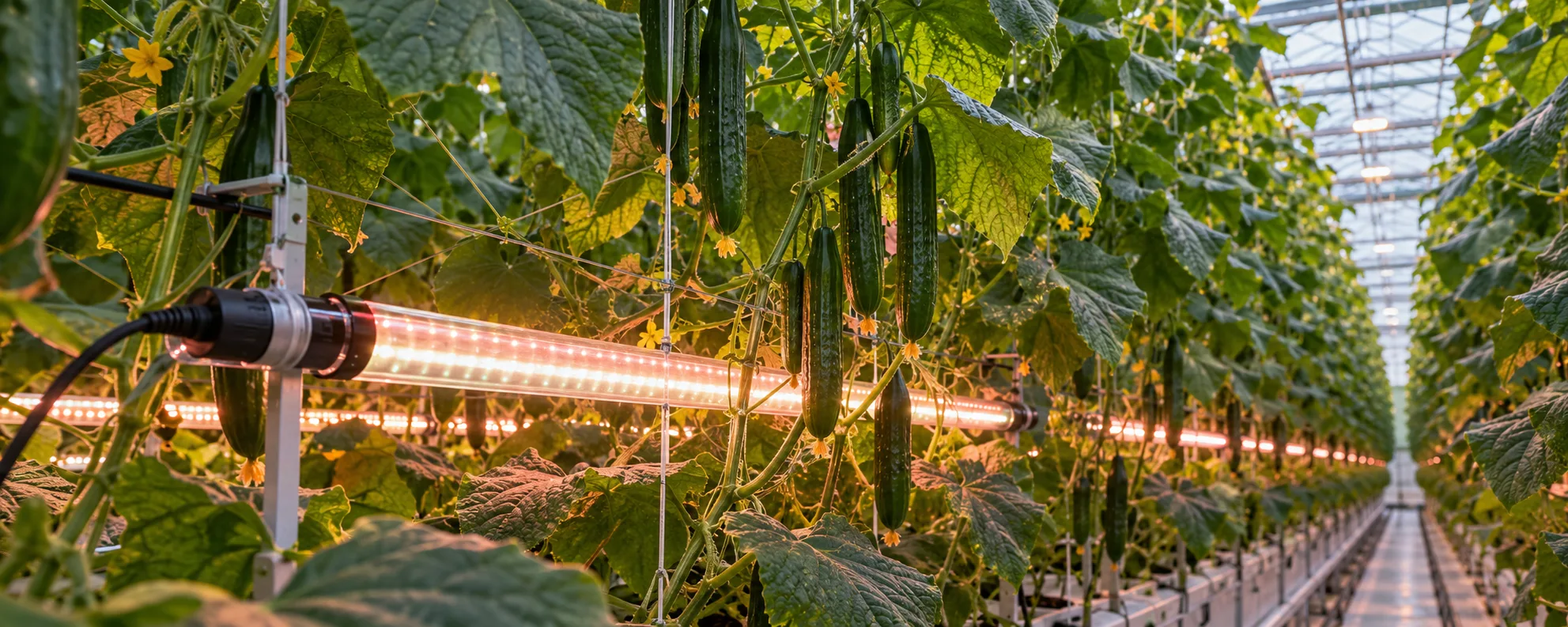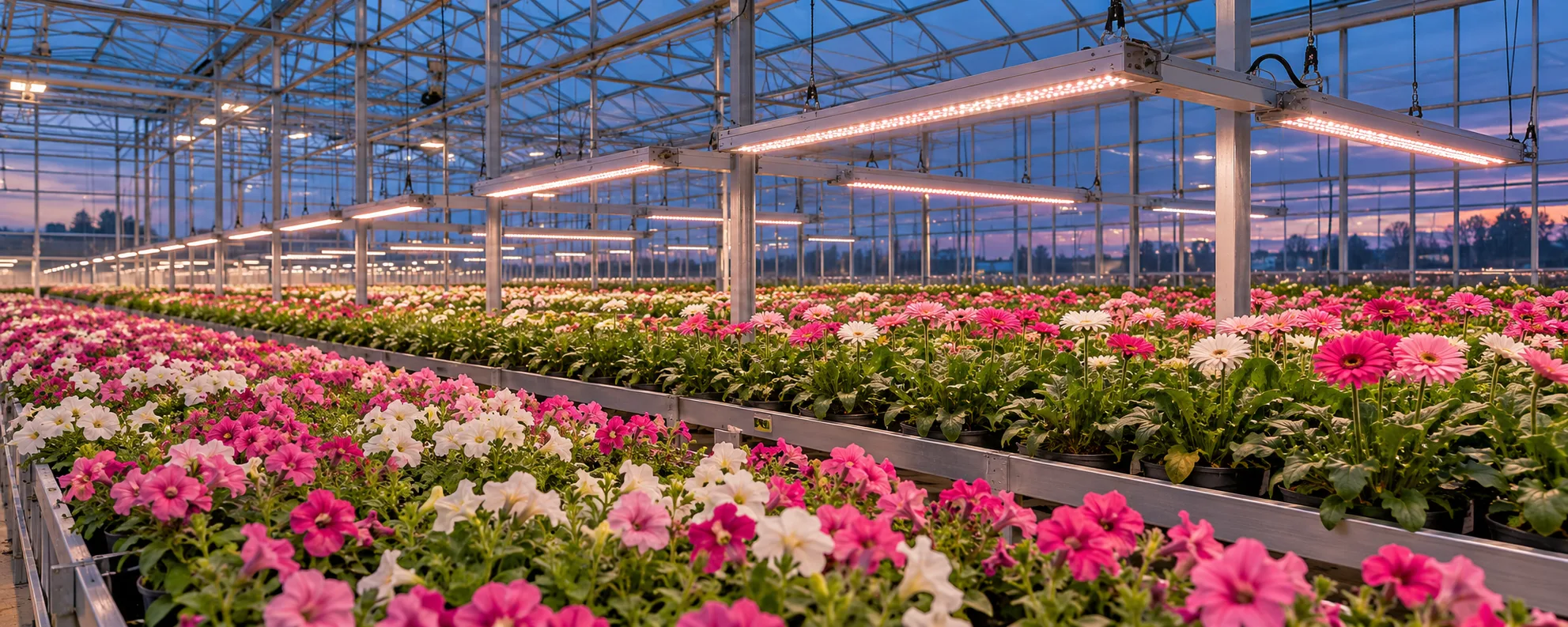
In a greenhouse, DLI planning has a twist the indoor farm does not: part of the light is free, part you pay for. Your job is to set a crop target DLI, measure what the sun already gives, and add only the deficit. For vegetables and flowering crops the target bands are typically higher than for leafy greens, and the economics of closing the winter gap are often strongest for high-value vines and flowers. This article lays out the planning method.
Crop bands are starting points, not law
Published extension guidance gives DLI bands for many greenhouse crops — higher for fruiting vegetables and many flowers, lower for cool-season greens. These are excellent starting points, but the optimum for your variety, climate and market should be confirmed with trials. The band tells you where to begin; your own data tells you where to settle.
| Crop group | Illustrative DLI band | Notes |
|---|---|---|
| Leafy greens | 12-17 mol/m²/day | Lower end of the greenhouse range |
| Fruiting vegetables (tomato, cucumber) | 20-30+ mol/m²/day | High-value, strong light response |
| Strawberry | ~17-25 mol/m²/day | Yield and grade respond to light |
| Cut / pot flowers | Varies widely | Species-specific; confirm per crop |
Seasonal targeting
Because natural DLI swings with season and latitude, a fixed supplemental setting is wrong for part of the year. The cleaner approach is a target DLI with dimmable top lighting that adds the live deficit. In summer the system idles; in winter it works hardest. This keeps energy spend aligned with the actual gap.
Target the deficit, not the total
Your LEDs only need to deliver (target DLI − natural DLI). Sizing to the full target doubles energy cost in a sunny climate and overheats the house. Measure natural light and size to the gap.
From target to a fixture plan
With a target DLI and a measured natural DLI, the deficit formula from the supplemental-lighting article gives the supplemental PPFD; from there the fixture-count estimate sizes the install. Keep all three numbers — target, natural, deficit — explicit so the plan is auditable. The greenhouse industry page links this into a full worked example.
| Natural DLI | Deficit | Supplemental PPFD | Verdict |
|---|---|---|---|
| 8 | 17 | 263 µmol/m²/s | Heavy winter supplement |
| 14 | 11 | 170 µmol/m²/s | Moderate supplement |
| 20 | 5 | 77 µmol/m²/s | Light top-up |
| 25 | 0 | 0 | None needed |
References
Worked example: a monthly DLI plan for one block
This worked example is illustrative. Take a 300 m2 cut-flower block with a planning target of 25 mol/m2/day. Monthly sunlight DLI at your site might look roughly like: December 8, February 14, April 20, June 28, October 15 (replace these with local climate data). The supplemental gap is then: December 17, February 11, April 5, June 0, October 10 mol/m2/day.
- December: gap 17 mol/m2/day over 16 hours needs 295 umol/m2/s of LED PPFD across the block.
- February: gap 11 over 16 hours needs 191 umol/m2/s.
- April: gap 5 over 16 hours needs 87 umol/m2/s, achievable with heavy dimming rather than additional fixtures.
- June: zero supplemental need; the system idles or supports a different crop.
- October: gap 10 over 16 hours needs 174 umol/m2/s.
- Fixture count for the December case at 300 m2 with uniformity factor 1.2: (295 x 300 x 1.2) / 2,000 PPF = 53 fixtures.
The structure of the answer matters more than the exact numbers: one month drives the fixture count, and every other month is a dimming schedule. Growers who plan this way buy fewer fixtures and use them more hours per year, which improves the return on the lighting investment.
Vegetables and flowers do not share one number
Where the bands differ
Fruiting vegetables (tomato, cucumber, pepper) generally carry high DLI targets because each unit of light converts into harvestable fruit over a long season. Cut flowers and potted colour often have moderate targets but sharp quality thresholds: light deficiency shows up as stretched stems and weak bud count rather than as slow growth. Leafy crops fall in between with tighter quality constraints, since excess light can trigger bitterness or tipburn in sensitive cultivars. Planning a mixed greenhouse therefore means planning per block, per month, not per greenhouse.
Quality is part of the target
A DLI plan that hits the number but produces soft, stretched stems has failed at its real job. Extension guidance is consistent on this: track quality indicators (stem strength, bud count, colour, shelf life) alongside DLI delivery, and treat the DLI band as a range to explore rather than a point to obey. The cheapest experiment is a dimming schedule change on one block for two weeks, with written records of what changed and what was observed.
Questions to ask before you buy
- Can the supplier model monthly supplemental needs from your local climate data before quoting a quantity?
- Do fixtures dim smoothly to the low outputs the shoulder months require?
- Is accumulated-DLI control supported so the system stops when the sun has already done the job?
- What is the efficacy at the partial output your plan uses most of the year, not just at full power?
- What is the warranty and service model for fixtures running 3,000-4,000 hours per year in a humid structure?
Common mistakes in greenhouse DLI planning
Greenhouse light planning adds the sun, and the sun is where most planning errors live:
- Planning with a single annual sunlight number instead of monthly values; December and June are different businesses.
- Using sunlight DLI from a different climate zone, or from outside the structure while ignoring glazing transmission losses.
- Forgetting that shade screens, gutters and hanging gutters steal light unevenly across the block, so the average hides dark rows.
- Setting one DLI target for a block that grows vegetables and flowers with different bands.
- Sizing fixtures for the June deficit (which is zero) or the average month (which barely exists); the darkest month sets the hardware.
- Treating the plan as finished at installation; sunlight statistics vary year to year and the control logic needs tuning against reality.
Glazing and transmission: the missing multiplier
What the glass does to your numbers
Climate data reports sunlight outside. Inside the greenhouse, glazing age, dirt, condensation and structure shadow cut transmission, commonly to 60-75 percent of outdoor levels and less on old glass. Every supplemental calculation in this article family must therefore start from inside-the-house measurements or an honest transmission assumption. A PAR sensor outside paired with one inside gives the actual ratio for your structure, and it changes seasonally with dirt and condensation, which is why the pairing should be logged, not spot-checked.
Uneven transmission inside one block
Transmission is not uniform: gutters shade strips, the north wall of a gutter differs from the south, and screens open and close in sections. The practical consequence is that supplemental layout should be checked against a transmission map, even a rough one from a season of sensors, so fixture density concentrates where sunlight under-delivers instead of spreading evenly by habit.
| Condition | Outdoor PAR (relative) | Indoor PAR (relative) | Transmission |
|---|---|---|---|
| Clear midday, clean glass | 100 | 72 | 72 percent |
| Overcast, clean glass | 100 | 68 | 68 percent |
| Clear midday, dirty glass | 100 | 58 | 58 percent |
| Morning condensation | 100 | 52 | 52 percent |
Frequently asked questions
Why are vegetable DLIs higher than leafy greens?+
Fruiting vegetables invest in biomass and fruit, and many show strong yield responses to higher light. The bands are higher, but still confirm for your variety.
Should I hit the top of the band?+
Not automatically. Higher DLI costs energy and can over-light. Target the point where marginal yield pays the marginal energy — often inside the band, not at its top.
How do flowers differ from vegetables?+
Flower light needs are highly species-specific; some want high light, others less. Treat flower DLI as per-crop and trial-driven rather than a single band.
Do I need to measure natural DLI every year?+
Climate and glazing cleanliness shift it. A periodic check (and cleaning glazing) keeps your deficit math honest.
Is the DLI formula exact?+
It is exact unit conversion for constant intensity. Real days have varying intensity, so measure to confirm rather than trust the constant assumption.
Where do I start if I have no light data?+
Begin with extension bands as a target, add a quantum sensor, and size supplemental PPFD to the measured deficit before scaling.
Planning greenhouse DLI?
Send crop, location and target. We help turn DLI bands into a deficit-sized LED plan.
Get a Grow Light Solution