Greenhouse supplemental LED lighting exists to fill the gap between the light nature provides and the light the crop needs. In winter, under clouds, or at high latitudes, the natural DLI can fall well below the crop target, and that is when supplementation earns its place. The question is never "do I add light" in the abstract — it is "how much, and when, to close the specific gap for this crop in this location." This article covers the decision and the sizing math. See the greenhouse industry page for the full planning method.
Start with the natural-light deficit
The only number that tells you how much to add is the deficit: target DLI minus the DLI the greenhouse already delivers. Natural DLI varies hugely by location, season and structure (glazing, shading, orientation), so the first step is to measure or model your site rather than assume. Once you know the deficit, supplemental lighting is sized to deliver that remainder during the photoperiod.
| Natural DLI | Deficit | Required supplemental PPFD |
|---|---|---|
| 10 mol/m²/day | 10 | 154 µmol/m²/s |
| 14 mol/m²/day | 6 | 93 µmol/m²/s |
| 17 mol/m²/day | 3 | 46 µmol/m²/s |
| 20 mol/m²/day | 0 | 0 (no supplement needed) |
When supplementation usually pays
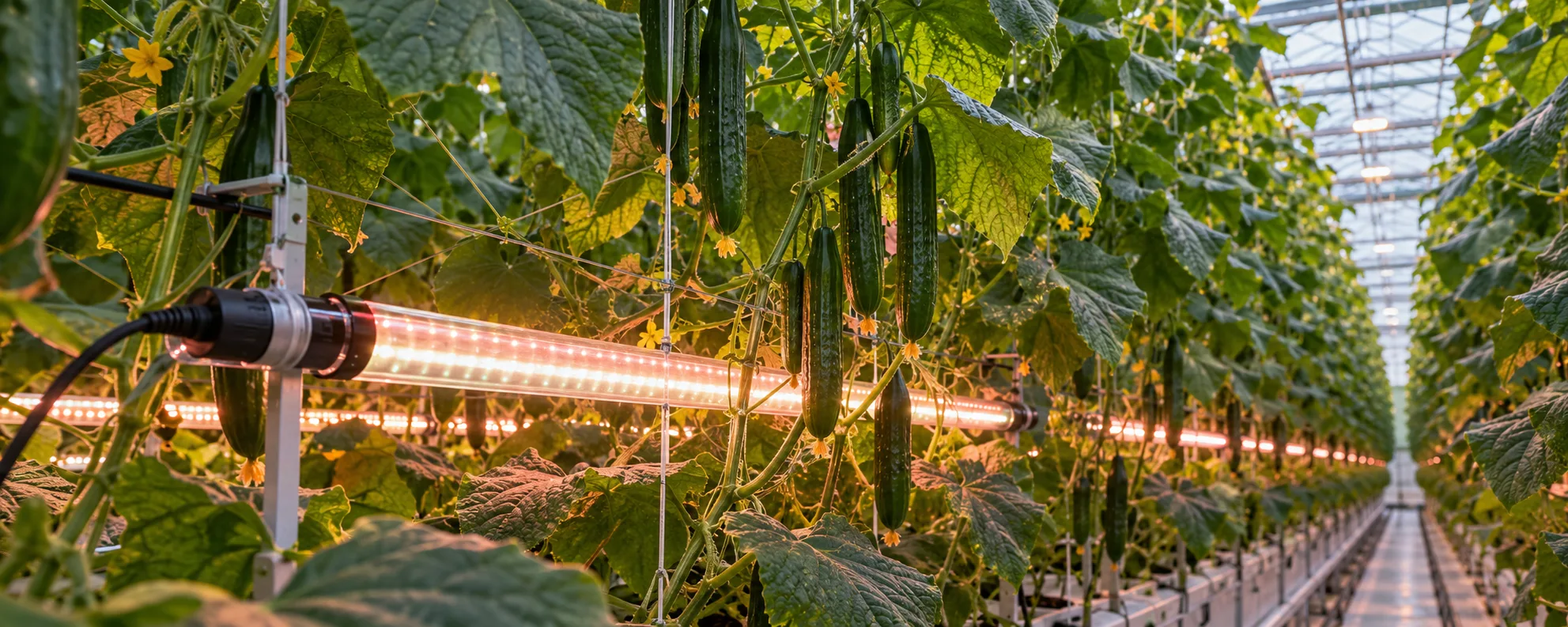
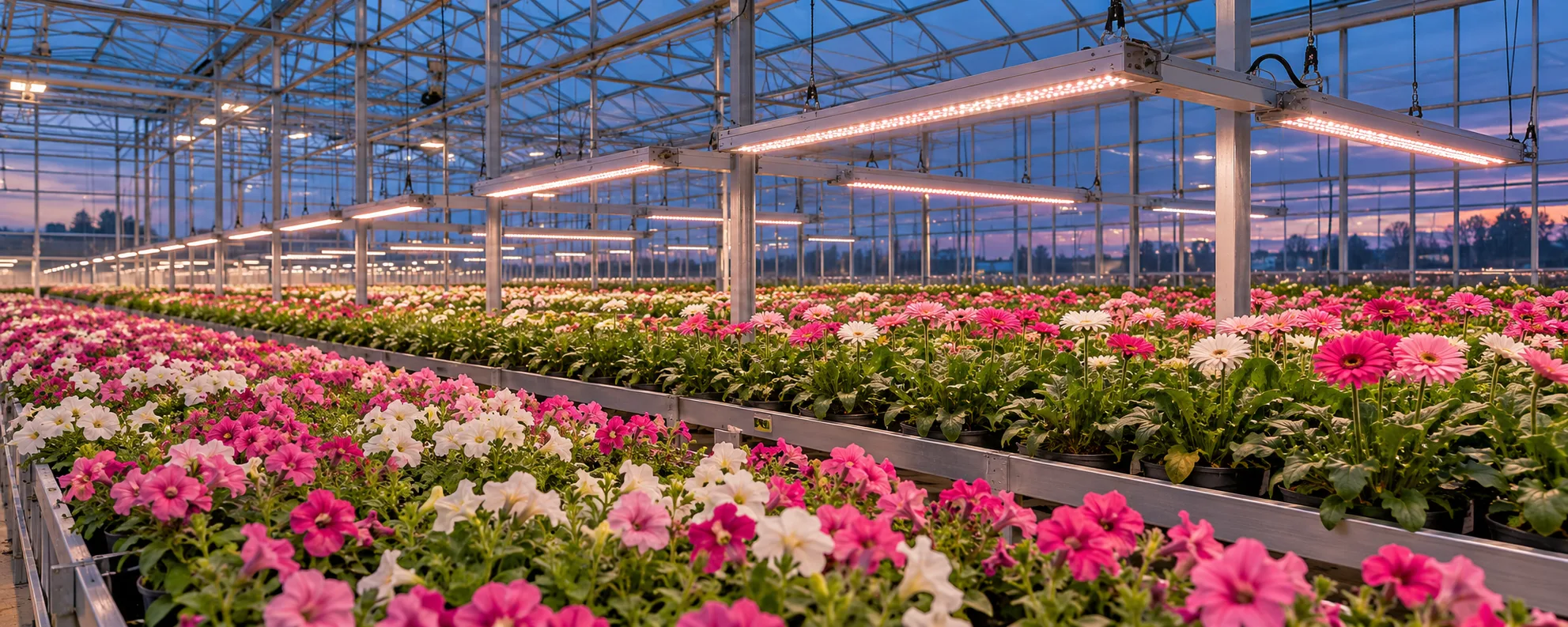
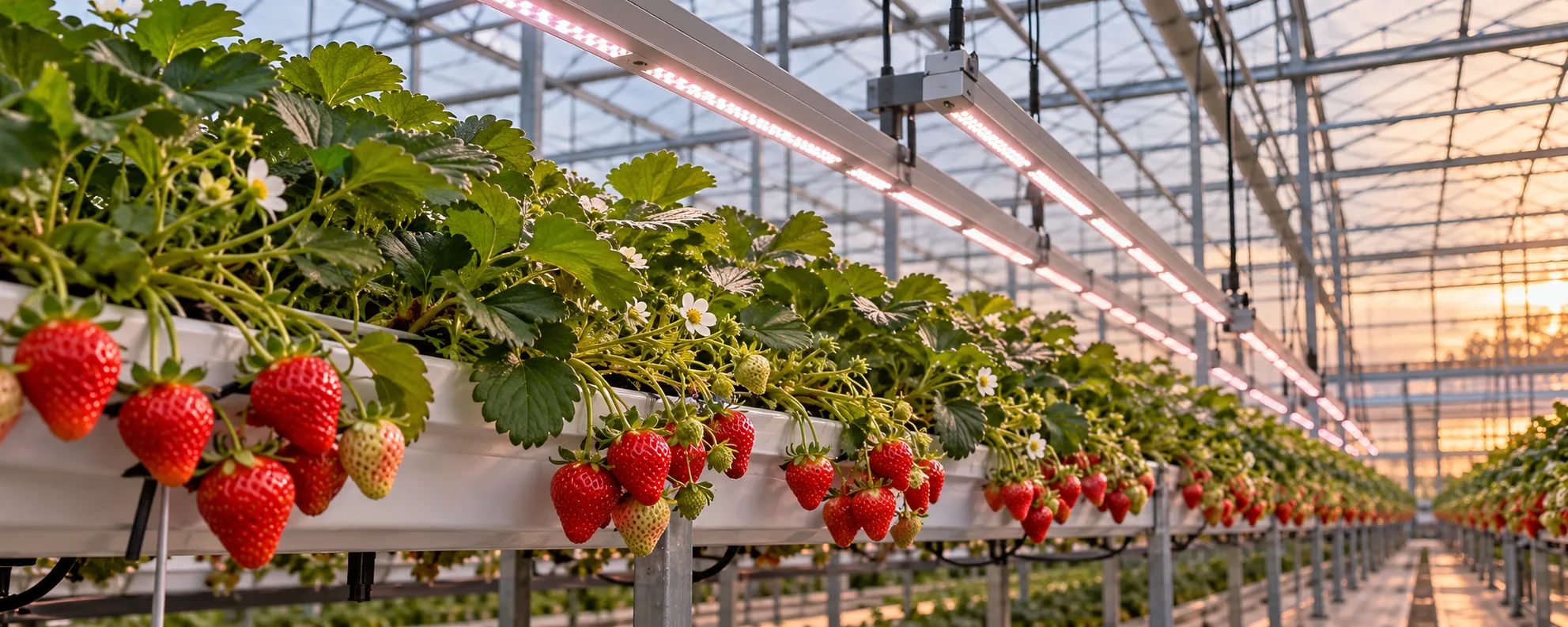
Supplementation is most defensible when the crop has a clear economic response to light — faster finish, higher grade, or year-round production that commands a price. High-value vine crops, strawberries and cut flowers are common candidates. In summer or sunny latitudes the deficit may be near zero for much of the year, so a dimmable, demand-driven system avoids burning energy when nature already delivers enough.
Two mistakes: too little and too much
Too little supplement leaves a residual deficit you already paid controls for. Too much wastes energy and can overheat or over-light the crop. Size to the measured deficit, make it dimmable, and re-check seasonally.
Top lighting vs the structure
Most greenhouse supplementation is top lighting mounted on the structure or trusses, delivering light from above the canopy. The alternative — interlighting between rows — is covered in a companion article. For top lighting, the same uniformity and spacing logic from indoor layouts applies, but you are layering onto uneven natural light, so a layout model that includes the structure shadow is worth it.
- Measure or model natural DLI for your location and season.
- Set a crop target DLI from extension guidance.
- Size supplemental PPFD to the deficit, not to a round number.
- Make it dimmable and season-aware to avoid waste.
- Validate with in-canopy measurements, not just the spec sheet.
References
- MSU Extension / e-GRO — greenhouse lighting
- University of Arizona CEAC — controlled environment agriculture
- University of Florida IFAS — greenhouse horticulture
| Situation | Action |
|---|---|
| Natural DLI already meets target | No supplement; idle the system |
| Deficit small and seasonal | Dimmable top-up, season-aware |
| Deficit large in winter | Size full supplemental PPFD |
| High-value crop, grade matters | Prioritise closing the gap |
Worked example: how much supplemental light a greenhouse actually needs
This is an illustrative calculation using daylight data you must replace with your own local numbers. Suppose a 500 m2 tomato block in a temperate winter climate receives an average of 8 mol/m2/day of sunlight DLI in December, and your planning target for the crop is 20 mol/m2/day. The gap is 12 mol/m2/day to be delivered by LEDs.
- Step 1 - convert the DLI gap into fixture output: at 16 hours of operation, required PPFD = 12 / (16 x 0.0036) = 208 umol/m2/s.
- Step 2 - size for canopy area with uniformity: 208 x 500 x 1.2 = 124,800 umol/s of required PPF (a higher uniformity factor is typical in mixed sun and shade conditions).
- Step 3 - with 2,000 PPF top-light fixtures, fixture count = 124,800 / 2,000 = 62.4, rounded to 64 for a clean grid.
- Step 4 - electrical load at 2.6 umol/J: 64 x 769 W = about 49 kW. Confirm service capacity and whether the greenhouse can shed this load on utility demand limits.
- Step 5 - run the same arithmetic for every month of the year; the required count usually collapses by March, which is why seasonal dimming and scheduling matter more than fixture count alone.
The monthly profile is the point of this exercise. Sizing for the darkest week and running all fixtures at full output year round is the most expensive possible answer. Sizing for the darkest month and dimming the rest of the year usually costs less and delivers the same DLI.
Controls: the difference between a plan and a bill
Sunlight-based control logic
Supplemental lighting should respond to the sun, not to a clock. The standard approach uses a PAR sensor at canopy level: fixtures run only when sunlight PPFD is below the level needed to reach the daily target, and the controller tracks accumulated DLI so lights switch off once the target is reached. Without accumulated-DLI tracking, a bright day followed by an evening schedule wastes exactly the energy the crop no longer needs.
Time-of-use and demand charges
Where electricity pricing varies by hour, shift as much supplemental lighting as possible into off-peak windows while respecting the crop photoperiod. Demand charges matter too: staggering fixture startup in blocks avoids a single demand spike, and some growers accept a slightly lower instantaneous PPFD to flatten the load profile. Both strategies change the economics without changing the fixture count.
Questions to ask before you buy
- Is the fixture rated for greenhouse humidity, water exposure and the temperature range of your structure?
- What IP rating and corrosion protection are offered, and what does the warranty exclude in a greenhouse environment?
- Does the fixture or controller support PAR-sensor input and accumulated-DLI control, or is that a separate purchase?
- What is the fixture weight and mounting system, and is your structure rated for the added load?
- Can fixtures be dimmed for the shoulder months so the same installation serves all seasons?
Common mistakes in supplemental lighting
Greenhouse supplemental projects fail in predictable ways. These are the recurring ones:
- Sizing from annual average sunlight instead of monthly data, which under-builds for winter and over-builds for the rest of the year.
- Clock control without a PAR sensor, so fixtures run through bright mornings and burn money the crop did not need.
- Forgetting demand charges: all fixtures start simultaneously, the demand spike lands in the peak window, and the bill reflects it for a year.
- Ignoring structure load: fixtures, screens and pipes add weight, and an unstudied roof is a safety finding waiting to happen.
- Buying on efficacy alone while accepting a layout with poor uniformity, so half the canopy never sees the target PPFD.
- No dimming, which makes the shoulder months wasteful; fixtures built for December darkness run at full output in October sun.
- Warranty fine print read after installation, when the humidity exclusions have already been triggered.
Integrating with screens, CO2 and heat balance
Screens and light interactions
Energy screens interact with supplemental lighting in both directions: during the photoperiod a closed screen can waste fixture output it reflects or absorbs, and at night a screen retains the heat the fixtures added. If the screen curtain runs during light hours, the layout and screen pattern must be designed together; some growers accept a small thermal loss to keep the screen open under lights, others choose screen patterns that transmit fixture light. Either decision should be made with the screen supplier in the room, not after installation.
CO2 and the winter light window
In a tightly sealed winter greenhouse, CO2 enrichment raises the value of every supplemental photon, and the enrichment system should be sized to the same months the lighting targets. When vents open on a warm winter afternoon, enrichment stops and the marginal value of light drops with it; a controller that dims fixtures during venting periods captures that change automatically. The point is not the specific control logic but the coupling: light, CO2 and ventilation decisions belong in one plan.
| Month | Sunlight DLI (mol/m2/day) | Supplemental need | Typical fixture output |
|---|---|---|---|
| December | 6-9 | Full target gap | 100 percent |
| February | 10-14 | Large gap | 70-90 percent |
| April | 18-22 | Small gap | 20-40 percent |
| June | 26-30 | None | Off |
| October | 12-16 | Moderate gap | 50-70 percent |
Frequently asked questions
Do I need supplemental light in summer?+
Often not. If your measured natural DLI already meets the crop target, adding light wastes energy. A dimmable system should idle when the sun covers the deficit.
How do I know my natural DLI?+
Measure with a quantum sensor logged over days/weeks, or use a local solar-light model. Do not assume — it varies by latitude, season, glazing and shading.
Is LED better than HPS for greenhouse supplement?+
LED is typically more efficient and cooler, which matters under glass where heat load is already a problem. The right choice depends on your economics and spectrum needs.
Should greenhouse lights be dimmable?+
Strongly yes. Natural light changes through the day and season; dimming matches delivery to the live deficit instead of over-lighting.
What target DLI should I use?+
It depends on crop and stage. Use extension guidance as a starting point and confirm with your own trials; these are planning numbers, not guarantees.
Can I just copy a neighbour’s setup?+
Only if your latitude, structure and crop match. The deficit math is location-specific; copying a setup from a different climate often over- or under-shoots.
Sizing greenhouse supplement?
Share your location, crop and structure. We help size supplemental PPFD to your real deficit.
Get a Grow Light Solution