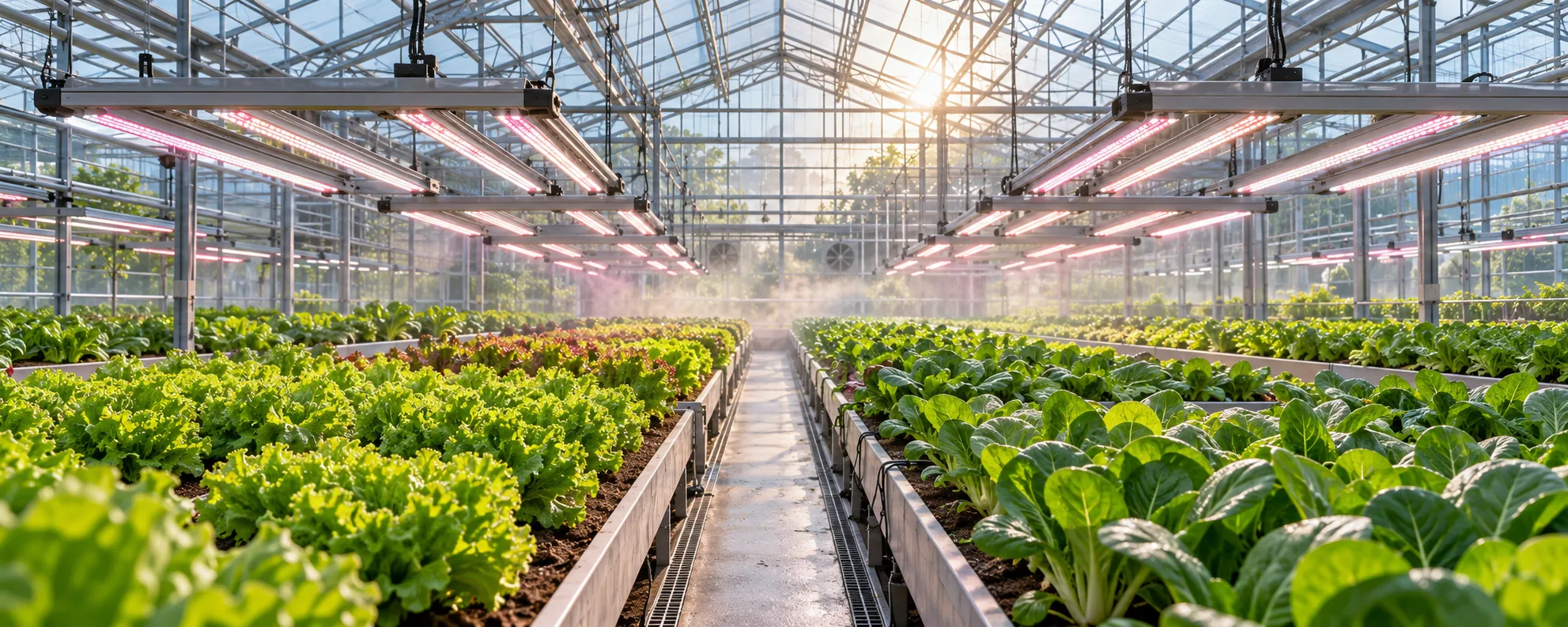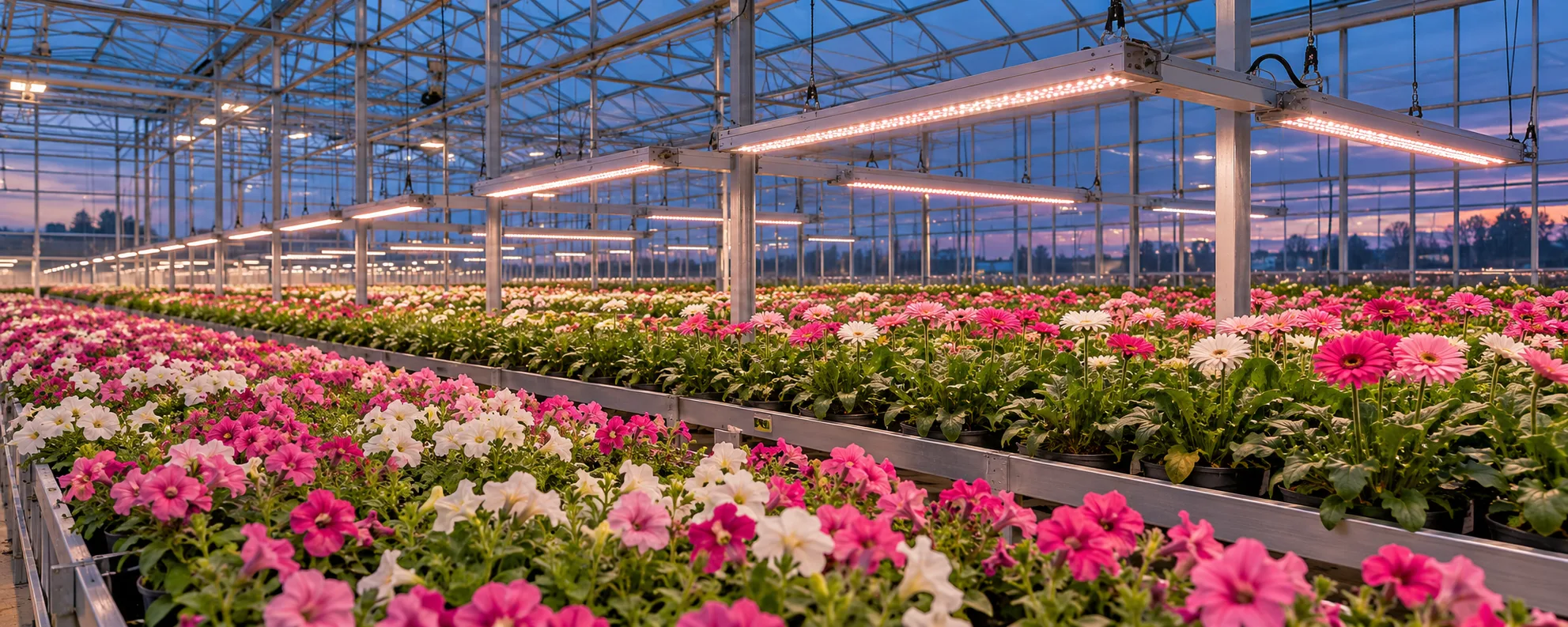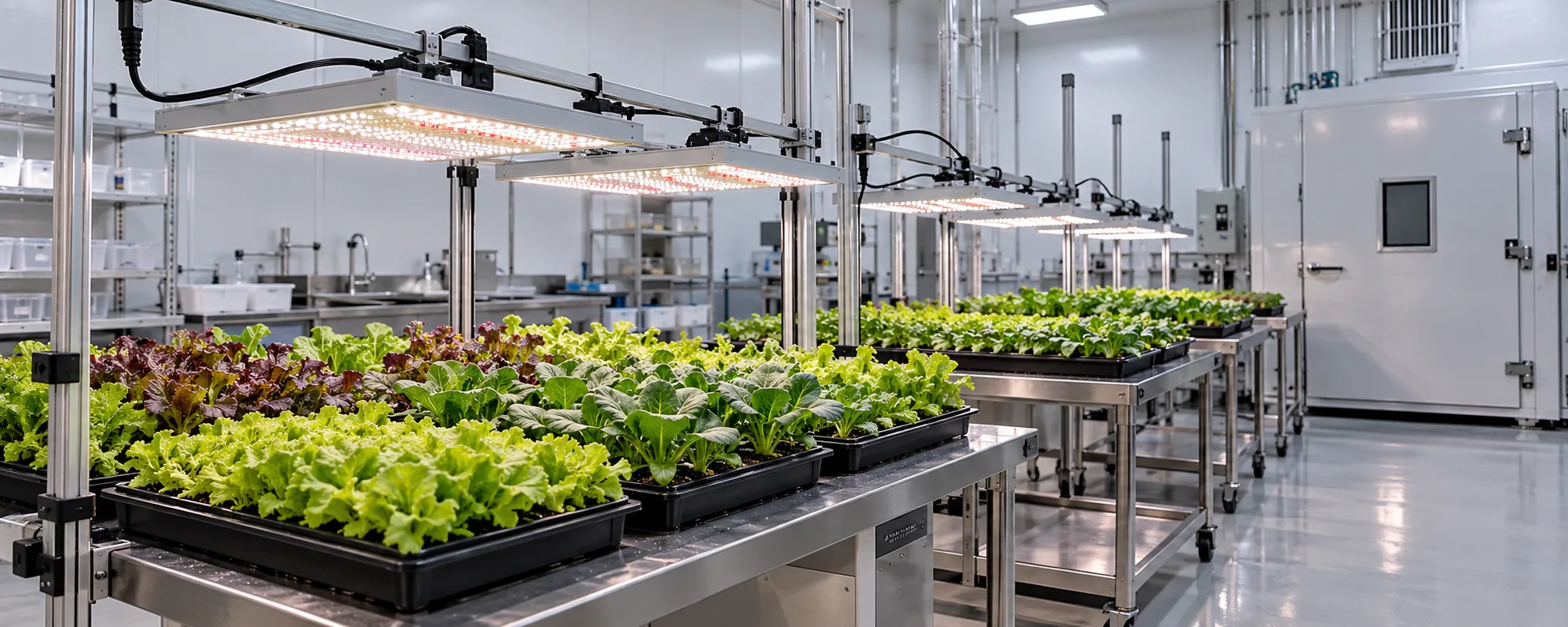
PPF measures the total number of photosynthetic photons a grow light emits each second (µmol/s), PPFD measures how many of those photons actually reach one square meter of plant canopy each second (µmol/m²/s), and PPE measures how efficiently the fixture converts electrical power into photons (µmol/J). All three describe light in the 400–700 nm photosynthetically active range, but at different points in the path from fixture to plant.
Key Takeaways
- PPF = total output (µmol/s); PPFD = canopy intensity (µmol/m²/s); PPE = efficacy (µmol/J).
- PPFD depends on optics and mounting height; PPF does not.
- PPE = PPF ÷ Power; DLC V4.0 requires ≥2.5 µmol/J for listed fixtures.
- DLI = PPFD × photoperiod × 0.0036 (mol/m²/day).
- lm/W is human brightness, not plant photons — ignore it for grow lights.
What Is PPF (Photosynthetic Photon Flux)?
PPF is the total number of photosynthetically active photons a fixture emits per second, in µmol/s. It is an output specification measured over the 400–700 nm band defined by ANSI/ASABE S640, typically with an integrating sphere per ANSI/IES LM-79. Everything the fixture produces, in every direction, counts — whether or not it ever reaches a plant. Higher PPF generally means a more powerful fixture, but on its own it says nothing about where the light goes.
What Is PPFD (Photosynthetic Photon Flux Density)?
PPFD is the photons arriving at a specific point on the canopy, in µmol/m²/s. This is the number your crop responds to, because plants react to the light that actually reaches them. PPFD depends on the fixture’s output, its optics, the mounting height and the distance from the fixture center. The same PPF can produce very different PPFD depending on how the photons are distributed in space.
What Is PPE (Photosynthetic Photon Efficacy)?
PPE is the fixture’s output divided by its total electrical input, in µmol/J. It answers “how many plant photons do I get per watt?” The DesignLights Consortium requires at least 2.5 µmol/J under its Horticultural V4.0 technical requirements. LUMAGROW’s 250 W and 400 W greenhouse top lights are specified at 3.0 and 3.3 µmol/J, comfortably above that line. PPE is what translates watts into both photons and operating cost.
Why These Three Metrics Get Confused
The terms sound similar and share units built on µmol, so they are routinely mixed up in sales conversations. Understanding the difference is the difference between buying a fixture and designing a lighting layout. PPF describes the fixture; PPFD describes the canopy; PPE describes the energy-to-photon conversion.
| Metric | Meaning | Unit | Used for |
|---|---|---|---|
| PPF | Total photosynthetic photon output | µmol/s | Fixture output specification |
| PPFD | Photons reaching canopy per area | µmol/m²/s | Canopy light intensity |
| PPE | Photons per unit electrical power | µmol/J | Electrical photon efficiency |
| PFFR | Far-red photon flux (700–800 nm) | µmol/s | Far-red effects, not PAR |
| DLI | Daily accumulated PPFD | mol/m²/day | Crop daily light dose |
The Core Relationship: PPE = PPF ÷ Power
Because PPE links output to energy, you can derive PPF from a known efficacy and power. Using real LUMAGROW catalog figures: a 250 W greenhouse top light at 3.0 µmol/J yields about 750 µmol/s PPF, and a 400 W unit at 3.3 µmol/J yields about 1320 µmol/s. These are calculated values from stated PPE and power, not independent measurements — confirm with the model’s LM-79 report.
From PPFD to DLI: Sizing the Photoperiod
PPFD is instantaneous; crops care about the total photons received per day, the daily light integral (DLI). Multiply PPFD by the photoperiod and the constant 0.0036 to get DLI in mol/m²/day. The constant converts µmol/m²/s × hours into mol/m²/day (1 mol = 1,000,000 µmol; 1 hour = 3600 s; 3600 / 1,000,000 = 0.0036).
PAR and the 400–700 nm Window
Photosynthetically active radiation (PAR) is the 400–700 nm waveband because that is where chlorophyll absorbs the photons that drive photosynthesis. Red light (around 600–700 nm) is the most photon-efficient band — Utah State University research (Cope & Bugbee) shows red is 25–35% more efficient than blue and 5–30% more efficient than green on a quantum basis. Far-red (700–800 nm) lies outside PAR but still affects morphology and flowering. The diagram below shows the PAR window and relative intensity shape.
What about far-red (PFFR)?
Far-red photon flux (PFFR) is reported separately over 700–800 nm. Michigan State University Extension notes that adding far-red (700–800 nm) to red light can accelerate flowering of long-day plants, while a spectrum rich in red alone inhibits short-day flowering. It is a useful production tool, but it is not part of the 400–700 nm PPF/PPE calculation.
How Mounting Height Changes PPFD
PPFD falls as the fixture is raised because the same photons spread over a larger area. Real LUMAGROW photometric data for a 400 W greenhouse top light shows the effect clearly: peak PPFD rises from about 650 µmol/m²/s at 30 cm to 708 at 45 cm and 717 at 60 cm as the beam consolidates — but the lit area also changes. This is why layouts must use your actual mounting height, never a catalog’s single headline number.
| Mounting height | Peak PPFD | Note |
|---|---|---|
| 30 cm (12 in) | ≈ 650 µmol/m²/s | Tight, high-intensity footprint |
| 45 cm (18 in) | ≈ 708 µmol/m²/s | Beam consolidating |
| 60 cm (24 in) | ≈ 717 µmol/m²/s | Wider, more uniform coverage |
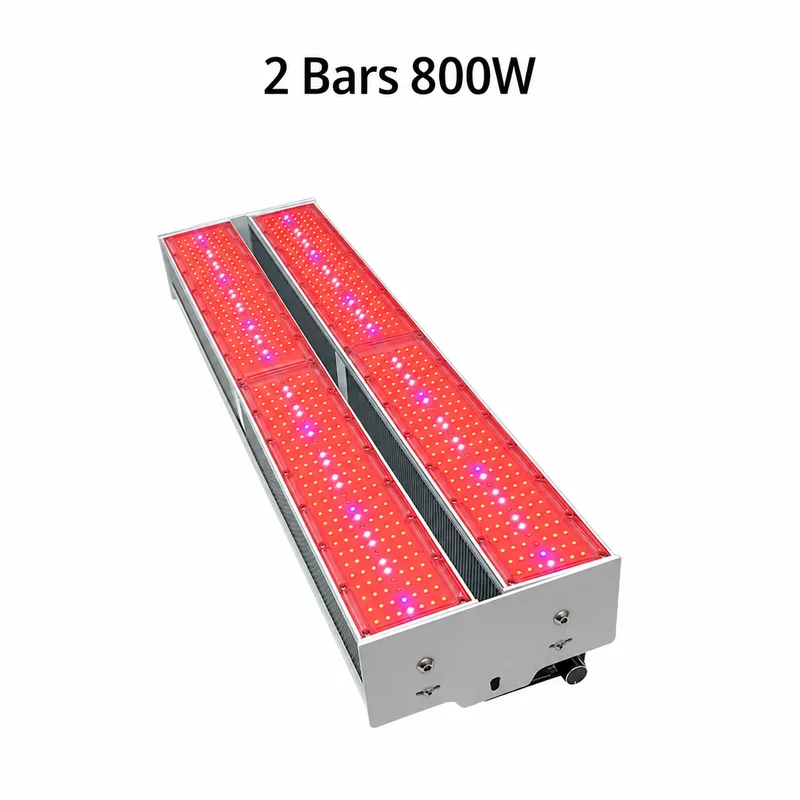
Luminous Efficacy (lm/W) Is Not Photon Efficacy
Some spec sheets list luminous efficacy in lm/W. That measures how bright a light looks to the human eye, weighted by our visual sensitivity — not how many photons a plant receives. Plant response follows photon count in 400–700 nm (µmol/J). A fixture can be efficient in lm/W yet weak in µmol/J, or vice versa. Always compare µmol/J for grow lights; lm/W is irrelevant to photosynthesis and should never be used to judge a horticulture fixture.
Common Mistakes
- Comparing fixtures by PPF alone without a PPFD map.
- Treating watts as light output.
- Using lm/W (lumens) as if it were µmol/J (photons).
- Quoting a single PPFD number regardless of mounting height.
- Assuming higher PPFD always means a better fixture, ignoring uniformity.
Frequently Asked Questions
Is higher PPE always better?+
Higher photon efficacy (µmol/J) means more light per watt, which lowers energy cost — usually good. But PPE is only one factor; spectrum, PPFD uniformity, driver quality, thermal design and reliability also determine results. A fixture with very high PPE but poor uniformity or weak warranty can cost more over five years than a balanced design.
Can PPF be converted directly into PPFD?+
Not by a simple formula, because PPFD depends on how the photons are distributed in space. The same PPF can produce very different PPFD depending on optics, reflector and mounting height. Always ask for a PPFD map at your intended height; PPF alone only tells you total output.
How is PPFD measured?+
PPFD is measured with a quantum sensor (PAR meter) or spectroradiometer placed at the canopy, reporting µmol/m²/s. Fixture manufacturers report PPF with an integrating sphere per ANSI/IES LM-79 over 400–700 nm. Independent LM-79 reports are more trustworthy than marketing numbers.
Does mounting height affect PPFD?+
Yes, strongly. PPFD drops as the fixture is raised because photons spread over a larger area. Real LUMAGROW data shows a 400 W greenhouse top light reaching about 650 µmol/m²/s at 30 cm, 708 at 45 cm and 717 at 60 cm — confirming why layouts must use your actual height.
What PPE is considered efficient for LED grow lights?+
The DesignLights Consortium Horticultural QPL requires at least 2.5 µmol/J under V4.0 (2.3 under V3.0). Commercial fixtures commonly rate 2.5–3.3 µmol/J; LUMAGROW’s 250 W and 400 W greenhouse lights are specified at 3.0 and 3.3 µmol/J. Treat any claim below ~2.3 as dated.
Can two lights with the same wattage have different PPF?+
Yes. Two 400 W fixtures with different diode efficiency, optics and thermal design can emit very different PPF. One may reach ~1320 µmol/s at 3.3 µmol/J while another sits near 1000 µmol/s. Watts set the energy budget; PPE and optics decide the photons.
What is the difference between PPF and DLI?+
PPF is instantaneous total output (µmol/s); DLI is the accumulated photons over a day (mol/m²/day) at the canopy, calculated as PPFD × photoperiod × 0.0036. PPF describes the fixture; DLI describes what the crop receives across a full light period.
Why do some specs show lm/W instead of µmol/J?+
lm/W is luminous efficacy — how bright a light looks to the human eye, not how many photons plants receive. Plant response follows photon count in 400–700 nm (µmol/J). Always compare µmol/J for grow lights; lm/W is irrelevant to photosynthesis and should not be used to judge a horticulture fixture.
Conclusion
PPF, PPFD and PPE answer three different questions — how much light the fixture makes, how much reaches the plant, and how efficiently it uses power. Read all three from a real LM-79 report, at your actual mounting height, and you can compare fixtures on merit instead of marketing. For buying decisions, see our commercial indoor grow light selection guide and the commercial greenhouse lighting guide.
References
- Michigan State University Extension — Greenhouse & Horticultural Lighting — DLI, PPFD and supplemental lighting principles.
- Michigan State University Extension — Choosing the right LEDs to regulate flowering — red (600–700 nm) and far-red (700–800 nm) effects on flowering.
- Utah State University (Bugbee & Nelson) — Economic Analysis of Greenhouse Lighting — definition of PPF, PPE and PAR (400–700 nm).
- Utah State University (Cope & Bugbee) — Blue and green light in plant photosynthesis — relative quantum efficiency across wavelengths.
- DesignLights Consortium — Horticultural Technical Requirements V3.0 (PDF) — PPF definition and LM-79 testing.
- DesignLights Consortium — Horticultural Technical Requirements V4.0 — current PPE threshold ≥2.5 µmol/J.
Need Help Reading a Grow Light Spec Sheet?
Send us a competitor datasheet or your target PPFD and we will translate the numbers into a fixture recommendation and a wholesale quotation.
Get a Grow Light Solution