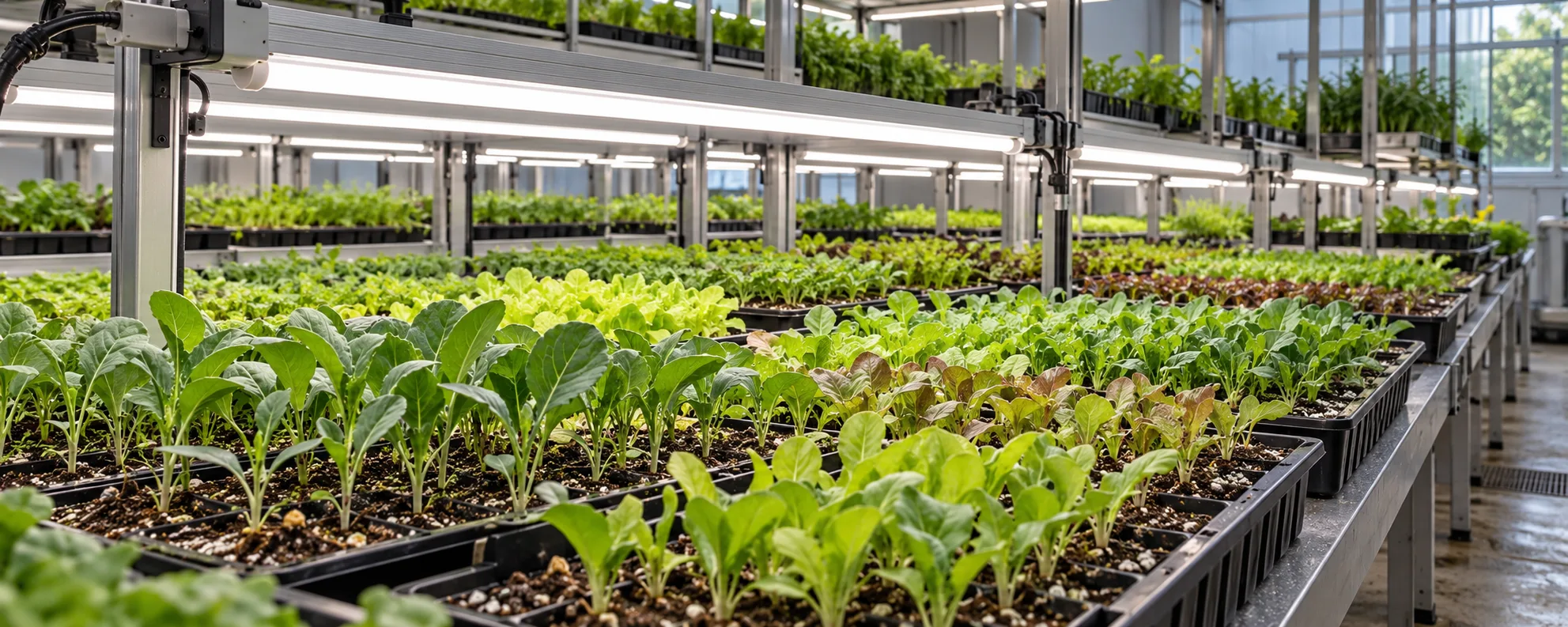
Success in propagation is measured in uniformity: a flat of seedlings or clones that all reach transplant size together. DLI and photoperiod are the two light levers that decide that uniformity. Set DLI to build stocky structure, choose a photoperiod that fits the stage, and you remove the two most common causes of uneven transplants — stretch and delayed finish. This article keeps the math exact and the targets as validated starting points.
DLI for young plants
Young plants generally need less DLI than finished crops, but too little is the classic stretch trigger. The conversion is exact; the target is a young-plant starting point to confirm by trial. The companion propagation lighting article gives the PPFD table from these DLIs.
| Stage | Illustrative DLI | Why |
|---|---|---|
| Sowings / germination | Low, gradual ramp | Tender, avoid bleaching |
| Seedlings | ~6-10 mol/m²/day | Stocky structure, no stretch |
| Cuttings / clones | Moderate, even | Rooting without stress |
| Hardening | Adjust to finish environment | Acclimate before transplant |
Photoperiod fits the stage
Photoperiod sets the daily window over which DLI is accumulated. Longer photoperiods let you hit a DLI at lower PPFD (gentler on tissue); shorter ones require higher PPFD. For propagation the goal is even, moderate light, so a moderate photoperiod with modest PPFD is usually kinder than a short, intense one.
Uniformity is the metric
You are not chasing a maximum DLI; you are chasing a flat, repeatable one so every cell in the tray finishes together. Measure across the shelf and log the recipe per batch.
Mistakes that break propagation
- Too-low DLI causing stretch, then over-correcting with bleaching intensity.
- Ignoring shelf-edge light drop-off.
- Changing photoperiod between batches without logging it.
- Mixing fixture types on one shelf and calling it one recipe.
| Mistake | Fix |
|---|---|
| Too-low DLI | Raise moderate light |
| Bleaching | Lower intensity, acclimatise |
| Edge drop-off | Overlap past tray edges |
| Unlogged schedule | Log photoperiod per batch |
Photoperiod as a species decision, not a room setting
Photoperiod matters in propagation for two different reasons. The first is energy budget: young plants need less total light than finishing plants, and a long photoperiod at low intensity delivers a modest DLI gently. The second is developmental: many species respond to day length itself, and propagation is where that response is either managed or accidentally triggered.
- Long-day plants (many annual bedding crops, some herbs) interpret extended photoperiods as a signal toward flowering; in propagation this causes premature stretching and finishing problems downstream.
- Short-day plants interpret long nights as a flowering cue; night-interruption lighting prevents unintended induction during the vegetative phase.
- Day-neutral species respond mainly to total light, so DLI planning matters more than photoperiod shape.
- Where day length must not shift, keep photoperiods at or under 16 hours (or use night interruption) and log the schedule as part of the batch record.
Worked example: two routes to the same DLI
Illustrative numbers. A seedling crop with a DLI target of 10 mol/m2/day can reach it at 16 hours with 174 umol/m2/s, or at 20 hours with 139 umol/m2/s. The 20 hour route lowers fixture demand and gives softer light, which suits delicate seedlings; the 16 hour route matches standard schedules and leaves a clear dark period. For a day-sensitive species the choice is made for you; for day-neutral crops it is an operations decision about fixture count, labour windows and energy tariffs.
Whichever route is chosen, measure it. A small quantum sensor logging at tray height, reviewed weekly, tells you whether the plan and the room agree. Propagation failures attributed to genetics or media are sometimes, on measurement, lighting failures: a tray zone that never reached its planned DLI because fixtures were moved and never re-checked.
Questions to ask before you buy
- Can the fixture and controller run stage-specific photoperiods per zone, including night interruption?
- Does PPFD hold linearly with dimming signal so low-intensity stages deliver predictable DLI?
- Is the spectrum stable across the dimming range, since young plant morphology is sensitive to shift?
- What is the measured efficacy at the low outputs propagation actually uses?
- Can schedules be exported and documented, so photoperiod records travel with the batch?
Common mistakes in propagation DLI and photoperiod
Propagation lighting errors concentrate in two areas: too much too early, and day length treated as an afterthought. The specific recurring mistakes:
- Applying finish-room DLI numbers to unrooted cuttings, which cannot support high light before roots supply water.
- Ignoring photoperiod sensitivity of the species in the tray, then diagnosing premature flowering downstream as a genetics problem.
- Assuming long photoperiods always help; for many species the extra hours signal developmental changes, not just extra photosynthesis.
- One schedule for the whole propagation room when species or even cultivars differ in day-length response.
- Measuring light at the room level and not at tray level; a propagation room can have a 2-to-1 spread between shelves.
- Never recording the DLI actually delivered per batch, so improvements cannot be reproduced and failures cannot be explained.
Light quality effects specific to young plants
Compactness without chemicals
A higher blue fraction and moderate intensity are the standard lighting levers for compact young plants, and many growers use them to reduce or replace mechanical and chemical growth control. The effect is cultivar specific and dose dependent, so the practical method is a small tray trial per new cultivar, recording the settings and the outcome. Once calibrated per crop, the recipe becomes a repeatable part of the young-plant program rather than a one-off experiment.
Night interruption done deliberately
Where long nights would trigger flowering in a sensitive species, night-interruption lighting (a short low-intensity period in the middle of the night) prevents induction. The technique is old and reliable, but it needs intention: correct timing, low intensity, and species-specific schedules in a mixed room. Applied carelessly, night interruption itself becomes the photoperiod signal; applied deliberately, it is one of the cheapest tools in young-plant scheduling.
| Species group | Day-length response | Propagation photoperiod approach |
|---|---|---|
| Day-neutral leafy crops | Little response | DLI-driven; 16-18 h typical |
| Long-day annuals | Flowering promoted by long days | Keep at or under 16 h; avoid night interruption |
| Short-day species | Flowering promoted by long nights | Night interruption during establishment |
| Mixed-species room | Varies | Zoned schedules or separate rooms |
Troubleshooting propagation by the numbers
Most propagation lighting problems present as symptoms in the tray and resolve as numbers in the log. A working troubleshooting sequence:
- Symptom: uneven rooting across one tray. First check: PPFD map of that shelf; edge and aisle deficits show up exactly like this.
- Symptom: seedlings stretch and lean. First check: delivered PPFD and photoperiod versus plan; chronic under-delivery stretches before it slows.
- Symptom: wilting after dome removal. First check: the light step size between stages, not the misting schedule alone.
- Symptom: premature flowering in the tray. First check: photoperiod log and night-interruption settings before blaming seed or season.
- Symptom: uniform stall in one rack column. First check: fixture output and driver faults in that column; one failed driver dims a tier quietly.
- Symptom: quality differs between two supposedly identical rooms. First check: sensor cross-calibration; instruments drift apart before crops do.
The sequence works because it starts with the cheapest, most measurable variable (light) before moving to media, water and genetics. In practice, a surprising share of propagation mysteries end at a sensor, a dimmer or a schedule that no longer matched the plan.
References you can verify
- University of Florida IFAS - light requirements and propagation guidance
- Royal Horticultural Society - light and plant growth
- e-GRO - young plant production lighting notes
Frequently asked questions
What DLI prevents stretch?+
Often a modest young-plant DLI (roughly 6-10 mol/m²/day as a start). Confirm for your species; too little is the usual stretch cause.
Short or long photoperiod for seedlings?+
A moderate photoperiod with modest PPFD is usually gentler than short-and-intense. Match the window to your DLI target.
Should I ramp light after germination?+
Often yes — tender new growth tolerates less. Ramp gradually rather than hitting full intensity immediately.
How do I keep a whole tray uniform?+
Even PPFD across the shelf (check edges), one documented recipe per batch, and consistent photoperiod.
Is DLI the same as PPFD?+
DLI is the daily total; PPFD is the instantaneous rate. DLI = PPFD × hours × 0.0036 for constant intensity.
When do I harden off lighting?+
Before transplant, gradually move the light regime toward the finish environment so plants acclimate rather than shock.
Standardising propagation?
Tell us crop and tray layout. We help set a uniform DLI and photoperiod recipe.
Get a Grow Light Solution