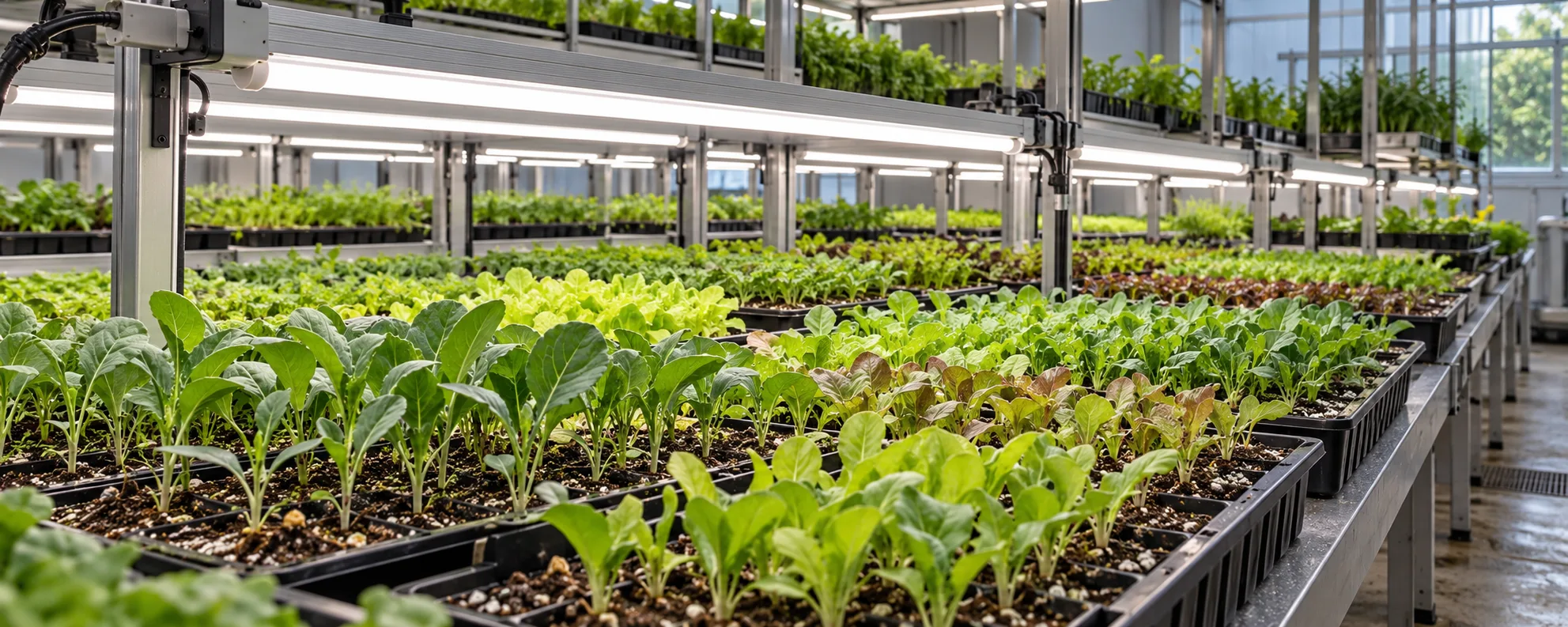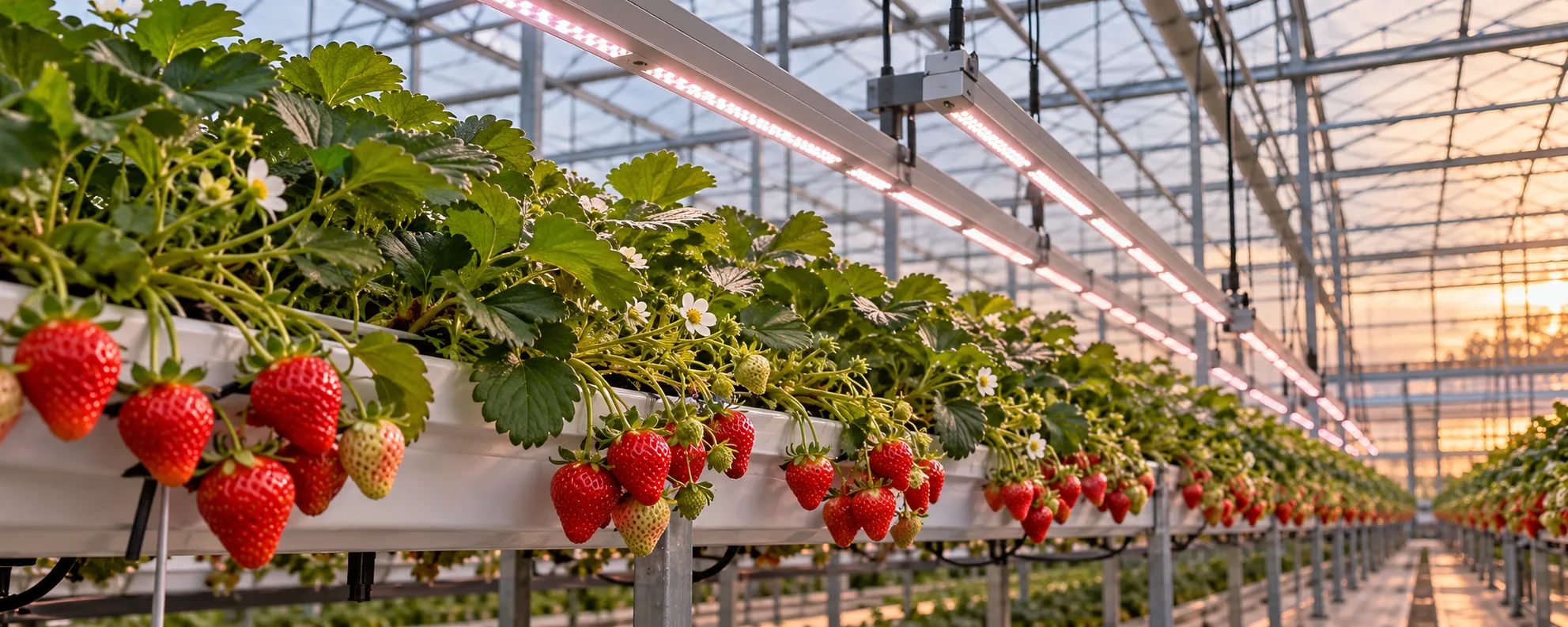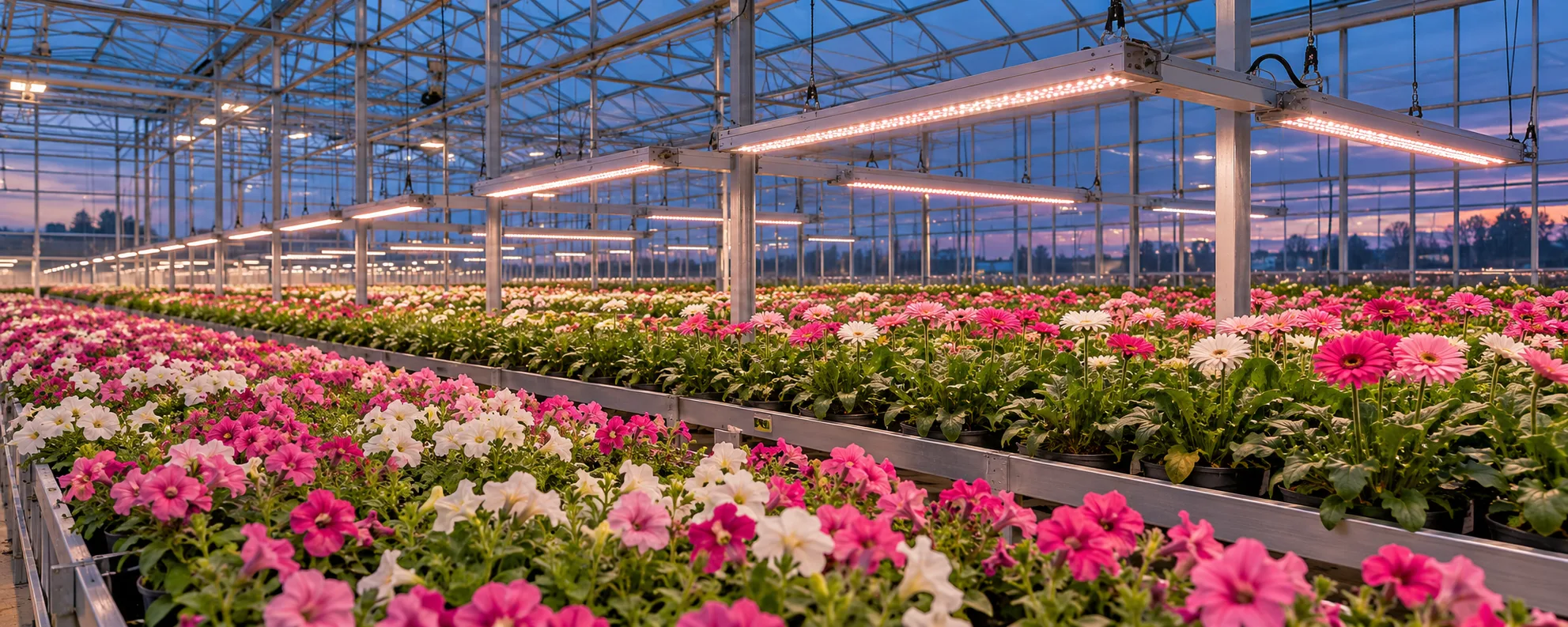
Propagation racks pack trays into dense, low shelves, which makes lighting layout unforgiving: a few centimetres of fixture height or a missed overlap shows up immediately as uneven trays. The method is the same as any layout — set target PPFD, overlap for uniformity, count fixtures — just at a smaller, closer scale. This article works a standard rack example and points to the propagation industry page for the full method.
Close spacing needs careful overlap
Because fixtures sit close to trays, each fixture covers a small area, so overlap matters even more than in a tall room. Edge trays are the usual victims — they get less light than centre trays. Design the shelf so fixtures overlap past the tray edges, and verify with a grid measurement on a loaded shelf.
| Layout | Centre PPFD | Edge PPFD | Result |
|---|---|---|---|
| Edge-to-edge | High | Low | Stretch at edges |
| Overlapped past edges | Even | Even | Uniform trays |
| Single centre bar | High centre | Very low edges | Worst |
Worked rack example
Standard rack: 1.2 m × 0.6 m shelf (0.72 m²), target 120 µmol/m²/s, generic propagation bar 300 µmol/s at tray, uniformity factor 0.85.
| Scope | Calculation | Result |
|---|---|---|
| Shelf demand | 120 × 0.72 | 86.4 µmol/s |
| Fixtures per shelf | 86.4 ÷ 300 ÷ 0.85 | 0.34 → min 1 |
| Rack (10 shelves) | 1 × 10 | 10 fixtures |
| Total canopy | 0.72 × 10 | 7.2 m² |
Measure a loaded shelf
An empty shelf reads differently from a full one — trays shade and reflect. Always measure PPFD across a fully loaded shelf and include the edges in the average and CV.
Worked example: fixtures per shelf for dense propagation racks
Illustrative numbers. A propagation shelf is 1.2 m x 2.4 m (2.88 m2) holding full trays of cuttings at a target of 150 umol/m2/s over 16 hours. Fixtures are 900 mm bars at 200 PPF and 2.6 umol/J.
- Required PPF per shelf: 150 x 2.88 x 1.15 (uniformity) = 497 umol/s.
- Bar count: 497 / 200 = 2.5, rounded to 3 bars per shelf for an even layout along the 2.4 m length.
- Electrical load per shelf: 3 x (200 / 2.6) = about 231 W; a 6-tier rack column draws roughly 1.4 kW.
- DLI delivered: 150 x 16 x 0.0036 = 8.6 mol/m2/day, a typical unrooted-cutting band.
- Dimming covers rooted stages: raising to 200-250 umol/m2/s for rooting progress is a schedule change, not a hardware change.
- Clearance: keep 0.35-0.45 m between bar and tray for service access and to avoid heat stress on tender cuttings.
On dense racks the edge problem is inverted compared with open benches: instead of losing light off the sides, adjacent tiers shade each other and the aisle, and tray edges can sit in the fixture hotspot. A mapping run with the trays in place (not empty racks) is the only honest uniformity check.
Uniformity on dense shelves
Tray density and bar spacing interact
The more uniform the tray occupancy, the easier uniformity is: full trays forgive layout sins, while a shelf mixing a full tray and two half trays puts different crops under the same light field. Where mixed occupancy is unavoidable, choose bar spacing that overlaps (spacing under the bar-to-bar throw distance) and dim per zone where the controller supports it. Uniformity targets for propagation are modest (min-to-avg around 0.8 or better) because cuttings are less stretch-prone than finishing crops, but chronic dark corners still show up as uneven rooting and staggered transplant dates.
Service and sanitation access
Propagation rooms are cleaned between batches, and fixtures at tray height get sprayed, splashed and knocked. Fixtures for this environment need sealed construction, smooth surfaces, cable management that survives trolleys, and mounts that allow single-person height adjustment. These build-quality factors determine whether the lighting still looks professional after two years of sanitation cycles, and they belong in the purchase decision, not the complaint log.
Questions to ask before you buy
- What is the fixture IP rating and cleanability under propagation humidity and sanitation sprays?
- Can mounting systems be adjusted without tools as trays change height through stages?
- Is the PPF figure measured for the exact bar length and drive current quoted?
- What per-zone dimming granularity does the controller support across a multi-tier rack?
- What is the warranty for fixtures installed close to the crop in humid conditions?
Common mistakes in propagation rack layout
Dense racks concentrate both plants and errors. The recurring layout mistakes:
- Designing bar spacing for full, uniform trays and then running mixed occupancy, which turns one light field into several unintended zones.
- Forgetting the aisle effect: trays nearest the aisle sit in a different light field than centre trays, and cuttings respond by rooting unevenly.
- Mounting fixtures permanently at one height, then adjusting crops to fit the hardware instead of the reverse.
- Ignoring rack-to-rack light spill and shading; the row in front shades the row behind for part of every day in lit corners of the room.
- Under-rating fixtures for a humid, sprayed environment and replacing them within two seasons.
- Mapping uniformity on empty racks, which validates geometry that no longer exists once trays, domes and plants are in place.
Working with the room around the racks
Room-level reflections and finishes
In a dense propagation room, light that misses a tray usually hits another tray after one or two reflections. Wall and ceiling finishes therefore contribute to uniformity: light-coloured, washable surfaces add more usable light than dark ones, and reflective materials placed behind perimeter racks recover edge losses. The contribution is modest but free at design time and expensive to add later, which makes it a layout-stage decision.
Maintenance that fits the schedule
Propagation runs on tight cycles, and fixture maintenance that requires emptying shelves will be deferred indefinitely. Choose fixtures and mounts that can be wiped, inspected and serviced in place, schedule the work between batches, and log cleaning because dust on fixtures and trays measurably reduces delivered PPFD. A propagation room with a written maintenance rhythm keeps its original uniformity; one without slowly loses it, one season at a time.
| Task | Frequency | Note |
|---|---|---|
| Fixture and tray-shelf wipe-down | Between batches | Log delivered PPFD before and after |
| PPFD map (one reference shelf) | Monthly | Compare with commissioning map |
| Sensor calibration check | Annually | Cross-check against reference sensor |
| Driver and cable inspection | Quarterly | Focus on sprayed zones |
Fixture options for propagation racks compared
Three fixture families dominate propagation racks, each with a different trade-off profile. The comparison below is generic; product specifics vary by vendor and should be verified against your own measurements:
| Fixture family | Strengths | Watch-outs |
|---|---|---|
| Slim LED bars | Even overlap along the shelf, easy height adjustment, low weight | More units per shelf; connector count rises |
| Compact modules / panels | High output per unit, fewer mounting points | Hotspots under the panel edge if spacing is wrong |
| Adjustable-spectrum units | Stage control (germination to hardening) in one fixture | Higher unit cost; verify PPE at the actual channel mix |
For most dense propagation shelves, slim bars with deep dimming are the default answer because uniformity and adjustability dominate the decision; intensity per unit matters less at propagation levels. Panels earn their place where mounting points are scarce; spectrum-adjustable units earn theirs where species diversity is high and one shelf serves several crops. Whichever family is chosen, the acceptance test is the same: a mapped PPFD field with trays in place, at the outputs the stages actually use.
References you can verify
- e-GRO - propagation and young plant lighting notes
- University of Florida IFAS - propagation and light guidance
- Michigan State University College of Agriculture and Natural Resources
Frequently asked questions
How close to trays can bars be?+
Close, but never touching, and watch leaf temperature on tender tissue. Follow the fixture clearance guidance.
Why are my edge trays weaker?+
Edge light drop-off from poor overlap. Extend fixture overlap past tray edges and measure the edges.
One bar per shelf enough?+
Only for very small shelves; single centre bars leave edges dark. Use overlap so the whole tray is lit.
How do I verify the layout?+
Grid-measure a loaded shelf, compute average and CV, and confirm edges are within tolerance of the centre.
Does spacing differ by crop?+
The layout method is the same; the target PPFD changes with crop and stage. Set the target, then lay out.
Can I reuse flowering-room fixtures?+
Too intense and poorly suited to close trays. Low-watt rack bars are built for this; see [propagation rack grow lights](/products/propagation-rack-grow-lights).
Laying out propagation racks?
Share shelf dimensions and crop. We help set overlap and fixture count per shelf.
Get a Grow Light Solution