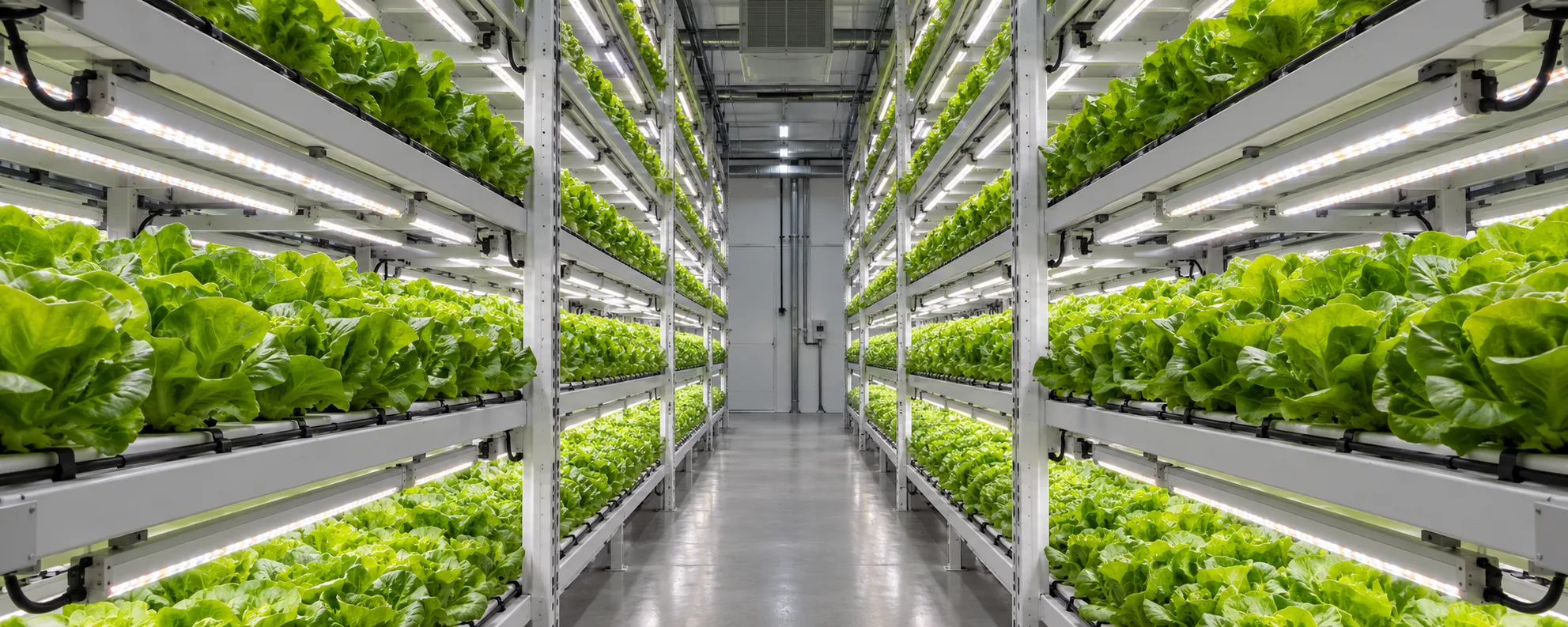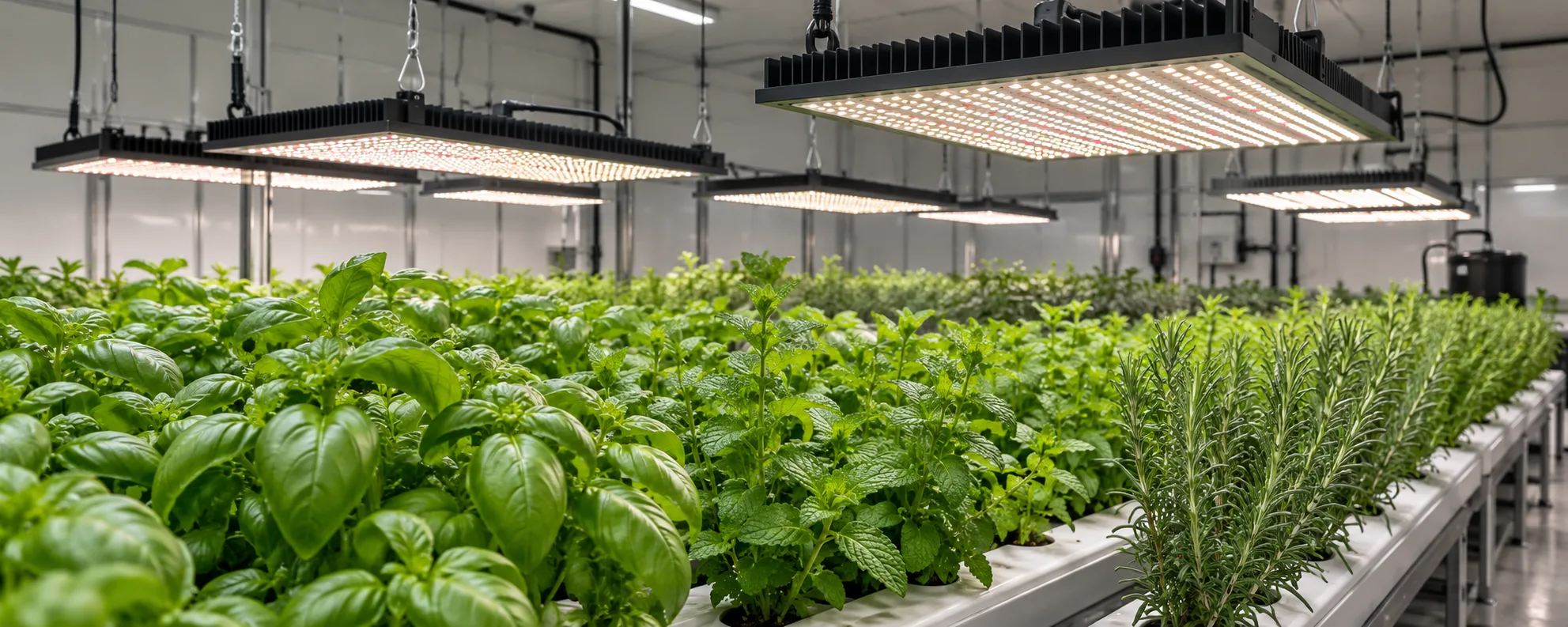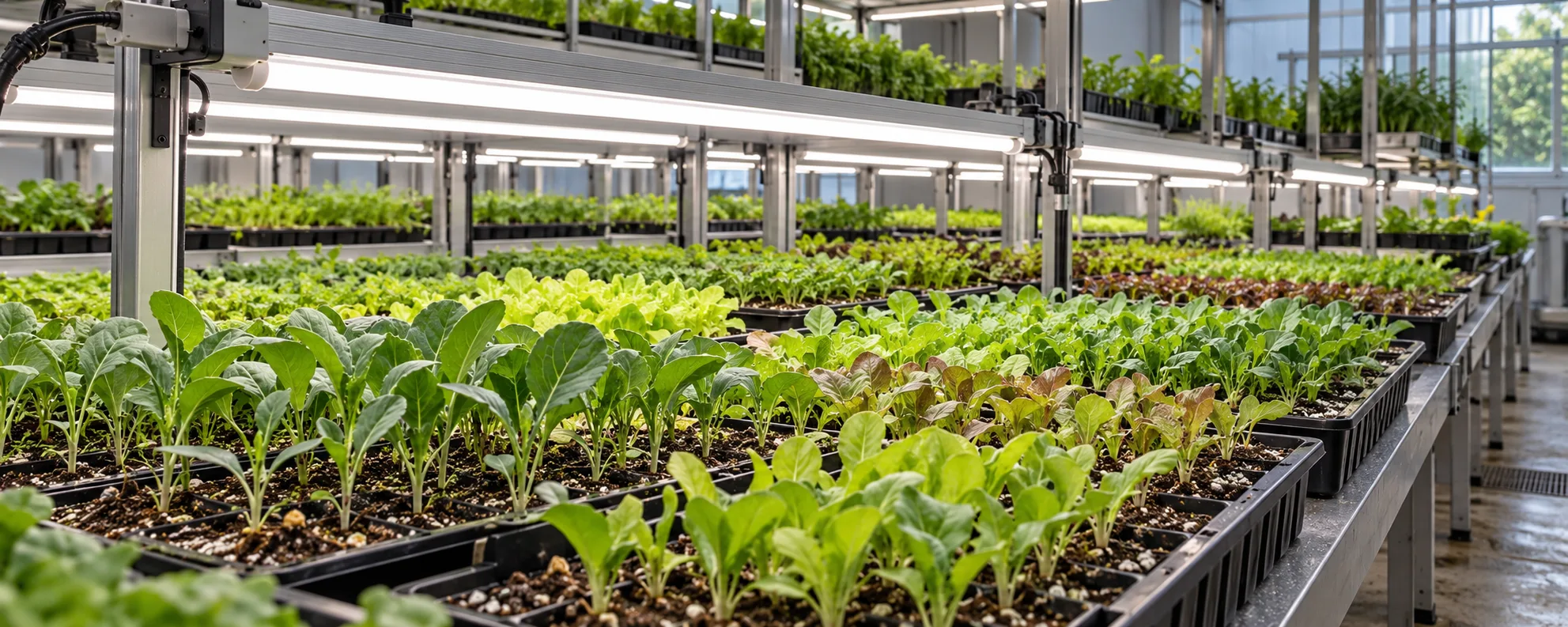
In a vertical farm the spectrum is the one lighting variable you can hold nearly identical on every tier, every week — which makes it a powerful consistency tool if you use it deliberately. For leafy greens and herbs the practical question is not "full spectrum or not" but which bands drive the traits you care about (compactness, colour, yield) and whether a fixed efficient recipe beats an expensive tunable one. This article gives a strategy.
The bands that usually matter
Most leafy-green and herb recipes are built on red and blue, the bands plants use most efficiently, often with a phosphor-created white for visual quality and some green for canopy penetration. Far-red is used deliberately for morphology (compactness and internode control) rather than by accident. The point is to choose bands for an effect you can name, not to chase a marketing colour name.
| Band | Trait commonly managed |
|---|---|
| Blue (400-500 nm) | Compactness, stomatal function, colour intensity |
| Red (600-700 nm) | Photosynthesis efficiency, biomass |
| Far-red (700-750 nm) | Morphology, internode length, flowering timing |
| Green (500-600 nm) | Canopy penetration, visual quality |
Fixed recipe vs tunable
A fixed, efficient spectrum is cheaper, simpler and easier to keep consistent — and for many greens and herbs it is all you need. Tunable channels earn their cost only when a stage-specific band mix is proven to change grade or yield enough to pay back. Specifying tunable "just in case" usually adds cost and complexity with no measured benefit.
Consistency beats novelty
A vertical farm’s advantage is repeatability. A fixed, documented spectrum that every tier shares will outperform a fancy tunable spectrum you never calibrate. Change spectrum only when a trial shows a paying benefit.
Keep spectrum consistent tier-to-tier
Because tiers share the same crop, mixing fixtures or settings across tiers silently breaks consistency. Log the recipe per tier, calibrate after any hardware change, and treat all tiers as one documented spectrum. This pairs with the photoperiod and dimming discipline covered in our indoor photoperiod article.
- Name the trait each band is meant to manage.
- Prefer a fixed efficient recipe unless a trial proves tunable pays.
- Log the spectrum per tier; recalibrate after hardware changes.
- Avoid mixing fixture models with different spectra in one zone.
| Dimension | Fixed recipe | Tunable recipe |
|---|---|---|
| Cost | Lower | Higher |
| Consistency | Easy to hold | Needs calibration discipline |
| Flexibility | One recipe | Stage-specific bands |
| Best when | Proven single recipe | Trial shows a paying benefit |
Why spectrum decisions differ in a vertical farm
In a vertical farm the fixture is the only light source, so the spectrum is fully under your control every hour of every day. That is an opportunity and a responsibility: whatever the spectrum does to the crop, you chose it. The practical starting position used by most commercial operators is a white-plus-red spectrum for a balance of plant response and human working conditions, with the red fraction adjusted for crop goals and the blue fraction used to manage compactness and colour.
Spectrum effects that matter for greens and herbs
Blue fraction: compactness versus growth speed
Raising the blue fraction generally produces more compact plants with deeper colour and thicker leaves; lowering it tends to favour leaf expansion and fresh weight. For lettuce, a moderate blue share is common, with increases used deliberately when compactness or anthocyanin colouration is a quality goal. Basil often responds well to higher total light with moderate blue. These responses vary by cultivar, which is why spectrum changes should run as small tray trials with written observations before a whole-room change.
Red and far-red: shape and timing
Red drives photosynthetic efficiency and is usually the largest spectral component in LED grow spectra. Far-red sits at the edge of photosynthesis but influences shade responses and can affect leaf expansion and flowering in some species. End-of-day far-red exposure is one of the documented levers, but its effect is crop specific and easy to get wrong at scale. Treat far-red as a trial-stage tool with explicit documentation, not a permanent room setting adopted from a conference talk.
Human factors: the overlooked spectrum constraint
Staff inspect, seed, harvest and clean under this light. Heavy blue-plus-red spectra render colours poorly, hide plant defects and tire the eyes; pink-lit rooms are a genuine operational cost. Options that preserve both goals include spectra with a strong white component, task lighting at inspection stations, and scheduling human work during a dimmed phase. A spectrum that grows plants well but cannot be worked under will lose to a slightly less efficient spectrum that staff can actually use.
Questions to ask before you buy
- Is the full spectral power distribution published per channel, not just a marketing spectrum graphic?
- Which channels are independently controllable, and what is the wavelength peak of each?
- Can spectrum settings be scheduled by crop stage and exported as a documented recipe?
- What is the efficacy of the exact spectrum you plan to run, since PPE changes with channel mix?
- Does the supplier support trial quantities so you can run cultivar tests before a full-room commitment?
Common mistakes in vertical farm spectrum strategy
Spectrum is the most over-claimed variable in CEA lighting, and vertical farms feel it first because the fixture is the only sun. Recurring mistakes:
- Buying a spectrum because of a trial on a different cultivar; responses vary enough that the transfer is a hypothesis, not a result.
- Changing spectrum and intensity together, then attributing the outcome to the spectrum.
- Optimising spectra for photosynthesis only, then discovering that staff cannot inspect, and defects hide under the pink light.
- Running untested far-red or end-of-day protocols room-wide after seeing one conference slide.
- Ignoring that fixture efficacy changes with channel mix, so the efficient spectrum at full power is not the efficient spectrum at 40 percent.
- Treating the spectrum as set once; crop stage, season and quality targets all justify scheduled changes that nobody planned.
Running spectrum trials that produce decisions
A minimal credible trial format
A decision-grade trial does not need a research budget. It needs zones: two or more rack sections at the same PPFD with different spectral mixes, a written record of the settings, and pre-agreed measurements (fresh weight, height, colour, days to harvest, unsaleable rate). One full crop cycle gives a first read; two confirms. The discipline of pre-agreeing the measurements is what separates a trial from a tour: decide before starting what number will trigger a room-wide change.
Recording the recipe with the result
Every trial result should travel with the exact settings that produced it: channel percentages, fixture model, drive level, measured PPFD and photoperiod. Six months later, when the quality team asks why week 32 was more compact, the recipe plus the measurement log answers in minutes. Without it, the room has produced a feeling rather than a finding, and feelings do not transfer to the next facility.
| Zone | Channel mix | PPFD (umol/m2/s) | Photoperiod (h) | Outcome measure |
|---|---|---|---|---|
| A (control) | Standard white-red | 220 | 18 | Fresh weight, days to harvest |
| B | Higher blue | 220 | 18 | Compactness index, colour |
| C | Higher red | 220 | 18 | Leaf expansion, cycle time |
| D | Control + EOD far-red | 220 | 18 | Morphology observations |
References you can verify
- e-GRO - spectrum and lighting trials for controlled environments
- Michigan State University College of Agriculture and Natural Resources
- Royal Horticultural Society - light quality and plants
Frequently asked questions
Do leafy greens need far-red?+
Not always. Far-red affects compactness and morphology; some operations use it deliberately, others avoid it. Test for your crop and grade goals rather than assuming.
Is a white light "full spectrum"?+
White LEDs are typically a red-blue base with phosphor fill — efficient and visually natural, not a special spectrum. Judge by bands and efficacy, not the label.
Should I tune spectrum by growth stage?+
Only if a trial shows a paying difference. Many farms run one fixed recipe across stages and get consistent results.
Why keep spectrum identical across tiers?+
So every tier produces the same product. Mixed spectra across tiers break the repeatability that justifies vertical farming.
Does spectrum affect flavour?+
Light can influence secondary metabolites and appearance, but effects are crop- and condition-specific. Validate rather than assume a flavour claim.
How often recalibrate?+
At commissioning, after any LED or driver change, and periodically or when batch quality drifts.
Fixing your vertical-farm spectrum?
Tell us crop and grade goals. We help choose a fixed, documented spectrum and a calibration plan.
Get a Grow Light Solution